
Course:
Development Studies – 0586

This lesson introduces the concept of development and explains why development is broader than economic growth. It explores economic, social and political dimensions of development and clarifies how quality of life is used to assess progress.
Development
Economic growth
Quality of life
Economic development
Social development
Political development
Development refers to improvement in the quality of life of people.
It goes beyond increasing income or production. True development improves how people live, work and participate in society.
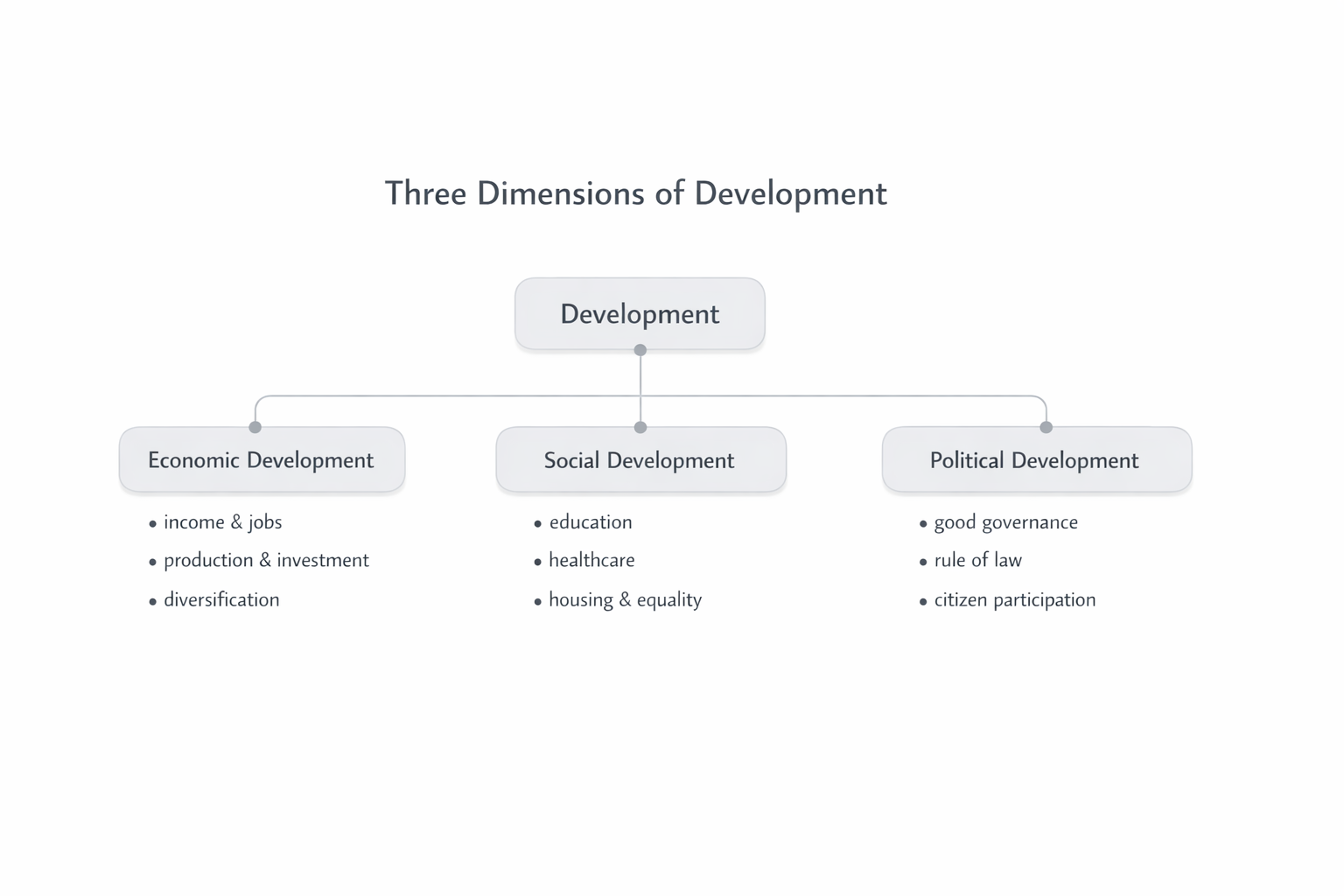
Development is multi-dimensional:
Increase in income and employment
Growth in production and investment
Industrialisation and diversification
Access to education
Quality healthcare
Housing and sanitation
Equality and social inclusion
Good governance
Rule of law
Democracy
Citizen participation
Accountability
A country may experience economic growth without real development if:
Wealth is unevenly distributed
Poverty and unemployment remain high
Education and healthcare are poor
Corruption prevents benefits reaching citizens
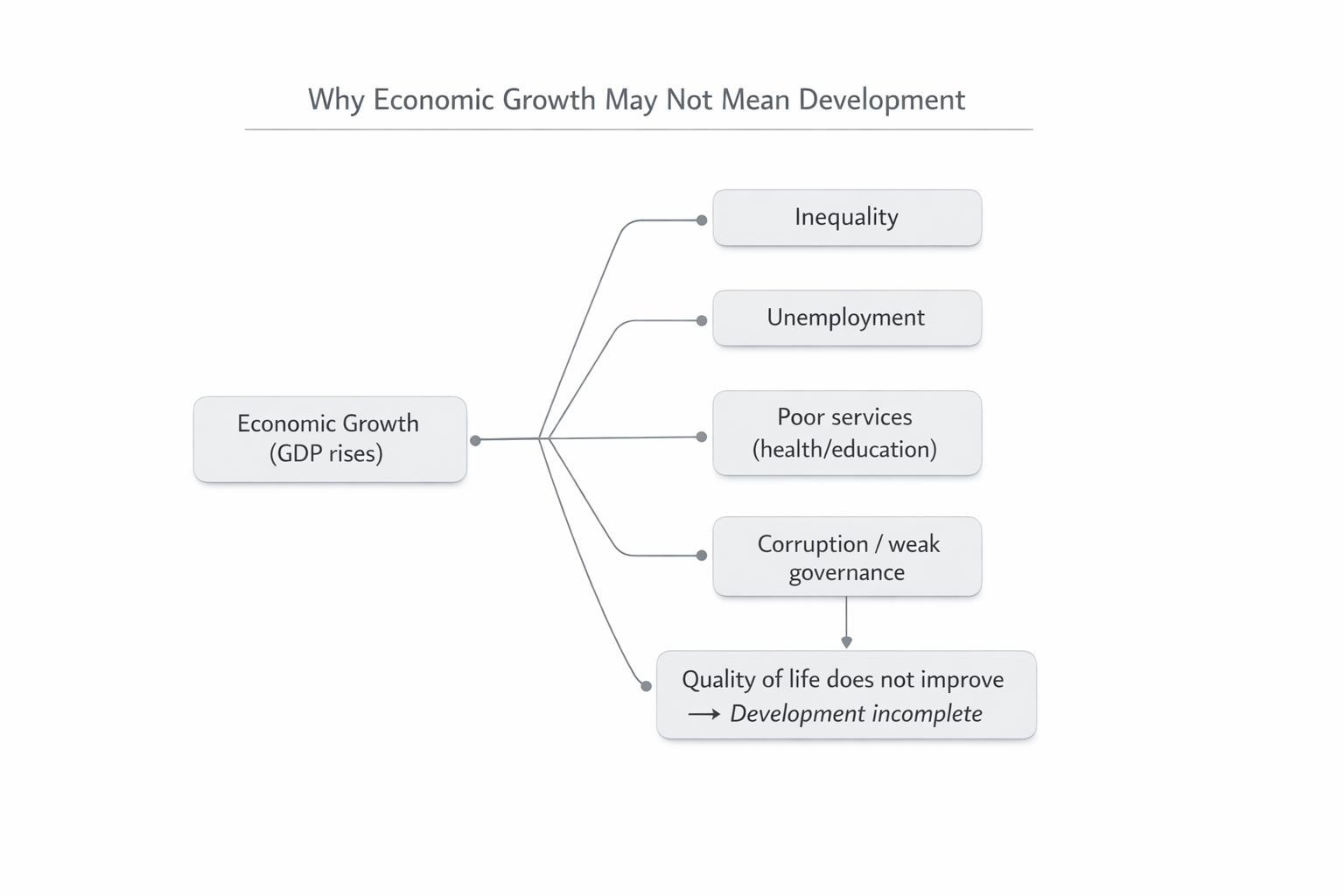
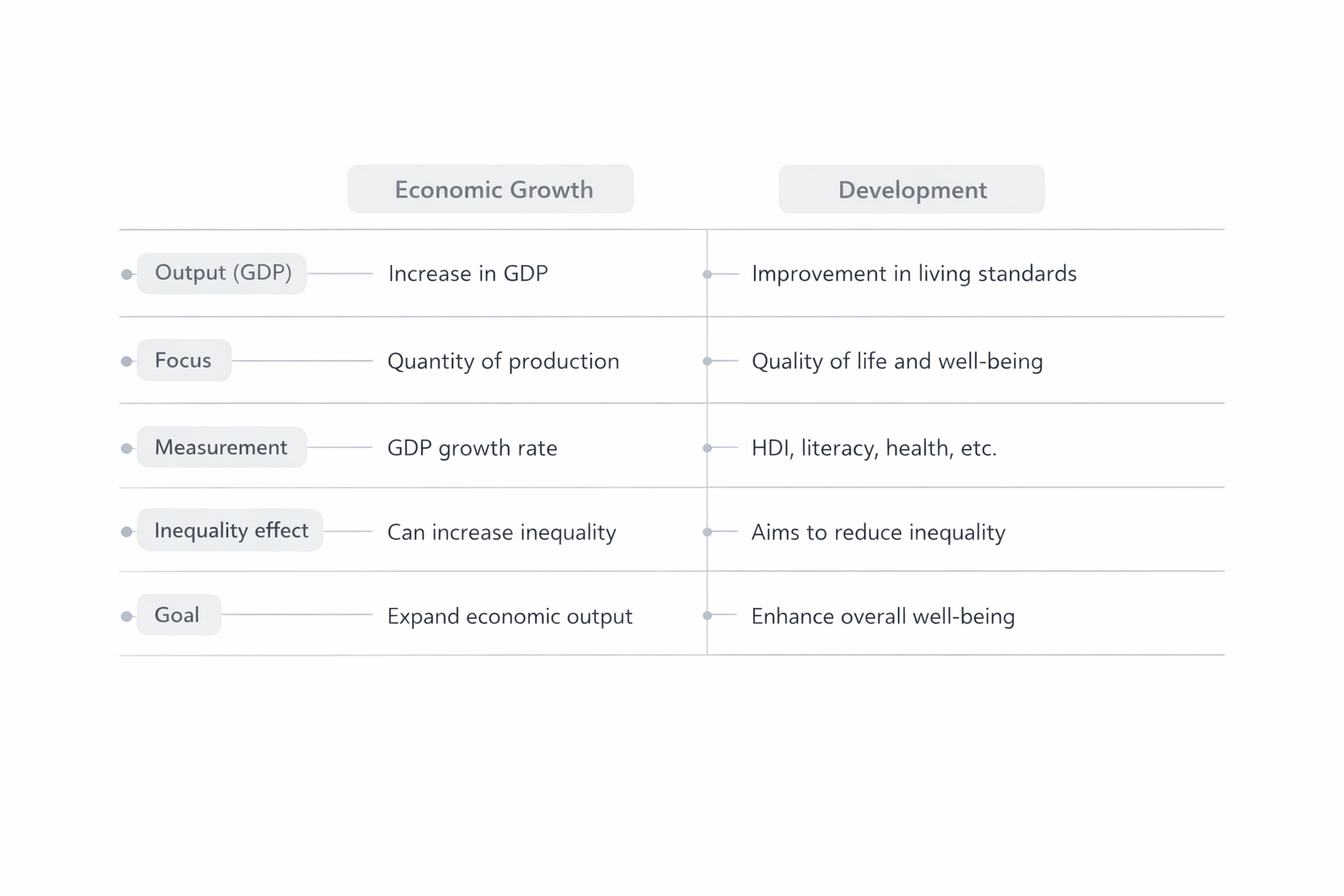
Economic growth is necessary but not sufficient for development.
Botswana has experienced strong GDP growth due to diamond mining.
Reduction in poverty
Expansion of education access
Improvement in healthcare
Infrastructure development
Employment opportunities
Growth without broad social improvement does not equal full development.
Define development – provide a clear definition including quality of life.
Explain development – discuss economic, social and political dimensions.
Compare development and growth – show clear differences using comparative language.
Avoid one-line definitions without explanation.
Defining development only as economic growth
Ignoring social and political dimensions
Listing points without explaining them
Confusing GDP with development
Define development.
State two differences between economic growth and development.
Explain why economic growth does not automatically lead to development.
Explain why development is described as multi-dimensional.
“A country with a high GDP is fully developed.”
Discuss this statement.
Improvement in quality of life
Multi-dimensional nature
Weak answers only mention GDP or income.
Explain inequality
Explain poor service delivery
Explain unemployment
Show cause-and-effect reasoning
The command word “Explain” requires linking cause to outcome.
Recognise GDP shows economic strength
Explain limitations (inequality, poverty, social services)
Provide balanced judgement
Conclude clearly
Evaluation requires balance and judgement, not simple agreement.
This lesson explains how countries are classified according to their level of development. It explores historical and modern divisions such as First World, Third World, Global North and Global South, as well as characteristics of developed and developing countries.
First World
Second World
Third World
Newly Industrialised Countries (NICs)
Least Developed Countries (LDCs)
Global North
Global South
Developed countries
Developing countries
During the Cold War, countries were divided into:
These terms originated from political alignment, not purely development level.
Global North and South refer more to economic inequality than strict geography.
Important: Development exists on a spectrum. Countries may share characteristics of both groups.
Botswana is classified as a developing country.
Political stability
Growing infrastructure
High literacy rates compared to many African countries
Youth unemployment
Income inequality
Economic dependence on diamonds
Botswana is not an LDC, but it is not fully developed.
Explain divisions of the world – define each classification clearly and mention historical context.
Compare developed and developing countries – use economic, social and political dimensions.
Discuss whether terms are outdated – mention Cold War origins and modern realities.
Use comparison language such as “whereas”, “in contrast”, “however”.
Treating First World and Developed as identical without explanation
Forgetting historical context of terms
Giving vague descriptions like “rich” and “poor”
Ignoring social and political characteristics
Define the term “Newly Industrialised Country.”
State two characteristics of Least Developed Countries.
Explain two differences between developed and developing countries.
Explain why the term “Third World” is considered outdated by some scholars.
“Global North and Global South are better classifications than First and Third World.”
Discuss this statement.
Rapid industrial growth
Transition from developing to developed status
Expanding manufacturing and exports
Simple definition without explanation is weak.
Compare income levels
Compare industrialisation
Compare social services
Explain differences, not just list them
The command word “Explain” requires linking features to development outcomes.
Recognise historical limitations of Cold War terms
Explain that North/South focuses on economic inequality
Mention that geography does not always match classification
Provide balanced judgement
Evaluation requires a reasoned conclusion.
This lesson explains why some countries are more developed than others. It examines historical, economic, political, social and geographical factors that influence development levels across the world. Development differences are rarely caused by one single factor; instead, they result from the interaction of multiple influences over time.
Colonialism
Governance
Human capital
Industrialisation
Infrastructure
Trade dependency
Resource curse
Population dynamics
Development levels differ because countries experience different historical, economic and political conditions.
No single factor explains development. Instead, development results from how multiple factors interact.
Many developing countries were colonised.
Extracted raw materials
Focused on export agriculture
Neglected industrial development
Limited investment in education and infrastructure
As a result, some countries began independence with weak economic structures.
Natural resources can promote development if managed effectively.
Over-dependence on one resource can limit diversification.
Poor governance may lead to corruption.
Price fluctuations can create instability.
This is sometimes called the resource curse.
Investment
Infrastructure development
Long-term planning
Policy consistency
Political instability, corruption and conflict discourage economic growth and damage social systems.
Skills and productivity
Technological advancement
Employment opportunities
Innovation
Countries with high literacy and strong education systems often develop faster.
Advanced technology
Diversified industries
Strong service sectors
Developing countries may rely heavily on agriculture or primary production, limiting income growth.
Industrialisation increases productivity and export capacity.
Export raw materials
Import finished goods
This can result in lower earnings and economic dependency.
Unfavourable trade terms may slow development.
Strain education and healthcare systems
Increase unemployment
Reduce per capita income
However, a well-educated and healthy population can contribute positively to development.
Roads
Electricity
Water supply
Telecommunications
Strong infrastructure promotes trade, productivity and social development.
Weak infrastructure discourages investment.
Development depends on the balance and management of these factors.
Effective management of diamond resources
Political stability since independence
Investment in infrastructure and education
Dependence on diamonds
Youth unemployment
Income inequality
Botswana’s experience shows that development involves both strengths and vulnerabilities.
If asked to:
Give reasons for differences in development – identify multiple factors and explain how each influences development.
Explain – show cause and effect relationships.
Evaluate – discuss which factors may be more significant in certain contexts.
Avoid listing factors without explanation.
Giving only one factor
Listing causes without explanation
Ignoring political or social factors
Overgeneralising without examples
Define the term “resource curse.”
State two factors that influence development levels.
Explain how political stability can promote development.
Explain why dependence on raw material exports may limit development.
“Natural resources are the most important factor determining development.”
Discuss this statement.
A strong answer should explain that the resource curse refers to situations where countries rich in natural resources experience slow development due to overdependence, corruption or poor management.
Simply saying “having resources is bad” is insufficient.
Link stability to investment
Link investment to growth
Show long-term policy benefits
The command word “Explain” requires clear cause-and-effect reasoning.
Recognise that resources can generate growth
Discuss governance and diversification
Compare with education, infrastructure or political stability
Provide balanced judgement
Evaluation requires considering multiple perspectives and concluding logically.
This lesson explains how development is measured using economic and social indicators. It examines GDP, GNP, health, life expectancy, education and energy consumption. It also explains why political development is difficult to measure and why no single indicator gives a complete picture of development.
GDP (Gross Domestic Product)
GNP (Gross National Product)
Social indicators
Life expectancy
Literacy rate
Energy consumption
Political development
Qualitative vs quantitative measurement
Development is measured using indicators, which are measurable signs of progress.
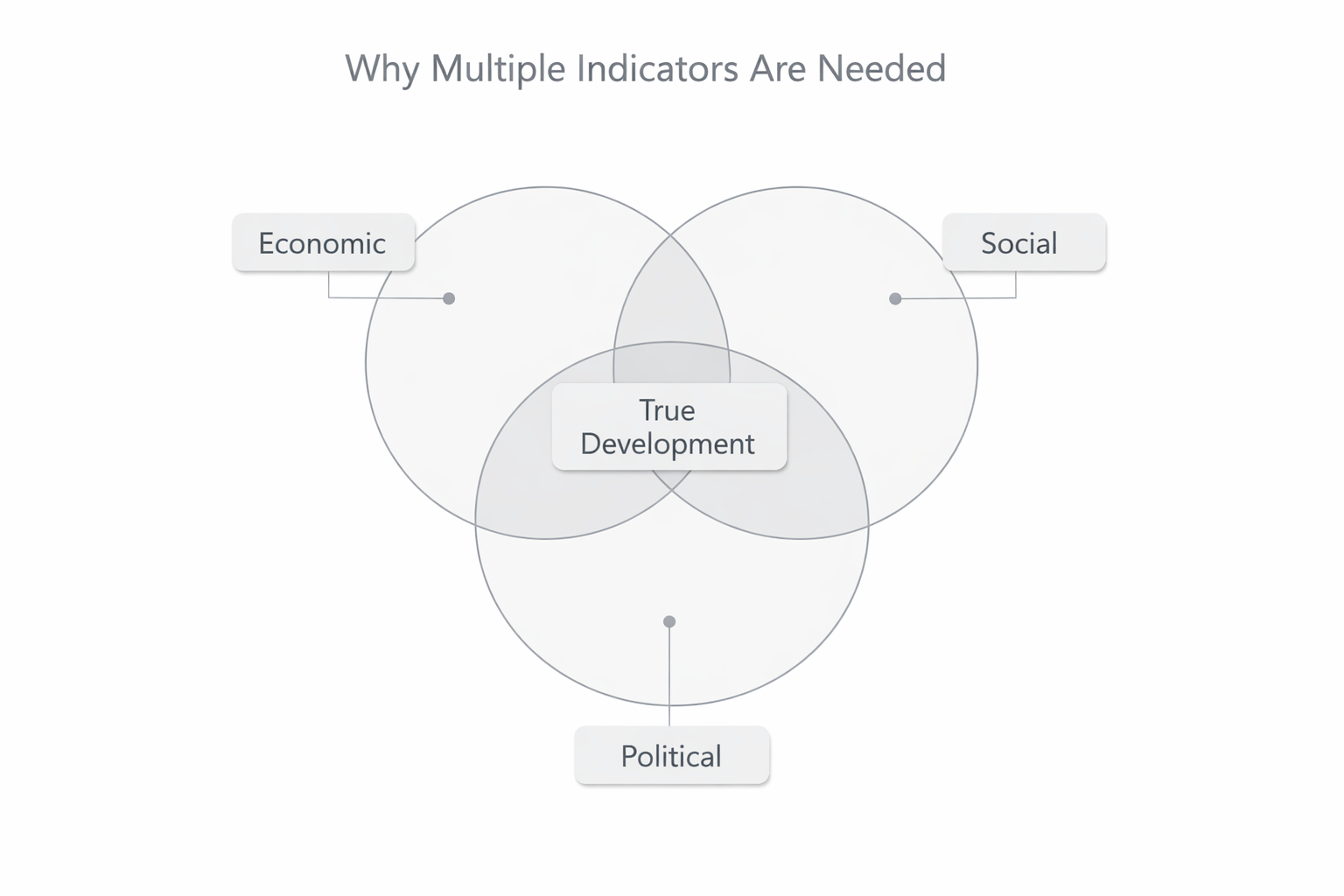
However, development is multi-dimensional, so multiple indicators must be used together.
GDP is the total value of goods and services produced within a country in one year.
Shows size of economy
Indicates economic growth
Allows comparison between countries
Does not show income distribution
Does not measure poverty
Does not include informal economy
Does not measure quality of life
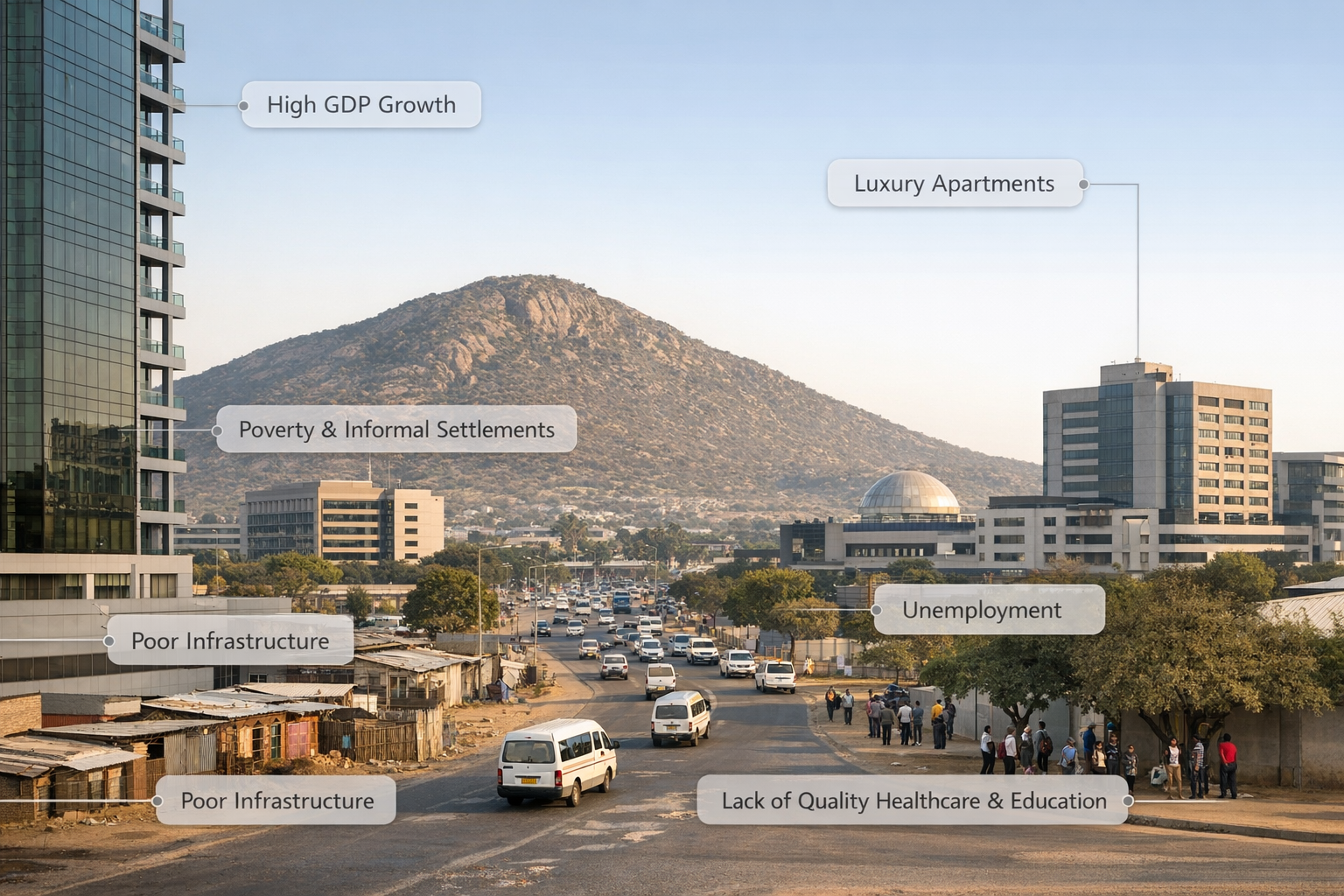
A country may have high GDP but high inequality.
GNP measures total income earned by a country’s citizens, including income from abroad.
Reflects national earning power
Useful for countries with foreign investments
Does not measure inequality
Does not show social development
Infant mortality rate
Access to healthcare
Disease prevalence
Good health improves productivity and life quality.
Average number of years a person is expected to live.
Better healthcare
Good nutrition
Safe living conditions
Literacy rate
School enrolment
Years of schooling
Skilled workforce
Innovation
Economic productivity
Industrialisation level
Access to electricity
Economic activity
However, high energy use does not always mean equitable development.
No single indicator is sufficient.
Political development includes:
Democracy
Governance
Rule of law
Accountability
Human rights
Citizen participation
Unlike GDP, these are not easily measured numerically.
Political factors are often qualitative
Laws may exist but not be practiced
Perceptions vary across societies
Surveys and reports may contain bias
Political situations change quickly
Political development is more subjective than economic measurement.
Relatively high GDP per capita in Africa
Improved life expectancy
Strong investment in education
Inequality remains
Youth unemployment persists
Political development involves interpretation, not just statistics
Botswana shows why multiple indicators must be used together.
Identify and discuss indicators – name them clearly and explain strengths and weaknesses.
Evaluate indicators – explain why one indicator alone is insufficient.
Show why political aspects are difficult to measure – explain qualitative nature and subjectivity.
Always compare economic and political measurement for clarity.
Assuming GDP equals development
Listing indicators without discussing limitations
Ignoring social indicators
Failing to explain why political factors are subjective
Define GDP.
State one limitation of using GDP to measure development.
Explain why development should be measured using multiple indicators.
Explain why political development is difficult to measure.
“GDP is the most reliable indicator of development.”
Discuss this statement.
Total value of goods and services
Produced within a country
In a given period
Partial definitions lack precision.
Mention multi-dimensional nature
Compare economic and social indicators
Explain strengths and weaknesses
Explanation requires linking indicators to quality of life.
Recognise usefulness of GDP
Discuss limitations (inequality, poverty, social factors)
Compare with other indicators
Provide balanced judgement
Evaluation requires balance and logical conclusion.
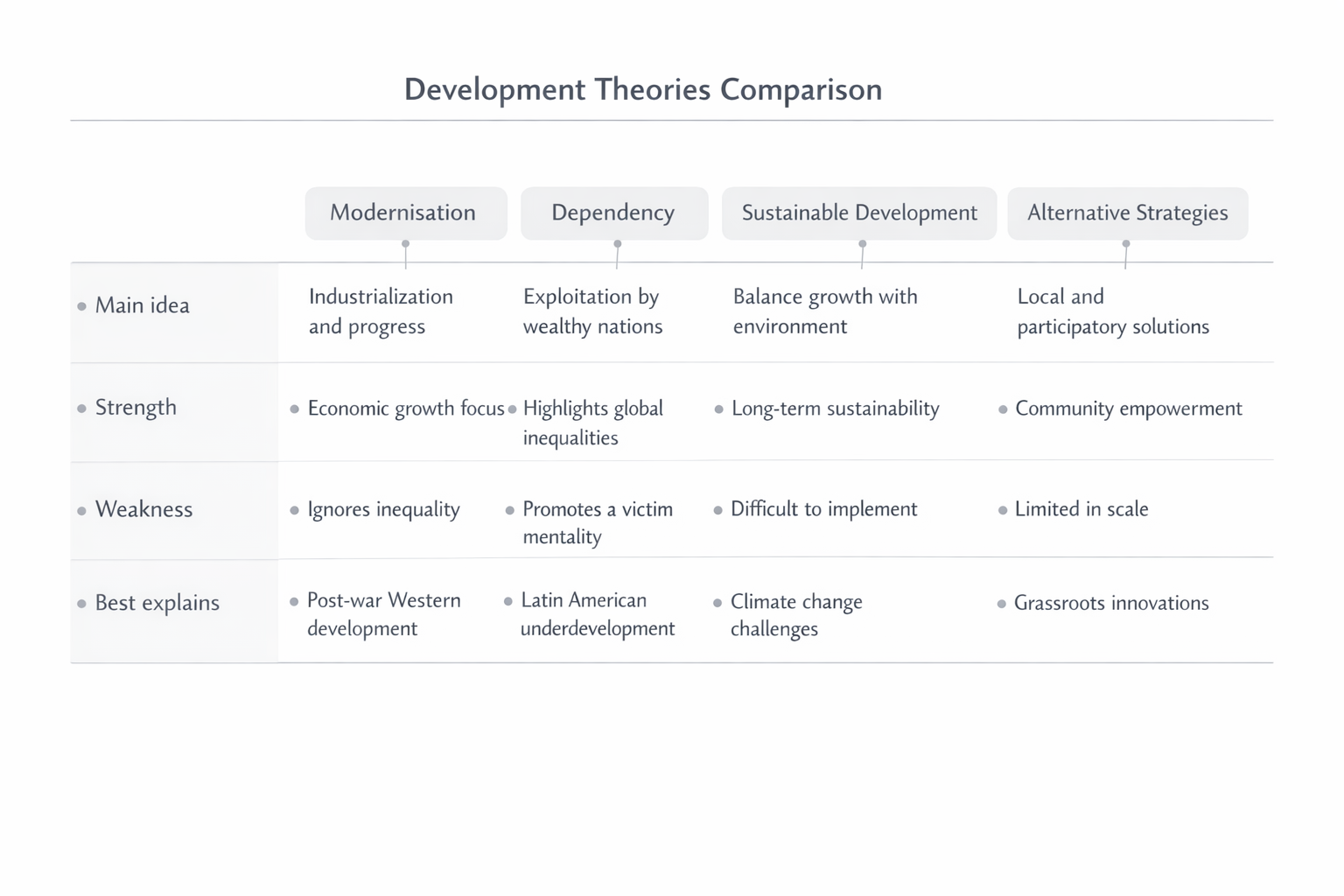
This lesson examines major theories that explain why some countries develop while others remain underdeveloped. It explores modernisation theory, dependency theory, sustainable development and alternative development strategies. The lesson evaluates their strengths, weaknesses and relevance to real-world cases such as Botswana.
Modernisation theory
Dependency theory
Sustainable development
Alternative development strategies
Core and periphery
Industrialisation
Structural inequality
Environmental sustainability
Why development levels differ
How countries can achieve development
What strategies governments should follow
Different theories provide different explanations and solutions.
Modernisation theory argues that development occurs when countries adopt Western-style economic, political and social systems.
Traditional societies must modernise
Industrialisation is essential
Investment and technology drive growth
Education increases productivity
Countries move through stages of development
Encourages industrial growth
Promotes education and technology
Provides a structured pathway to development
Assumes Western model is superior
Ignores colonial history
May increase inequality
Does not prioritise environmental sustainability
Dependency theory argues that underdevelopment results from exploitation by developed countries.
Developed countries (core) benefit from developing countries (periphery)
Raw materials are exported cheaply
Finished goods are imported at higher prices
This creates long-term economic dependence
Explains global inequality
Recognises impact of colonialism
Highlights structural trade imbalances
May discourage international trade
Does not fully explain successful NICs
Underestimates internal governance problems
Sustainable development focuses on meeting present needs without compromising future generations.
It balances:
Economic growth
Social equality
Environmental protection
Promotes long-term stability
Protects natural resources
Addresses climate change
Implementation can be expensive
May slow rapid industrial growth
Difficult to balance economic and environmental goals
Community-based development
Grassroots participation
Human-centred approaches
Poverty reduction
Microfinance
Rural development projects
Small-scale enterprise support
Focuses on people rather than GDP
Encourages local empowerment
Reduces inequality
Often small-scale
Requires strong governance
Limited impact without national support
Modernisation: investment in education, infrastructure and industrialisation
Sustainable development: environmental conservation policies
Dependency concerns: reliance on diamond exports
Alternative strategies: poverty reduction programmes
This shows that development often combines approaches rather than following one single theory.
Analyse a theory – explain how it works and its implications.
Evaluate a theory – discuss strengths and weaknesses and give balanced judgement.
Compare theories – identify similarities and differences clearly.
Compare at least two theories
Apply them to real examples
Conclude with reasoned judgement
Avoid describing theories without evaluation.
Only describing theories
Ignoring strengths and weaknesses
Failing to compare theories
Not applying theory to real examples
Giving unbalanced judgement
Define dependency theory.
State one key feature of sustainable development.
Explain two differences between modernisation theory and dependency theory.
Explain why sustainable development is important for long-term development.
“Dependency theory provides the best explanation for underdevelopment.”
Discuss this statement.
Exploitation
Core and periphery
Structural inequality
A vague definition like “poor countries depend on rich countries” lacks depth.
Compare Western model adoption vs structural exploitation
Explain trade relationships
Show contrast clearly
The command word “Explain” requires detailed reasoning.
Acknowledge strengths of dependency theory
Compare with modernisation or sustainable development
Discuss internal governance factors
Conclude clearly
Evaluation requires balance, comparison and justified judgement.
This lesson explores development projects within local communities and evaluates their impact. Learners will identify types of development projects, assess their effectiveness and consider sustainability. The focus is on applying development concepts to real-life examples.
Development project
Community development
Sustainability
Impact assessment
Stakeholders
Cost-benefit
Short-term vs long-term impact
A development project is a planned activity designed to improve economic, social or environmental conditions in a community.
Reduce poverty
Improve living standards
Increase access to services
Promote economic growth
Small business support
Microfinance programmes
Agricultural improvement schemes
Youth employment initiatives
Increase income
Create employment
Stimulate local economic activity
School construction
Healthcare clinics
Water and sanitation projects
Housing programmes
Improve quality of life
Expand access to services
Reduce inequality
Roads
Electricity supply
Telecommunications
Public transport systems
Support economic growth
Improve connectivity
Increase productivity
Reforestation
Conservation initiatives
Renewable energy projects
Waste management programmes
Protect natural resources
Promote sustainable development
When evaluating a development project, consider:
Did it achieve its objectives?
Did it improve living standards?
Will benefits continue long-term?
Does it protect future generations?
Who benefits?
Are benefits distributed fairly?
Did it create jobs?
Did it stimulate local business?
Did it improve education, health or housing?
Did it reduce inequality?
Strong evaluation considers both positive and negative outcomes.
Poverty eradication programmes
Youth employment schemes
Infrastructure expansion (roads, electricity)
Water supply projects
Community-based tourism initiatives
Long-term sustainability
Economic diversification
Impact on inequality
Environmental protection
Some projects may succeed economically but fail socially or environmentally.
Identify development projects – clearly describe examples.
Evaluate a project – discuss strengths and weaknesses.
Assess impact – consider economic, social and environmental outcomes.
Provide balanced analysis
Consider multiple perspectives
Conclude with reasoned judgement
Avoid describing projects without evaluating them.
Only describing the project
Ignoring sustainability
Ignoring who benefits
Giving one-sided evaluation
Failing to conclude
Define a development project.
State two types of development projects found in communities.
Explain how a youth employment project can contribute to development.
Explain why sustainability is important when evaluating development projects.
“Infrastructure projects are the most effective way to promote development in communities.”
Discuss this statement.
Planned activity
Aimed at improving economic or social conditions
A vague answer such as “a project that helps people” lacks precision.
Link employment to income
Link income to living standards
Mention skill development
Show multiplier effects in the local economy
The command word “Explain” requires cause-and-effect reasoning.
Recognise benefits of infrastructure
Compare with social and environmental projects
Discuss sustainability
Provide balanced judgement
Evaluation requires balance and a justified conclusion.

