
Course:
Development Studies – 0586

This lesson explains how to identify a development problem, define a clear research focus and select appropriate sources and methods for investigation. Proper planning ensures reliable and meaningful data collection.
Research problem
Research question
Primary data
Secondary data
Method justification
Reliability
A development investigation begins with identifying a clear and focused problem.
A good research problem should be:
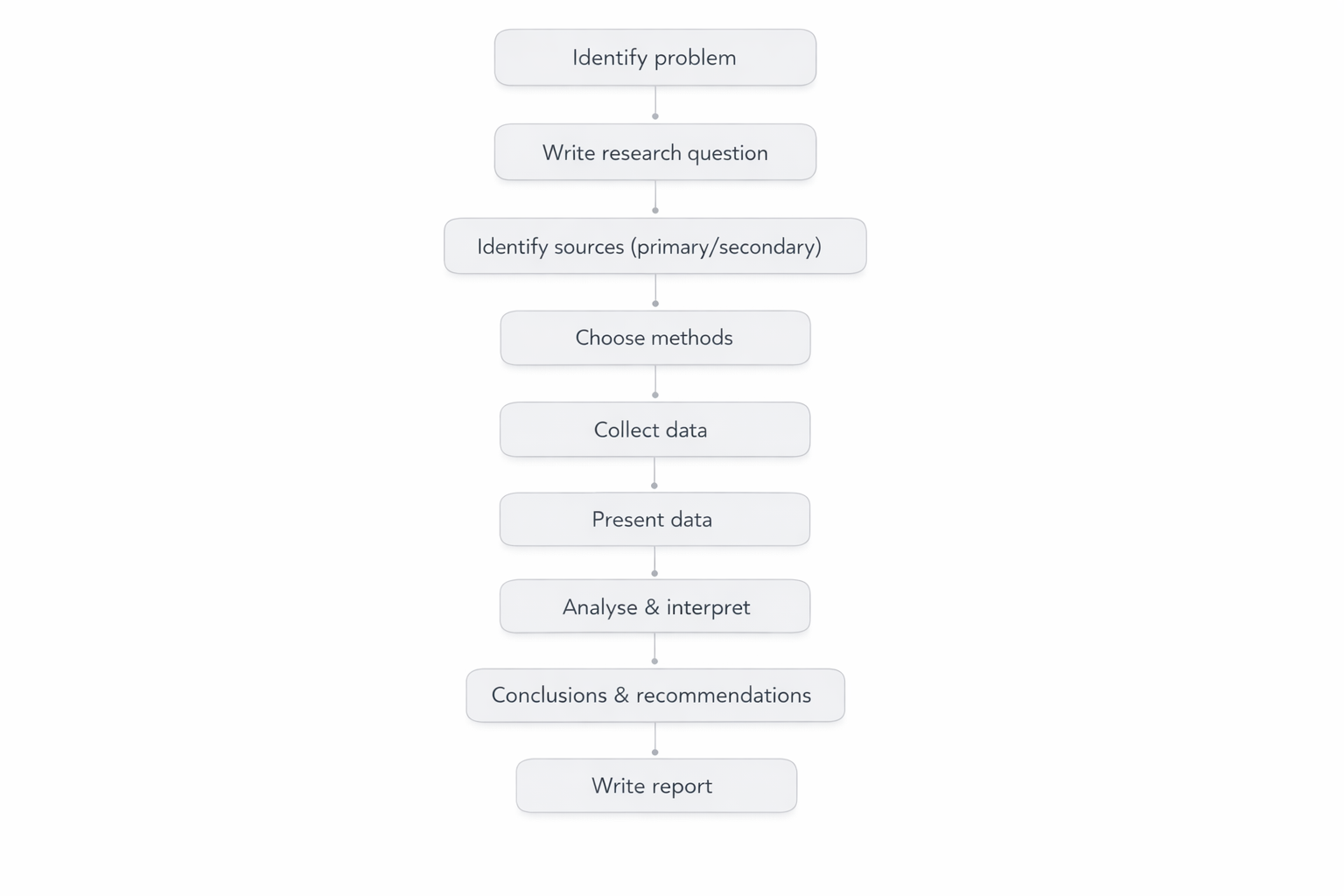
Youth unemployment in a local community
Access to clean water in rural areas
Impact of microfinance on small businesses
A vague topic such as “poverty” is too broad.
The research question guides the investigation.
What are the main causes of youth unemployment in Gaborone?
How effective is a local poverty eradication programme?
Be clear
Be focused
Allow data collection
There are two main sources:
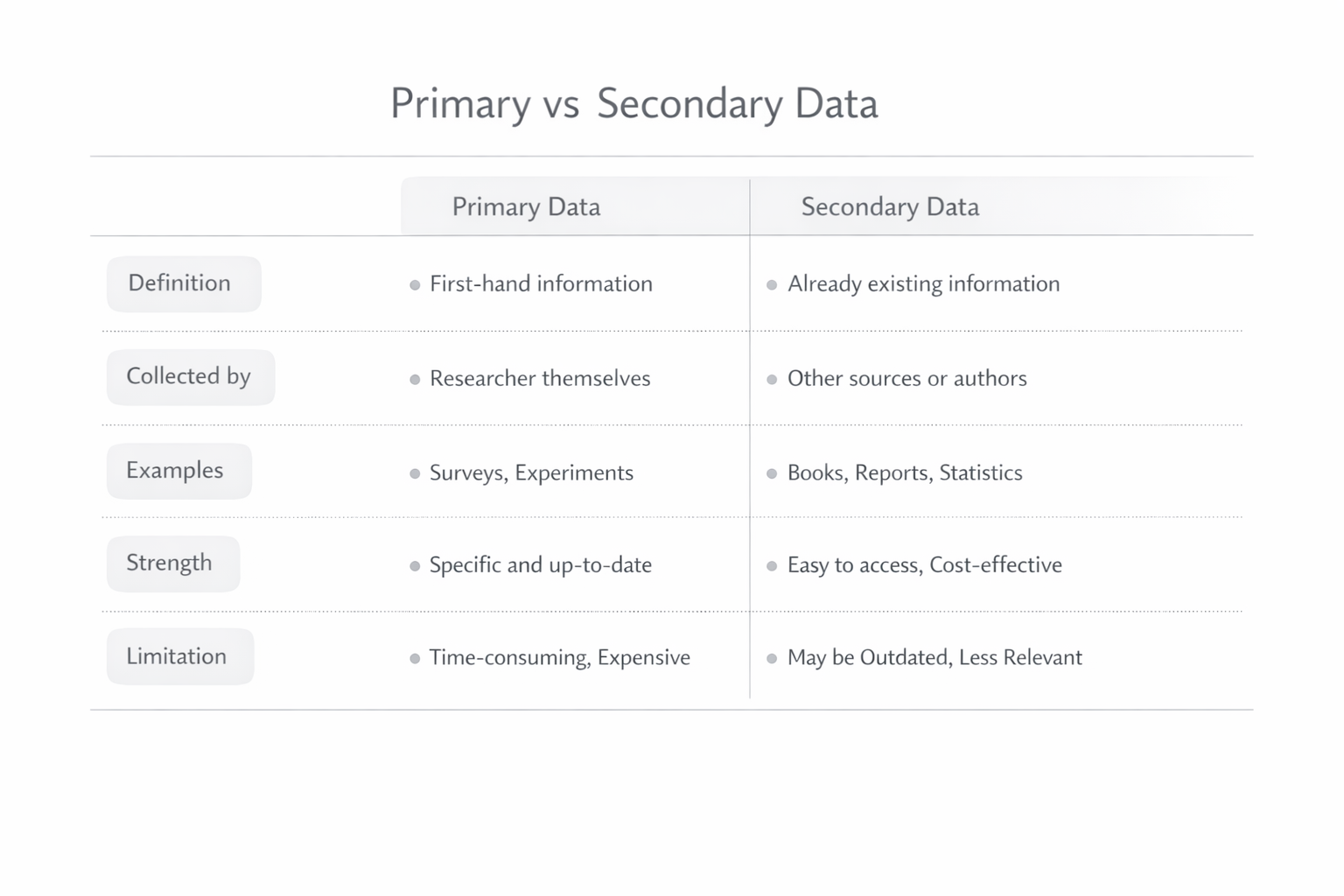
Government reports, textbooks, statistics, online databases.
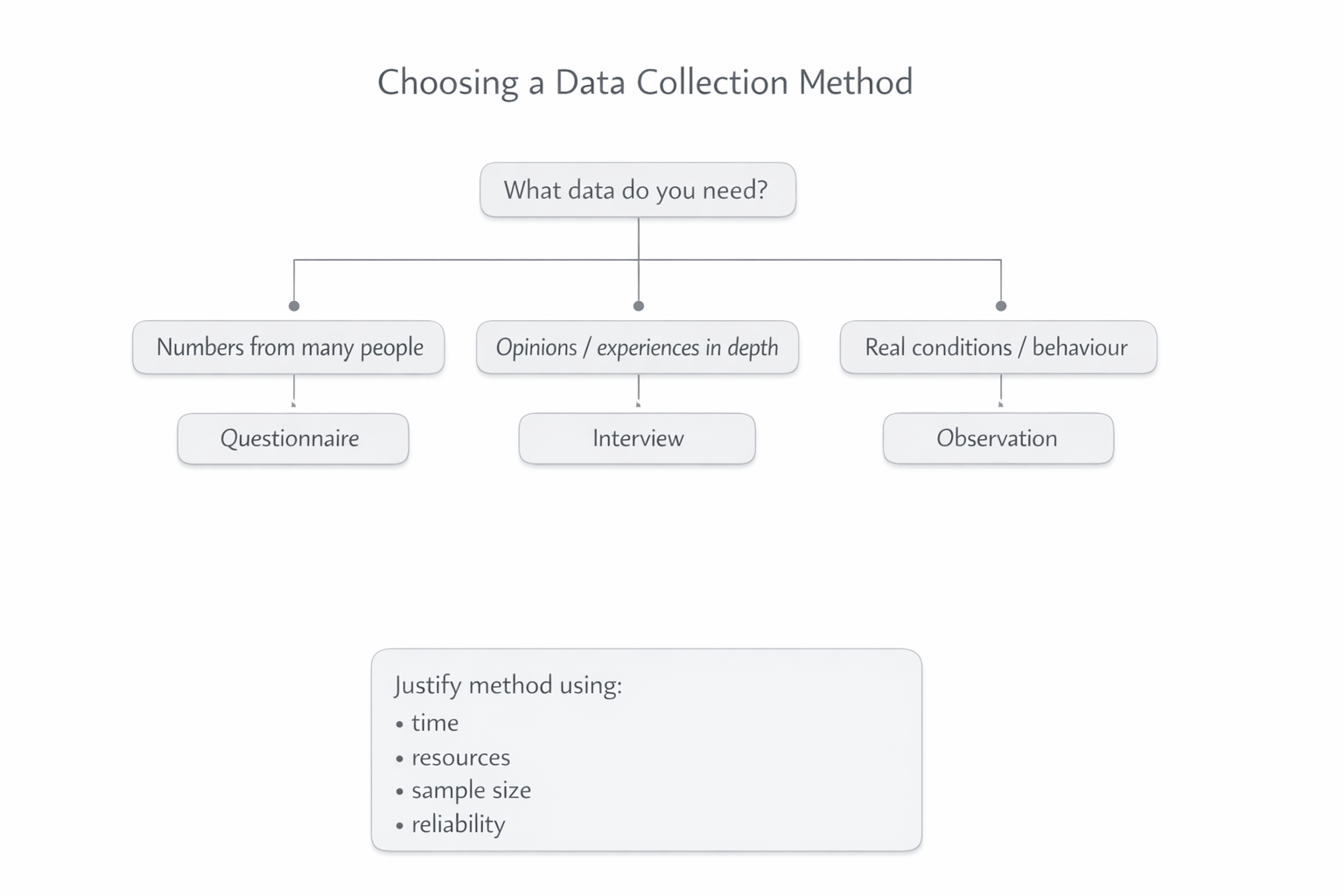
If investigating community opinions, interviews may be suitable.
If collecting numerical data, questionnaires may be appropriate.
Strong investigations justify why a method was chosen.
Use questionnaires for unemployed youth (primary data)
Consult government labour statistics (secondary data)
Combining methods improves reliability and depth.
Identify a problem – state it clearly and specifically.
Justify methods – explain why a method suits the research question.
Distinguish primary and secondary data – define and give examples.
Avoid vague or broad research topics.
Choosing overly broad topics
Failing to justify methods
Using only one source of data
Confusing primary and secondary data
Define primary data.
State one difference between primary and secondary data.
Explain why it is important to clearly define a research problem.
Explain why combining primary and secondary data improves an investigation.
“Questionnaires are the best method for investigating development problems.”
Discuss this statement.
A strong answer must state that primary data is collected directly by the researcher for a specific investigation.
Saying “data collected first” is unclear and incomplete.
Explain clarity improves focus
Link focus to relevant data collection
Show impact on reliability
The command word “Explain” requires cause-and-effect reasoning.
Recognise advantages of questionnaires (cost, large samples)
Mention limitations (bias, shallow responses)
Compare with interviews or observation
Conclude with balanced judgement
Evaluation requires comparison and reasoned conclusion.
This lesson explains the main methods used to collect primary data in development investigations: questionnaires, interviews and observation. It evaluates their advantages, limitations and appropriate use in different research contexts.
Questionnaire
Interview
Observation
Structured vs unstructured questions
Bias
Reliability
Validity
Primary data is collected directly from people or situations during an investigation.
Questionnaires
Interviews
Observation
Each method has strengths and weaknesses.
A questionnaire is a written set of questions given to respondents.
Closed questions (Yes/No, multiple choice)
Open-ended questions (allow detailed responses)
Can reach many people quickly
Easy to analyse if structured
Cost-effective
Anonymous responses may encourage honesty
Limited depth in closed questions
Misunderstanding of questions
Low response rate
Respondent bias
Questionnaires are suitable when collecting numerical data from large groups.
An interview involves direct conversation between researcher and respondent.
Structured (set questions)
Semi-structured
Unstructured (flexible discussion)
Allows detailed responses
Clarifies misunderstandings
Provides deeper insight
Time-consuming
Smaller sample size
Interviewer bias
More difficult to analyse
Interviews are useful when investigating opinions, experiences or complex issues.
Observation involves watching and recording behaviour or conditions.
Observing living conditions
Monitoring service delivery
Recording traffic patterns
Provides real-life evidence
Does not rely on self-reporting
Useful when respondents may not give accurate information
Observer bias
Limited to visible behaviour
Time-consuming
Ethical considerations
Observation is useful for studying physical conditions or behaviour patterns.
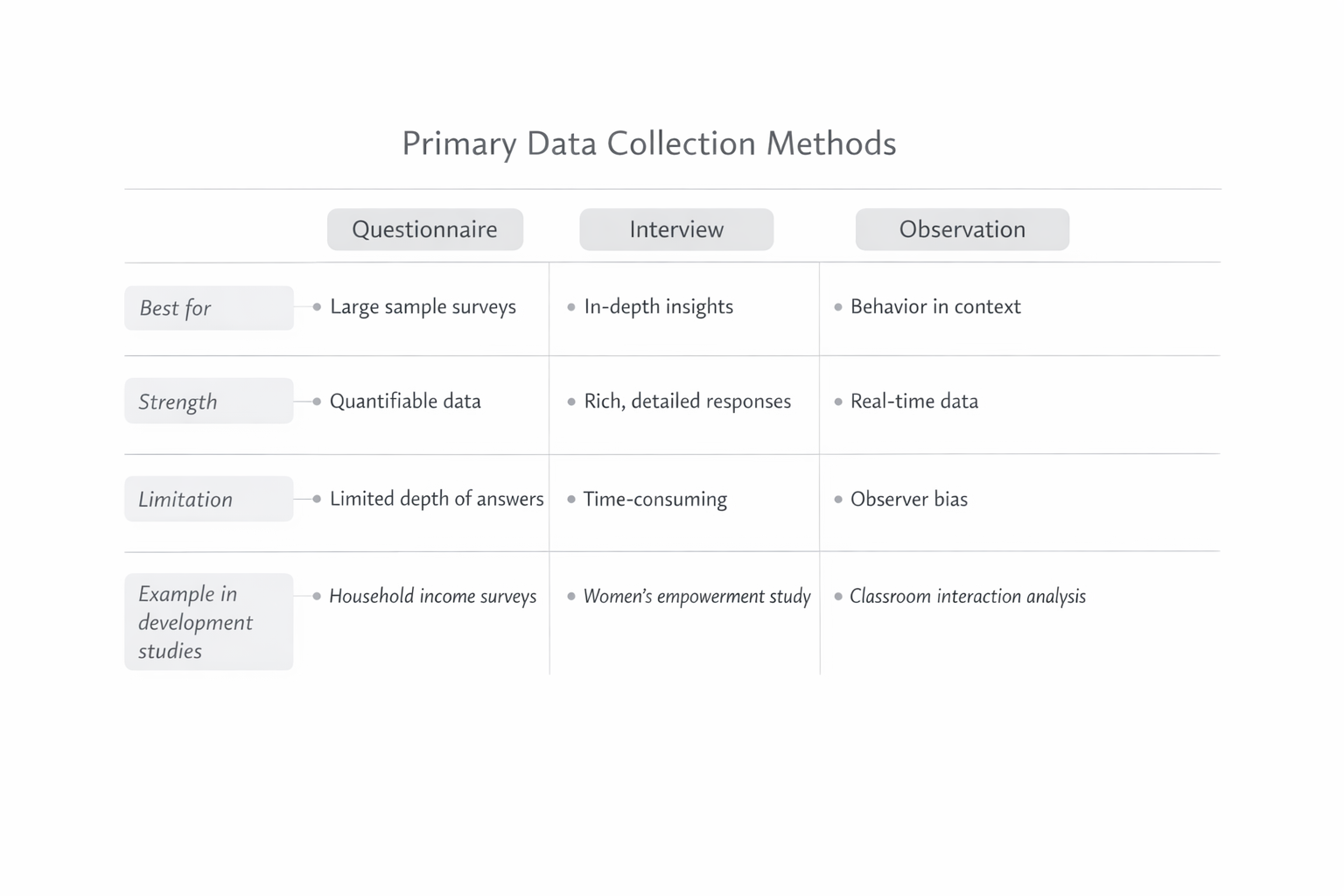
Strong investigations often combine methods.
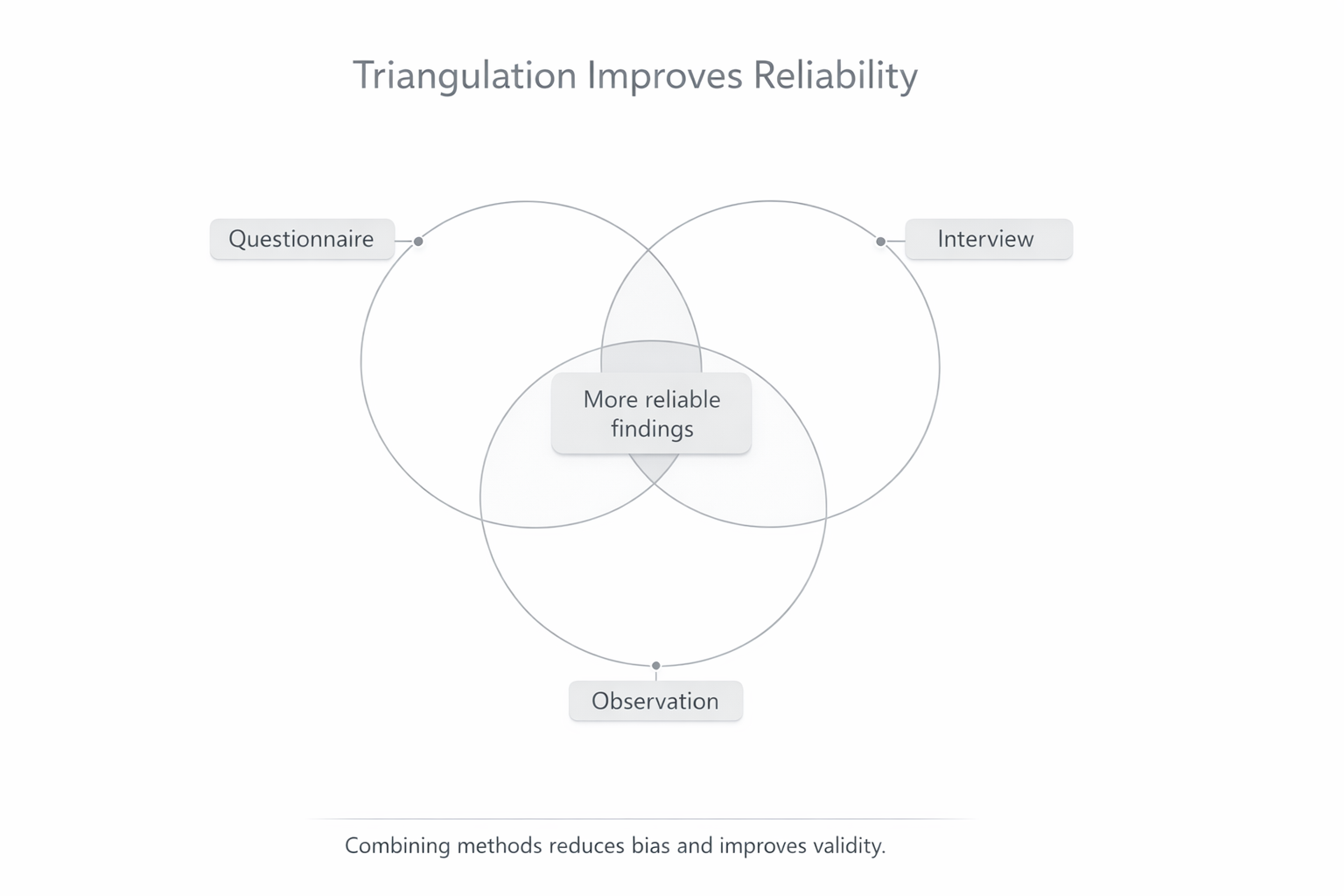
Research objective
Time available
Resources
Target population
Reliability
A well-designed investigation justifies why a method was selected.
A student investigating:
May use questionnaires to collect data from many young people.
May conduct interviews to understand personal experiences.
May observe job centres or business activity.
Combining methods strengthens validity and reliability.
Describe a method – explain how it works.
Explain advantages and limitations – provide balanced analysis.
Justify a method – link the method clearly to the research objective.
High-level answers explain why a method is appropriate, not just what it is.
Only describing methods without evaluation
Ignoring limitations
Choosing inappropriate methods
Failing to justify selection
Confusing structured and unstructured interviews
Define an interview.
State one advantage of using observation.
Explain why interviews may provide more detailed data than questionnaires.
Explain two limitations of using questionnaires in development research.
“Using only one data collection method is sufficient for a reliable investigation.”
Discuss this statement.
A strong answer must state that an interview involves direct questioning of a respondent to collect information.
Simply saying “asking questions” is incomplete.
Mention ability to probe
Mention clarification
Mention flexibility
Cause-and-effect explanation is required.
Explain strengths of single methods
Discuss weaknesses and bias
Argue for triangulation (using multiple methods)
Conclude clearly
Evaluation requires balanced reasoning and justified conclusion.
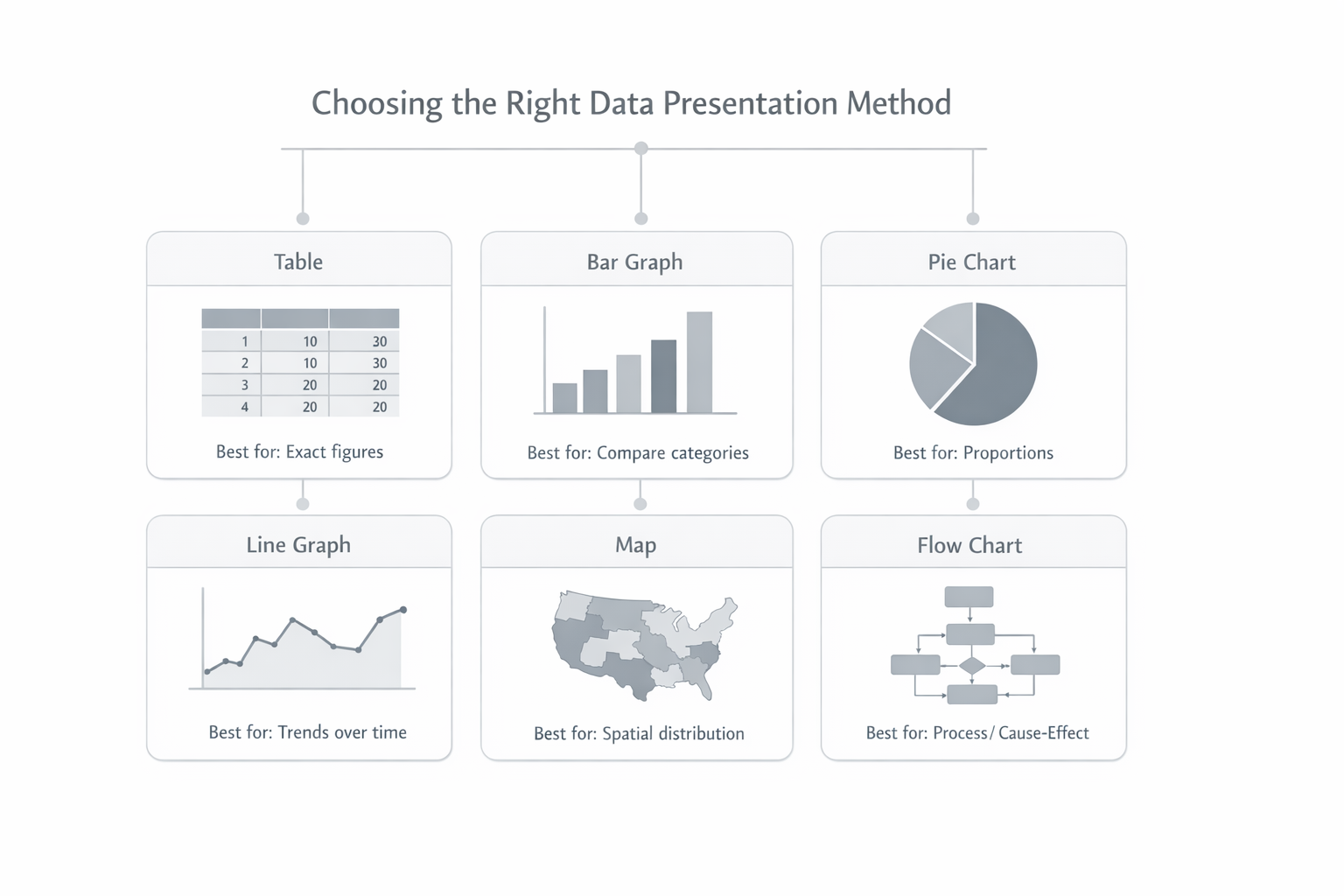
This lesson explains how to present data clearly and accurately using tables, graphs, maps and flow charts. Effective data presentation improves analysis and makes findings easier to understand and interpret.
Data presentation
Table
Bar graph
Pie chart
Line graph
Map
Flow chart
Clarity and accuracy
Presenting data properly allows patterns, trends and comparisons to be easily identified.
Poor presentation can lead to misinterpretation.
Tables organise data into rows and columns.
Showing precise figures
Comparing categories
Presenting raw data clearly
Clear and structured
Shows exact numbers
Useful for detailed comparison
Trends may not be immediately visible
Large tables can become confusing
Tables are often used before converting data into graphs.
Bar graphs compare categories using rectangular bars.
Comparing unemployment rates
Comparing income levels
Showing differences between groups
Easy to read
Clear comparisons
Suitable for discrete data
Not ideal for showing continuous trends
Pie charts show proportions or percentages of a whole.
Showing budget allocation
Representing population composition
Shows proportions clearly
Simple visual impact
Difficult to compare small differences
Not suitable for large numbers of categories
Line graphs show trends over time.
Shows trends clearly
Useful for time-series data
Less suitable for comparing separate categories
Maps show spatial distribution.
Showing poverty levels across regions
Access to services
Population density
Maps highlight geographical patterns.
Flow charts show processes or sequences.
Showing development processes
Explaining cause-and-effect relationships
Demonstrating stages of industrialisation
Choosing the correct presentation method depends on the type of data.
Clear title
Correct labels
Units of measurement
Appropriate scale
Accurate data
Neat and organised layout
Mislabelled or poorly scaled graphs reduce credibility.
Use a table to show raw data
Convert it into a bar graph to compare districts
Use a line graph to show changes over time
Presenting data correctly strengthens analysis and conclusions.
Present data – choose the most appropriate method.
Describe a graph – mention trends, highest/lowest values, comparisons.
Interpret data – explain what the data suggests about development.
High-level answers move beyond description and include interpretation.
Choosing inappropriate graph type
Missing labels or units
Poor scaling
Only describing data without interpreting
Drawing incorrect conclusions
State one advantage of using a line graph.
Identify the best method to show proportions of government spending.
Explain why a bar graph is suitable for comparing unemployment rates across districts.
Explain why clear labelling is important when presenting data.
“Tables are more reliable than graphs for presenting development data.”
Discuss this statement.
A strong answer should mention that line graphs show trends or changes over time.
Simply stating “it shows data” is insufficient.
Mention comparison of categories
Explain visual clarity
Link to interpretation
Explanation requires linking graph type to purpose.
Recognise precision of tables
Recognise visual clarity of graphs
Discuss context of use
Conclude logically
Evaluation requires comparison and reasoned judgement.
This lesson explains how to move beyond simply describing data to analysing and interpreting it. Learners will identify trends, patterns, relationships and anomalies, and link findings to development concepts.
Data analysis
Data interpretation
Trend
Pattern
Correlation
Anomaly
Cause and effect
Presenting data shows information visually.
Analysing and interpreting data explains what the information means.
Description tells what is happening.
Analysis explains why it is happening.
Interpretation links findings to development concepts.
Identifying highest and lowest values
Noting increases or decreases
Comparing categories
Identifying general trends
“Unemployment increased from 12% to 18% over five years.”
This is description only.
Analysis involves explaining patterns and linking them to possible causes.
“Unemployment increased from 12% to 18% over five years, possibly due to slow economic diversification and limited industrial growth.”
Analysis adds explanation.
Interpretation connects findings to development concepts.
“Rising unemployment may slow development because it reduces income levels and increases poverty.”
Interpretation shows impact on development.
A trend is a general direction of change over time.
Increasing
Decreasing
Stable
Fluctuating
Strong analysis explains why trends occur.
Sometimes two variables are linked.
Higher education levels may correlate with higher income.
Improved healthcare may increase life expectancy.
Correlation does not always mean direct causation.
Students must avoid assuming cause without evidence.
An anomaly is an unusual or unexpected result.
If one district has extremely high income compared to others, this should be noted and explained.
Ignoring anomalies weakens analysis.
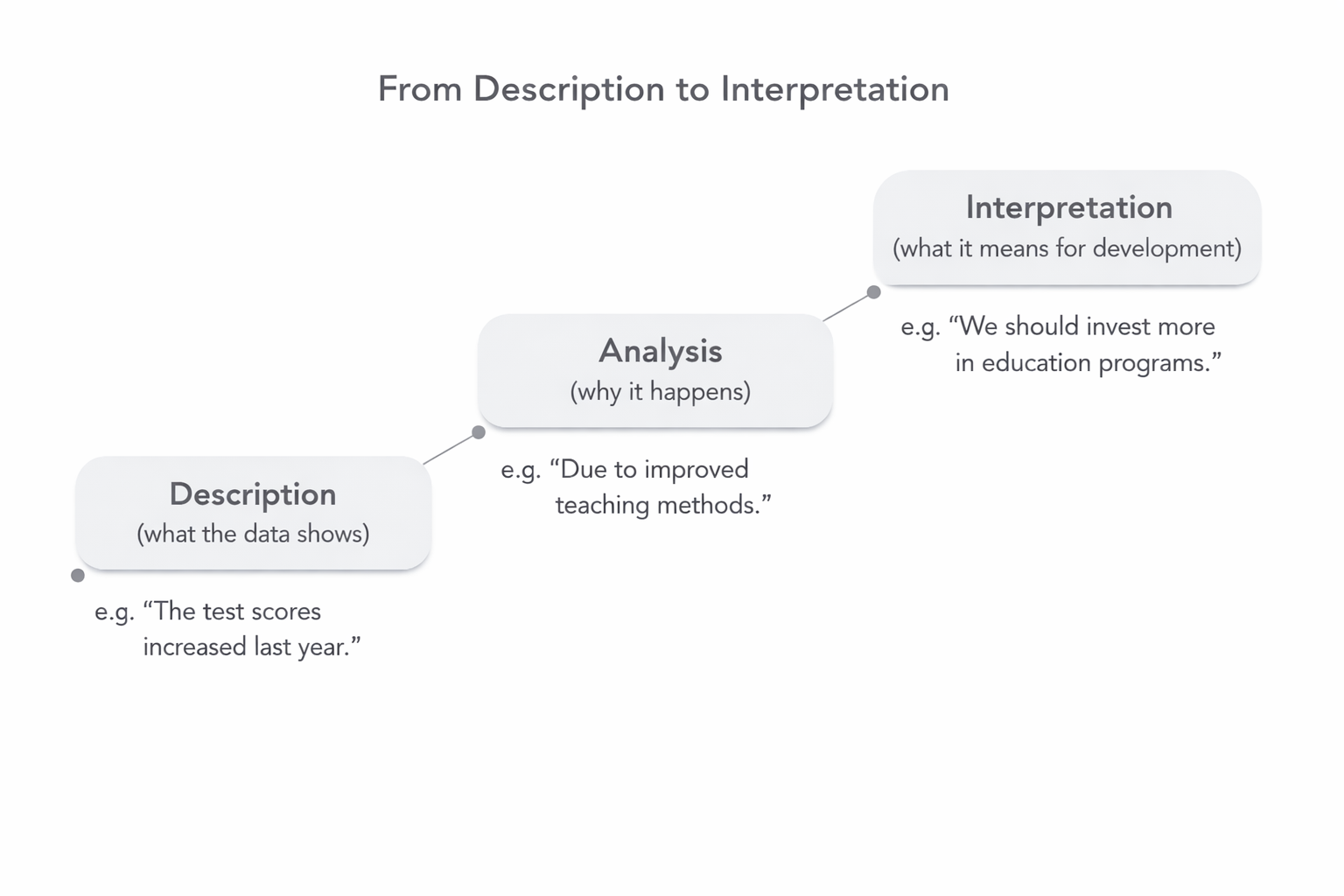
High-level answers include all three.
Rising GDP
High youth unemployment
Strong interpretation would explain that:
Although economic growth exists, unemployment limits full development.
Linking data to development concepts is essential.
Analyse data – explain trends and relationships.
Interpret data – explain what the data suggests about development.
Avoid copying numbers without explanation.
Identify trends
Explain possible causes
Link to development outcomes
Avoid unsupported assumptions
Only describing data
Ignoring trends
Making unsupported conclusions
Confusing correlation with causation
Ignoring anomalies
Define the term “trend.”
What is the difference between description and analysis?
A graph shows life expectancy increasing over 10 years.
Explain what this may indicate about development.
Unemployment decreases while GDP increases.
Explain what relationship this might suggest.
“Data interpretation is more important than data presentation.”
Discuss this statement.
A strong answer should mention that a trend is the general direction of change over time.
Simply stating “change” is insufficient.
Link rising life expectancy to improved healthcare
Connect healthcare improvements to social development
Mention possible limitations
Explanation must link data to development.
Recognise importance of accurate presentation
Explain that interpretation provides meaning
Argue that both are necessary
Provide balanced judgement
Evaluation requires comparison and logical conclusion.
This lesson explains how to draw logical conclusions from analysed data and make realistic, evidence-based recommendations. Strong investigations do not end with data presentation; they evaluate findings and suggest practical solutions.
Conclusion
Recommendation
Evidence-based judgement
Feasibility
Sustainability
Practical solution
Draw conclusions
Make recommendations
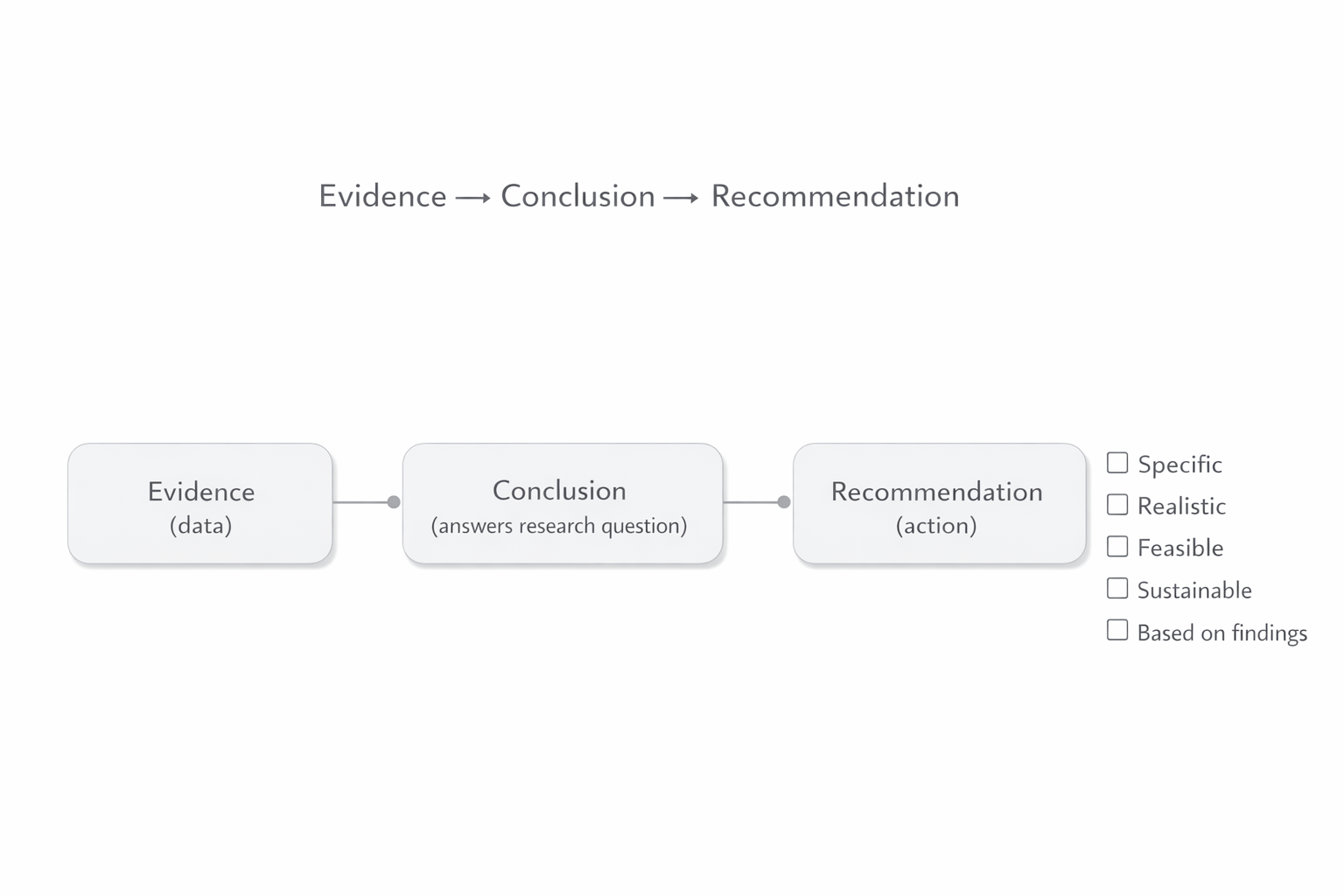
Conclusions must be based on evidence collected during the investigation.
Recommendations must be realistic and practical.
Summarises key findings
Answers the research question
Is supported by data
Does not introduce new information
If data shows high youth unemployment linked to lack of skills training, the conclusion should reflect this connection.
A weak conclusion repeats data without interpretation.
Recommendations suggest actions based on findings.
Realistic
Specific
Linked directly to findings
Achievable
Sustainable
If unemployment is linked to lack of skills, recommend vocational training programmes.
A vague recommendation such as “government should improve development” is weak.
Uses data to justify conclusions
Explains why certain actions are needed
Considers possible limitations
If infrastructure is weak in rural areas, recommend targeted infrastructure investment rather than general policy change.
Cost
Long-term sustainability
Available resources
Community support
Unrealistic recommendations weaken the investigation.
High youth unemployment
Limited industrial diversification
Expand vocational training
Encourage SME development
Promote economic diversification beyond diamonds
“Reduce unemployment” without explanation of how.
Evidence-based recommendations strengthen credibility.
Draw conclusions – summarise findings clearly and link to research question.
Make recommendations – propose practical, realistic actions based on evidence.
Avoid repetition
Avoid introducing new data
Justify recommendations
Always connect recommendations to evidence.
Repeating data without concluding
Introducing new information in conclusion
Making vague recommendations
Ignoring feasibility
Not linking recommendations to findings
Define the term “recommendation” in an investigation.
Why should conclusions be based on evidence?
An investigation finds poor road infrastructure limits market access for farmers.
Explain one suitable recommendation.
Explain why unrealistic recommendations weaken an investigation.
“Recommendations are more important than conclusions in a development investigation.”
Discuss this statement.
A strong answer should state that a recommendation is a practical suggestion based on findings aimed at improving a situation.
A vague definition lacks precision.
Link infrastructure problem to market access
Suggest road improvement or transport subsidies
Explain how it improves income and development
Explanation must show cause and effect.
Recognise importance of evidence-based conclusions
Explain role of actionable recommendations
Argue that both are necessary
Provide balanced judgement
Evaluation requires comparison and justified reasoning.
This lesson explains how to structure, write and present a development investigation report. A strong report is clear, logical, evidence-based and professionally presented. Good presentation enhances credibility and improves communication of findings.
Investigation report
Structure
Methodology
Findings
Analysis
Conclusion
Recommendations
Referencing
An investigation report communicates the entire research process and findings in a structured format.
Logical
Clear
Well-organised
Evidence-based
Professionally presented
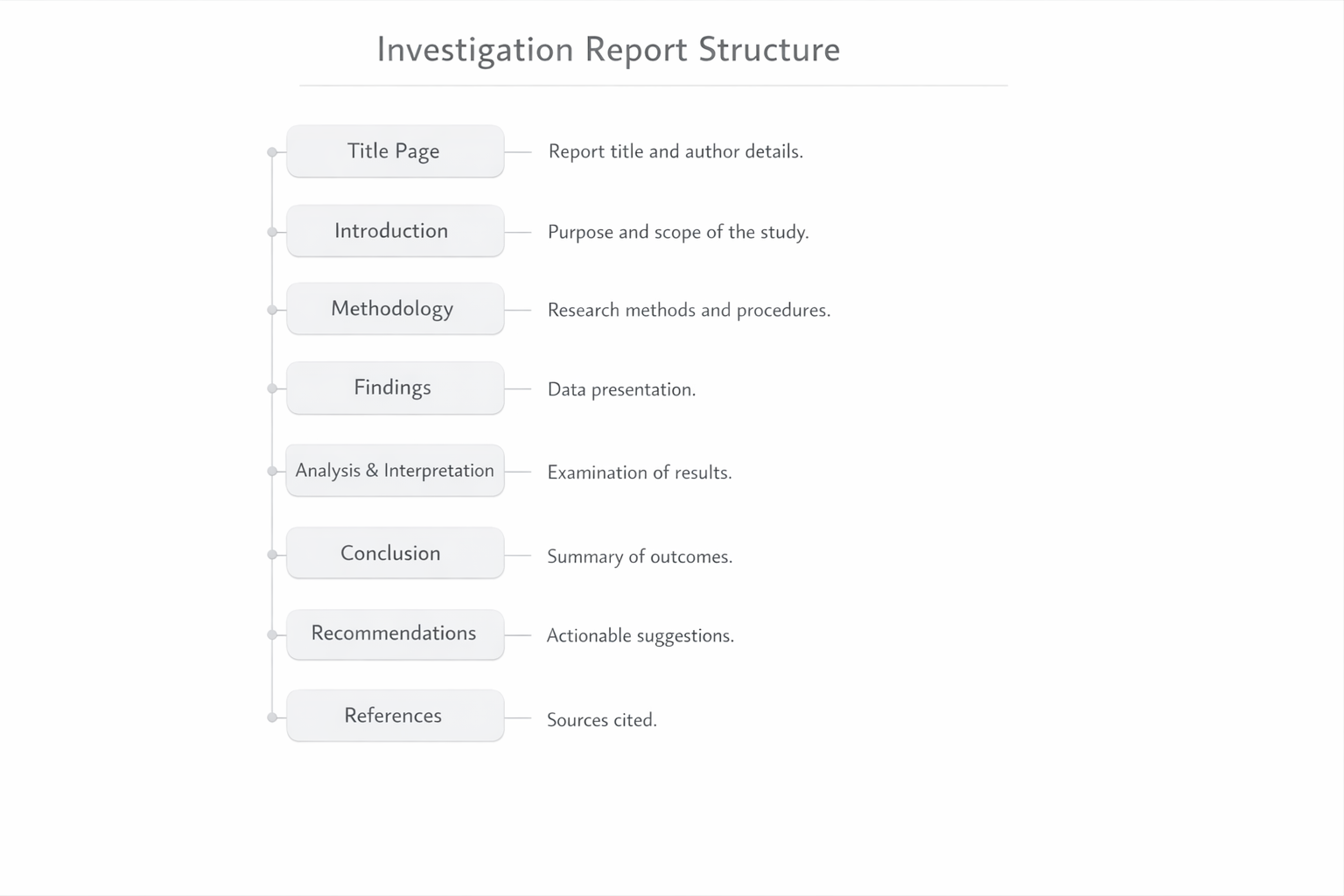
A standard development investigation report includes:
Title of investigation
Name of researcher
Date
School or institution
The introduction should:
State the research topic
Explain the research problem
Present research objectives
Provide brief background information
The introduction sets the purpose of the investigation.
This section explains:
Methods used (questionnaires, interviews, observation)
Sample size
Sources of data
Justification of methods
It must explain why certain methods were chosen.
Tables
Graphs
Charts
Maps
Data should be clearly labelled and organised.
No interpretation yet — only presentation.
Explains trends and patterns
Links findings to development concepts
Identifies relationships
Explains anomalies
This is where reasoning is demonstrated.
Summarises key findings
Answers the research question
Does not introduce new data
It must be based on evidence.
Must be realistic
Must be based on findings
Should be specific and achievable
All secondary sources used should be acknowledged.
Use headings and subheadings
Be neatly organised
Use correct grammar
Include labelled diagrams and graphs
Avoid repetition
Maintain logical flow
Clarity improves credibility.
Introduction explaining the unemployment issue
Methodology using questionnaires and government statistics
Graphs showing unemployment trends
Analysis linking unemployment to lack of diversification
Recommendations for vocational training
A structured report shows academic maturity.
Outline report structure – list sections in logical order.
Explain importance of report writing – emphasise clarity and communication.
Demonstrate understanding of logical flow
Explain purpose of each section
Avoid listing sections without explanation
Missing key sections
Mixing data presentation and analysis
Introducing new information in conclusion
Poor labelling of graphs
Making recommendations not linked to findings
State two sections of an investigation report.
Why should findings and analysis be separated?
Explain why a clear methodology section strengthens an investigation report.
Explain why introducing new data in the conclusion weakens a report.
“Presentation quality is just as important as data accuracy in an investigation report.”
Discuss this statement.
A strong answer should clearly name sections such as introduction, methodology, findings, analysis, conclusion or recommendations.
Mention transparency
Mention reliability
Mention replicability
Explain how it builds credibility
Explanation requires linking method clarity to investigation strength.
Recognise importance of accurate data
Recognise importance of clarity and structure
Explain communication impact
Provide balanced judgement
Evaluation requires comparison and reasoned conclusion

