
Course:
History – 0583

This lesson introduces learners to the nature of history as a discipline and explains how knowledge about the past is constructed. It examines the different types of historical sources and how historians use evidence to interpret past events. Learners also develop skills to assess the reliability and accuracy of information obtained from various sources. Understanding sources of history is fundamental because all historical knowledge is based on evidence and interpretation.
History
Interpretation
Primary source
Secondary source
Bias
Validity
Reliability
Corroboration
Perspective

History is the study of past human activities based on evidence and interpretation.
Important elements in the definition:
• It studies the past
• It focuses on human activities
• It uses evidence
• It involves interpretation
History is not simply memorising dates and events. It involves analysing evidence to explain causes, consequences and significance of past events.
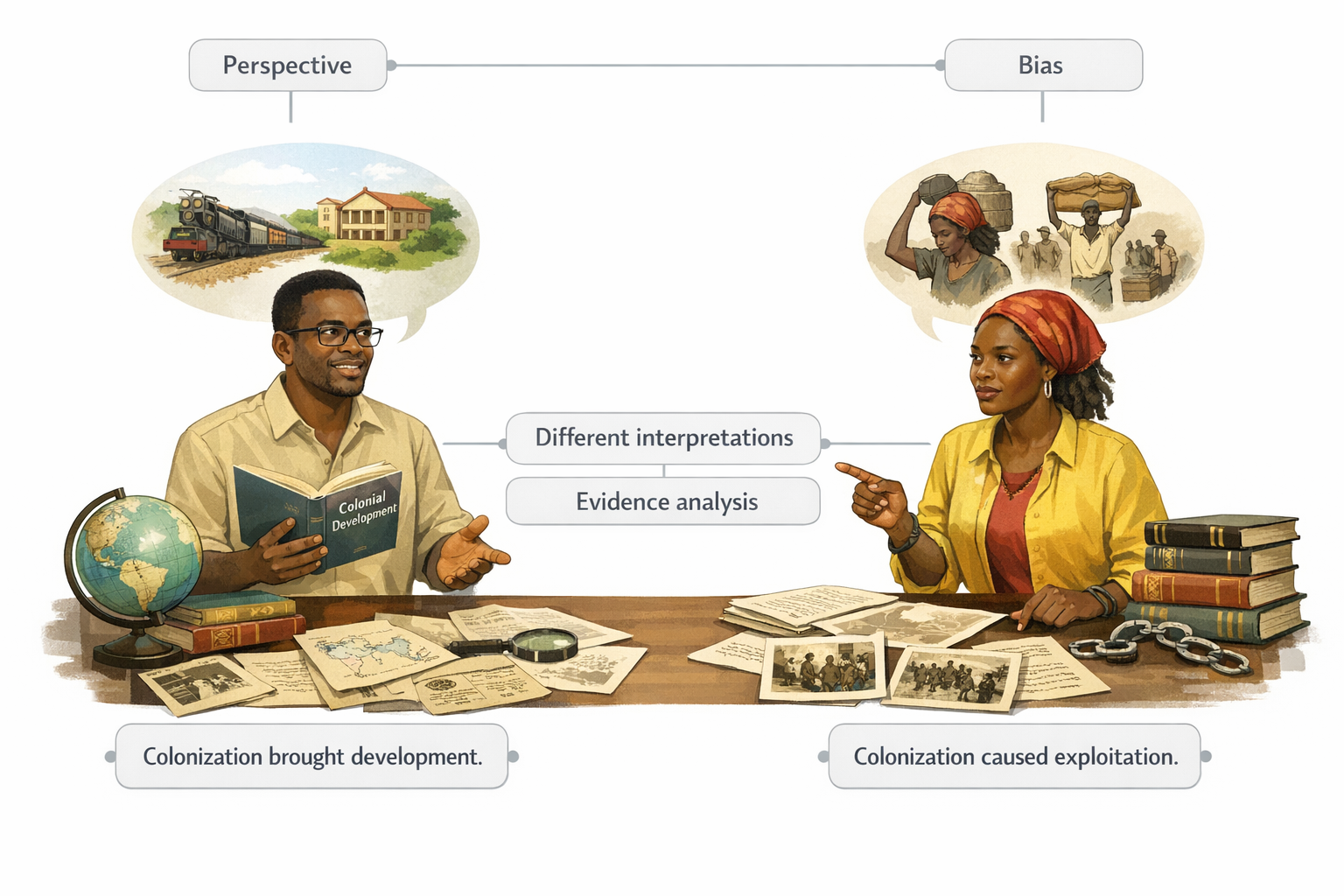
History can be interpreted in different ways.
An interpretation is an explanation or viewpoint about past events.
Different historians may interpret the same event differently because of:
Perspective – cultural, political or social background
Bias – personal opinions or beliefs
Purpose – why the source was created
Availability of evidence – new discoveries may change interpretations
Time period – views change over time
One historian may argue that colonisation brought development.
Another may argue that colonisation caused exploitation.
Both may use evidence but interpret it differently.
Conclusion: History is not fixed; it is continuously re-examined.
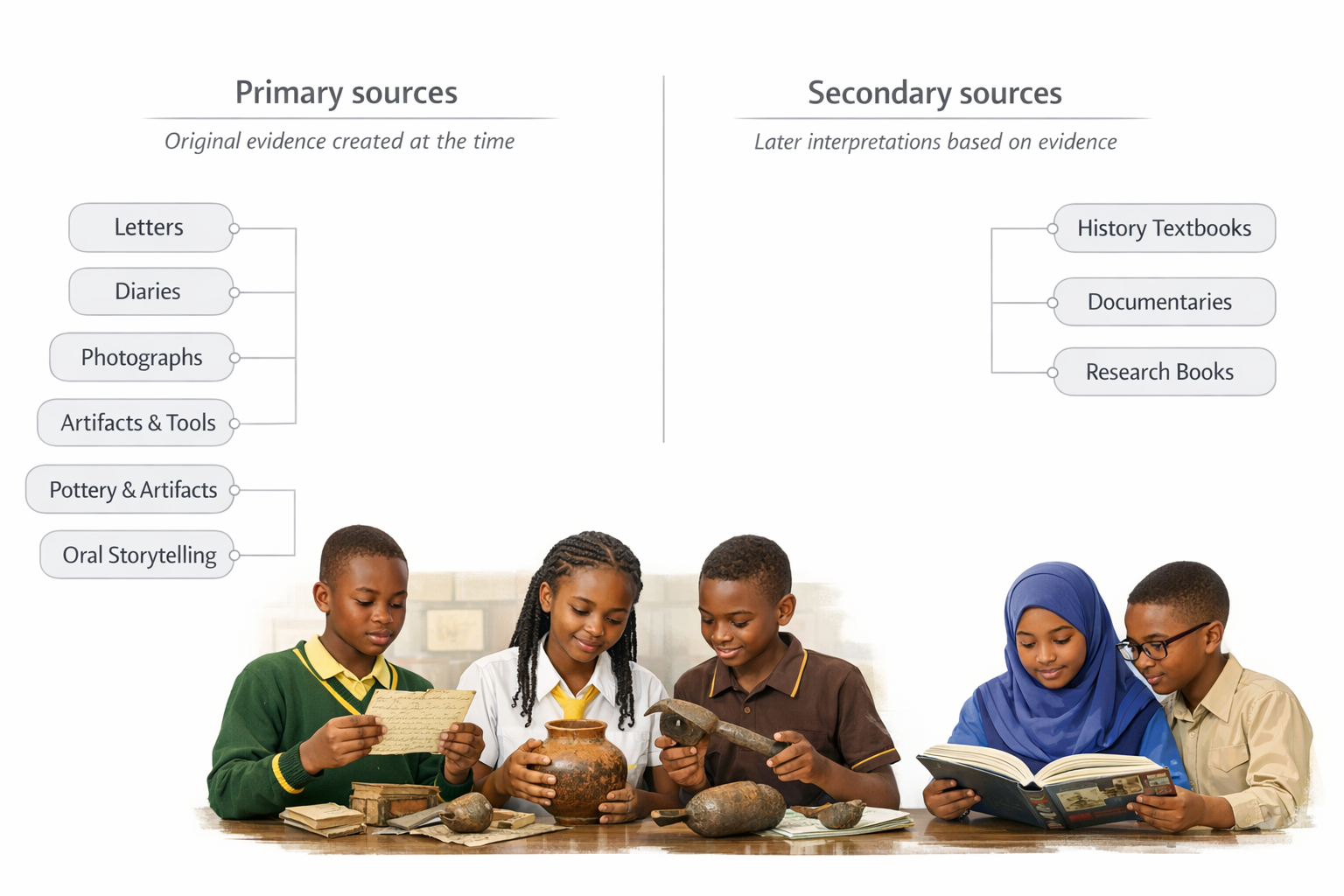
A source is evidence used to study the past.
• Primary sources
• Secondary sources
Definition:
Primary sources are original pieces of evidence created at the time an event occurred.
Written sources
• Letters
• Diaries
• Treaties
• Government records
Oral sources
• Oral traditions
• Interviews
• Praise poetry
• Storytelling
Visual sources
• Photographs
• Paintings
• Cartoons
• Maps
Archaeological sources
• Tools
• Pottery
• Skeletons
• Ruins
• Rock paintings
Eye-witness accounts
• Accounts from people who directly saw the event
• Provide direct evidence
• Offer first-hand accounts
• Show attitudes of the time
• May contain bias
• May be incomplete
• May exaggerate
Definition:
Secondary sources are accounts produced after the event, using primary sources.
Examples:
• History textbooks
• Research articles
• Documentaries
• Biographies written later
• Provide analysis and explanation
• Combine many sources
• Often more structured
• Depend on interpretation
• May reflect historian’s bias
• Created at the time
• Direct evidence
• May be biased
• Created later
• Based on primary evidence
• Involve interpretation
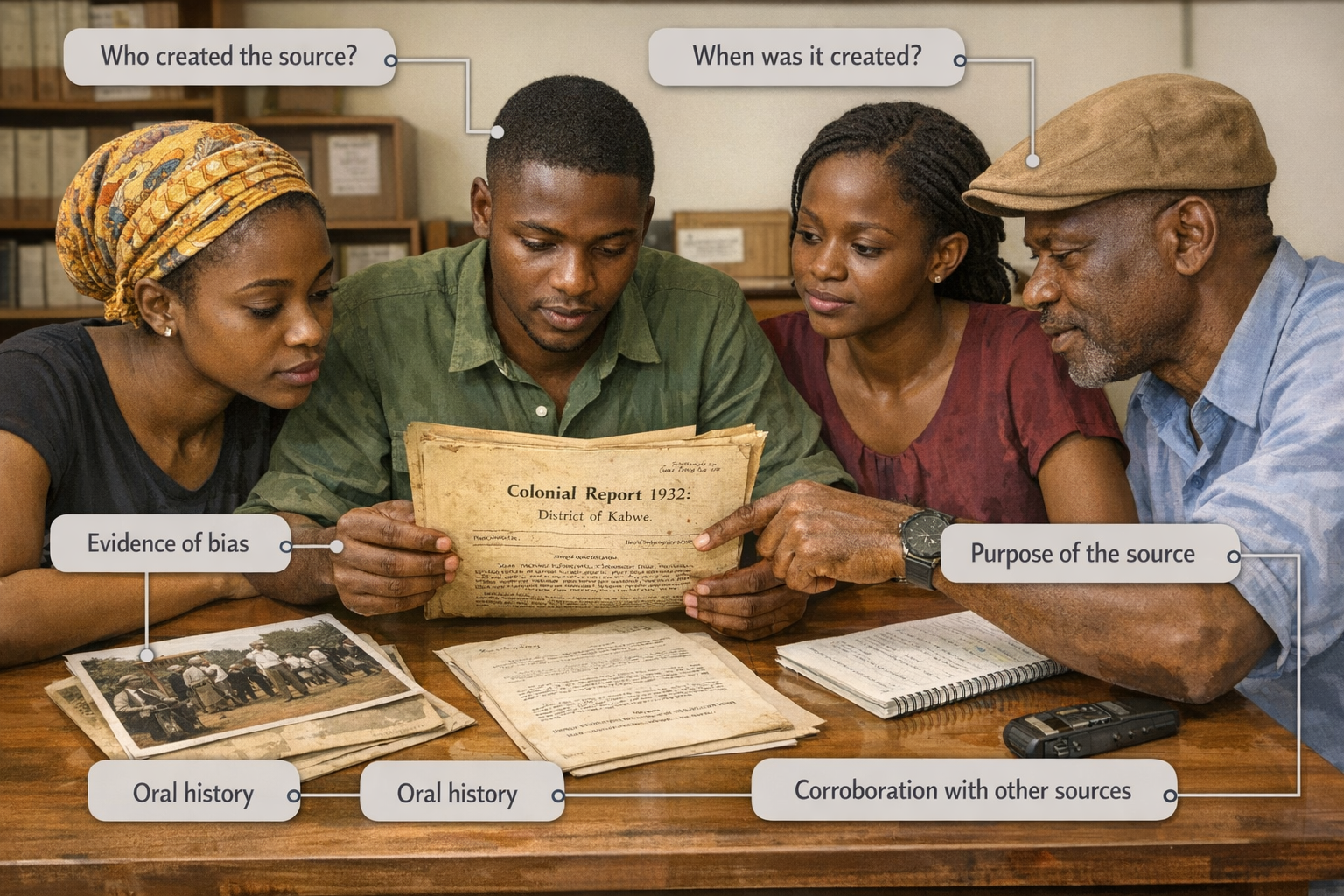
Validity refers to how accurate and reliable a source is.
When analysing validity, historians ask:
Who created the source?
When was it created?
Why was it created?
Who was the intended audience?
Is there evidence of bias?
Is the information supported by other sources?
This process is called source evaluation.
Bias
Personal beliefs may influence information.
Purpose
Was the source meant to inform, persuade, or defend?
Time gap
A source written long after the event may contain errors.
Perspective
Different social groups may present different views.
Corroboration
A source is stronger if supported by other sources.
If a colonial officer writes that Africans resisted taxation because they were “lazy,” we must ask:
• Was he defending colonial policy?
• Was he biased?
• Do African oral sources agree?
This shows how validity must be examined carefully.
Cause: Bias
Effect: Distorted account
Cause: Limited evidence
Effect: Incomplete history
Cause: Political influence
Effect: Selective interpretation
Short Answer (4 marks):
Define history.
State two primary sources of history.
Give two reasons why historians may interpret events differently.
Explain Questions (6 marks):
Explain why oral tradition can be useful but unreliable.
Explain two differences between primary and secondary sources.
Essay Question (10 marks):
“Primary sources are always more reliable than secondary sources.”
How far do you agree?
• Provide arguments supporting
• Provide arguments against
• Make a balanced judgement
Define key terms
Advantages of primary sources
Limitations of primary sources
Advantages of secondary sources
Limitations of secondary sources
Balanced evaluation
History is:
• The study of past human activities
• Based on evidence
• Open to interpretation
Sources are:
• Primary (original)
• Secondary (interpretive)
Validity depends on:
• Bias
• Purpose
• Perspective
• Corroboration


 Google