Mathematics - 0563

- Description
- Curriculum
- Reviews
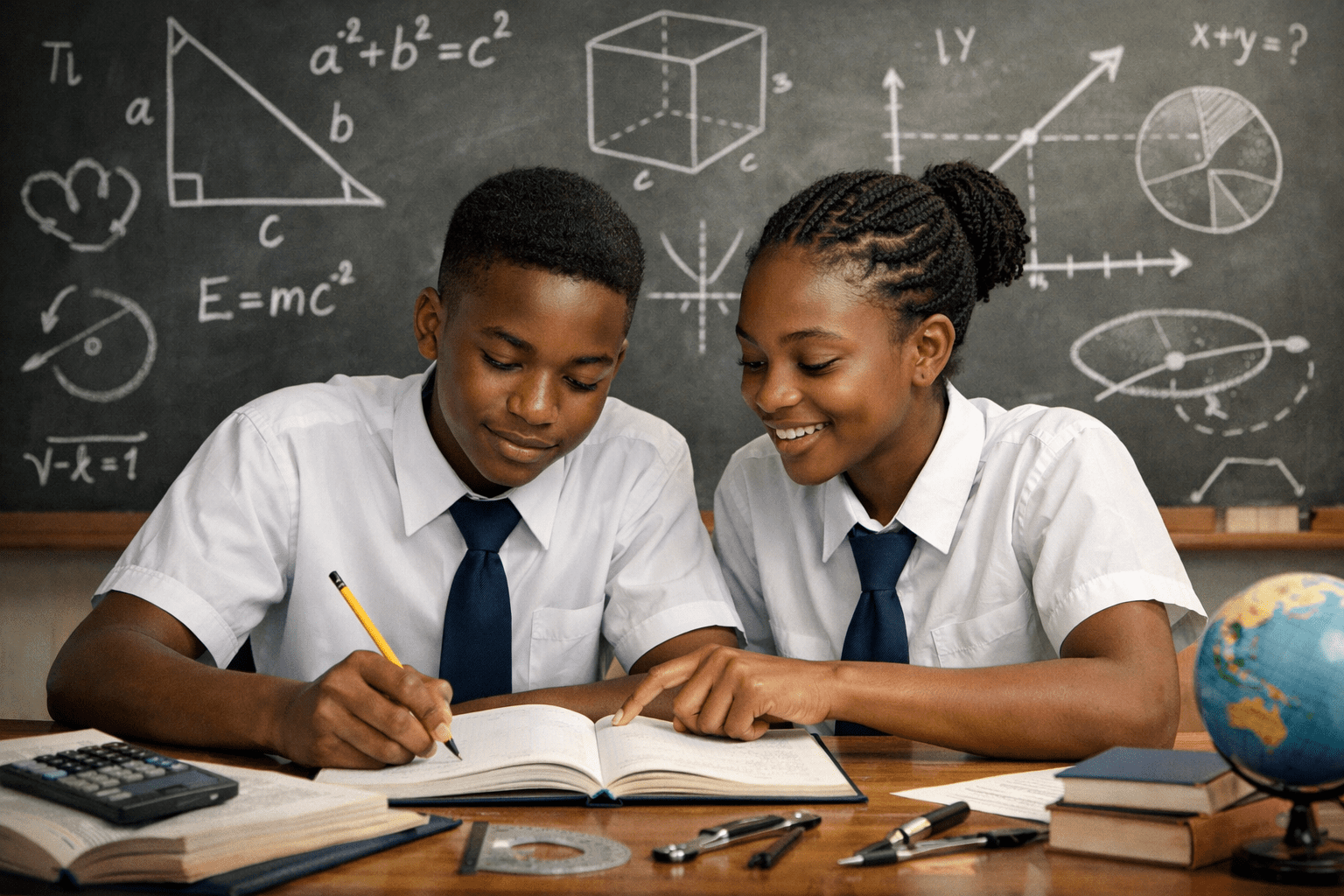
Mathematics is a fundamental subject that develops logical thinking, analytical reasoning and problem-solving skills. This course is designed to help learners build a strong understanding of mathematical concepts required for the Botswana General Certificate of Secondary Education (BGCSE).
The course covers essential areas of mathematics including number operations, algebra, geometry, trigonometry, statistics and probability. Learners will develop the ability to interpret mathematical information, solve practical problems, and apply mathematical techniques in real-life situations.
Throughout this course, students will learn how to perform calculations accurately, interpret graphs and data, understand mathematical relationships, and solve examination-style problems confidently.
The course follows the structure of the BGCSE Mathematics syllabus and prepares learners for examination success through structured lessons, quizzes, and exam simulations.
Key learning areas include:
• Number and numerical operations
• Algebra and mathematical expressions
• Geometry and trigonometry
• Graphs and coordinate geometry
• Statistics and probability
By the end of the course, learners will have developed strong mathematical skills that will help them perform confidently in the BGCSE examinations and apply mathematics effectively in everyday life.
-
1
 Types of Numbers
Numbers are used everywhere in everyday life. We use numbers when counting money, measuring distance, telling time, calculating scores in sports, and solving problems in science and business.
In mathematics, numbers are grouped into different types depending on how they behave and how they are used. These include natural numbers, whole numbers, integers, rational numbers, irrational numbers and real numbers.
Learners will also explore special classes of numbers such as odd and even numbers, square numbers, triangular numbers, cube numbers, prime numbers, factors and multiples. These number classes help us solve many real-world problems.
Understanding the different types and classes of numbers is important because they form the foundation for all other mathematical topics, including algebra, geometry, statistics and financial calculations.
By the end of this lesson, learners will be able to recognise and classify numbers and understand how these numbers are used in practical situations such as sharing items, arranging objects, measuring quantities and solving everyday problems.
-
2
The Four Operations
Use the four basic operations for calculations with whole numbers, decimal fractions, and vulgar (and mixed) fractions, including correct ordering of operations and use of brackets.
-
3
Calculator
A scientific calculator is an important mathematical tool that helps learners perform calculations quickly and accurately. It is widely used in school subjects such as mathematics, physics, chemistry, geography, and business studies.
Scientific calculators can perform many operations including:
-
basic arithmetic calculations
-
working with fractions and decimals
-
powers and roots
-
trigonometric functions
-
scientific notation
-
statistical calculations
Learning how to use a scientific calculator correctly allows students to solve complex problems more efficiently and avoid calculation errors.
In examinations such as BGCSE Mathematics Paper 2 and Paper 3, calculators are allowed and students must know how to use them properly.
-
-
4
Patterns and Sequences
Patterns and sequences are important parts of mathematics that help us recognise relationships between numbers. A sequence is an ordered list of numbers that follows a specific rule or pattern.
Sequences appear in many real-life situations such as saving money regularly, arranging objects, planning schedules, and calculating distances or growth patterns.
Some sequences increase or decrease by the same amount each time. These are called linear sequences. Other sequences grow at different rates and are called non-linear sequences.
By learning how to identify patterns and describe them using algebra, learners develop important problem-solving skills that are used in science, engineering, finance, computer programming, and everyday decision-making.
-
5
Approximation and Estimation
In mathematics and everyday life, exact values are not always necessary. Sometimes it is faster and more practical to use approximation and estimation to obtain values that are close enough to the correct answer.
Approximation involves rounding numbers to a specific number of decimal places, significant figures, or place value. Estimation involves making a quick and sensible guess about the value of a quantity.
These skills are very important because they help learners check whether calculator answers make sense, avoid errors in calculations, and solve problems quickly in real-life situations such as shopping, construction, budgeting, and measurement.
-
6
Directed Numbers
Directed numbers are numbers that have a direction or sign, either positive (+) or negative (−). They are used to represent quantities that move in opposite directions or values that increase and decrease.
In everyday life, directed numbers are used to represent things such as temperature changes, financial gains and losses, elevations above and below sea level, and movement forward or backward.
Understanding directed numbers helps learners perform calculations involving positive and negative values and solve practical problems that involve increases and decreases.
-
7
Fractions
Fractions, decimals and percentages are different ways of representing parts of a whole. These forms are widely used in everyday life, especially in situations involving money, measurements, sharing quantities and financial calculations.
Learners must understand how to convert between fractions, decimals and percentages, because different situations require different forms. For example, shop discounts are often expressed as percentages, while sharing items may involve fractions.
This lesson also introduces how fractions and percentages are used in ratios, proportions, and financial calculations such as interest. These mathematical skills are important for understanding banking, budgeting, business, and everyday decision-making.
-
8
Indices
Indices (also called powers or exponents) are used to represent repeated multiplication of numbers. Instead of writing the same number multiplied many times, indices provide a shorter and clearer way to express it.
For example:
2 × 2 × 2 × 2 can be written as 2⁴.
Indices are widely used in mathematics, science, engineering, computing, and finance. They help simplify calculations involving very large numbers, very small numbers, and algebraic expressions.
Learners must understand how to interpret positive indices, negative indices, and fractional indices, and apply the laws of indices to simplify expressions and solve problems.
-
9
Applications
Mathematics plays a very important role in everyday financial decisions. People use mathematics when calculating wages, managing household budgets, comparing prices, converting currencies, and understanding profits or losses in business.
This lesson focuses on applying mathematics in real-life financial situations such as shopping, salaries, banking, and business transactions. Learners will also learn how to interpret financial information presented in tables, charts, and graphs.
Understanding these skills helps learners make informed decisions about money management, budgeting, saving, and spending.
-
10
Perimeter, Area, Volume, Mass, Density and Time
Measurement is an important part of everyday life. People measure length, area, volume, mass and time in many activities such as construction, cooking, travelling and manufacturing.
Mathematics helps us calculate measurements accurately. For example:
-
Builders calculate the area of floors and walls before construction.
-
Engineers calculate volumes of tanks and containers.
-
Scientists calculate density of materials.
-
Travellers use timetables and clocks to plan journeys.
Understanding measurement allows learners to solve real-life problems involving space, weight, capacity and time
-
-
11
Limits of Accuracy
In mathematics and real-life measurements, numbers are often rounded to a certain level of accuracy. For example, a length may be measured to the nearest metre or the nearest centimetre.
However, when a number is rounded, the exact value is not known. Instead, the true value lies within a range of possible values called the limits of accuracy.
Understanding limits of accuracy helps learners determine the largest and smallest possible values a measurement could have. This is important in fields such as engineering, construction, science and manufacturing, where accurate measurements affect safety and design.
-
12
Travel Graphs
Graphs are powerful tools used to represent motion visually. Travel graphs show how distance, speed and time change during a journey.
By studying these graphs, learners can understand how objects move, whether they are moving at constant speed, accelerating, decelerating, or stopping.
Travel graphs are widely used in fields such as transportation, engineering, aviation, and sports science to analyse motion and predict travel behaviour.
-
13
Substitution
Algebra allows us to represent real-world relationships using formulas and variables. A formula shows how different quantities are related.
Two important algebra skills are substitution and changing the subject of a formula.
Substitution means replacing variables with known numbers in order to calculate a result. Changing the subject of a formula means rearranging the formula so that a different variable becomes the main variable being calculated.
These skills are widely used in science, engineering, economics, and everyday problem solving.
-
14
Expressions
Algebraic expressions allow us to represent mathematical relationships using numbers, variables and operations. These expressions are used widely in mathematics, science, engineering and economics.
In this lesson learners will learn how to:
-
simplify algebraic expressions
-
expand binomial expressions
-
factorise expressions
-
manipulate algebraic fractions
Understanding algebraic expressions helps learners solve equations and analyse patterns in real-life situations such as business profits, area calculations and scientific formulas.
-
-
15
Equations
Equations are mathematical statements that show that two expressions are equal. They are used to represent relationships between quantities and to find unknown values.
There are several types of equations learners will encounter, including linear equations, simultaneous equations, fractional equations, and quadratic equations.
These equations are used to solve many real-life problems such as calculating costs, distances, profits, and dimensions of objects.
Understanding how to form and solve equations is an essential skill in mathematics and helps develop problem-solving abilities used in science, engineering, economics, and everyday life.
-
16
Inequalities
An inequality is a mathematical statement that compares two expressions using symbols such as:
< (less than)
(greater than)
≤ (less than or equal to)
≥ (greater than or equal to)
Unlike equations, inequalities often have many possible solutions rather than a single answer.
Inequalities are useful in representing real-life situations where limits or restrictions exist, such as budget limits, maximum capacities, minimum requirements, and safety limits.
-
17
Graphs
Graphs are powerful tools used in mathematics to represent relationships between variables. They help learners visualize how one quantity changes in relation to another.
Many real-life situations such as distance travelled, temperature change, business profit, and population growth can be represented using graphs.
In this lesson learners will study:
-
straight-line graphs
-
polynomial graphs
-
functions and their tables of values
-
gradients and tangents
-
graph transformations
These concepts are essential for understanding mathematical models used in science, economics, and engineering.
-
-
18
Geometrical Terms and Relationships
-
19
Geometrical Terms and Relationships
Geometry is the branch of mathematics that studies shapes, sizes, positions, and relationships between objects in space.
Understanding geometrical terms helps learners describe and analyze different shapes and their properties. Geometry is widely used in architecture, engineering, construction, navigation, and design.
In this lesson learners will study important geometrical ideas such as points, lines, angles, triangles, quadrilaterals, circles, polygons and three-dimensional shapes. They will also learn how to use the properties of angles and shapesto calculate unknown measurements.
-
20
Angle Properties of Circle
Circles have several important angle relationships that help solve geometric problems. These properties describe how angles are formed when points, chords, radii, and tangents interact within or around a circle.
Understanding these relationships allows learners to calculate unknown angles and lengths in geometric diagrams. Circle theorems are widely used in mathematics, engineering, architecture, and design.
-
21
Symmetry Properties of Circle
A circle has important symmetry properties that help explain how its chords, radii, and tangents behave. These properties allow mathematicians to determine relationships between line segments and angles within a circle.
Understanding these properties makes it easier to solve geometric problems involving chords and tangents. These ideas are also widely used in engineering, architecture, and design, where circular shapes are common.
-
22
Rotational Symmetry
Rotational symmetry occurs when a shape can be rotated around a central point and still appear exactly the same as its original position. This means that the shape fits perfectly onto itself during rotation.
The point around which the shape rotates is called the centre of rotation, and the amount of turning is called the angle of rotation.
Understanding rotational symmetry helps learners identify patterns and structures in geometry. This concept is widely used in architecture, engineering, art, and design, where balanced and repeating shapes are important.
-
23
Symmetry Properties of Polygons
Symmetry describes how a shape can be divided or transformed so that two or more parts match exactly. Many geometric shapes show symmetry, which means they are balanced around a line, point, or axis.
Polygons and solid shapes often have special symmetry properties that help mathematicians understand their structure. By studying symmetry, learners can recognise patterns in shapes and predict how shapes behave when they are reflected or rotated.
Symmetry is widely used in architecture, engineering, art, and design, where balanced shapes create stability and visual harmony.
-
24
Bearings
Bearings are used to describe the direction of one location from another using angles measured from the north direction. Bearings are commonly used in navigation, aviation, map reading, and surveying to describe positions and directions accurately.
In mathematics, bearings are measured clockwise from the north direction and are written using three digits, known as three-figure bearings.
Understanding bearings helps learners interpret maps, describe journeys, and calculate directions between different locations.
-
25
Trigonometric Ratios and Pythagorean Theorem
Trigonometry is the branch of mathematics that studies the relationships between the angles and sides of triangles. It is particularly useful when working with right-angled triangles.
Two important tools in trigonometry are:
-
the Pythagorean theorem, which relates the lengths of the sides of a right-angled triangle
-
the trigonometric ratios: sine, cosine and tangent
These mathematical ideas allow us to calculate unknown sides or angles in triangles and are widely used in fields such as engineering, navigation, architecture, surveying and physics.
-
-
26
Sine and Cosine Rule
The sine rule and cosine rule are important trigonometric formulas used to solve problems involving non-right-angled triangles. While basic trigonometric ratios are mainly used in right-angled triangles, the sine and cosine rules allow learners to calculate unknown sides and angles in any triangle.
These rules are widely used in fields such as engineering, surveying, navigation, and construction, where accurate measurements of distances and angles are required.
Understanding how to apply the sine and cosine rules enables learners to solve more complex geometric problems.
-
27
Distances
The Cartesian plane is a coordinate system used to locate points using ordered pairs. It consists of two perpendicular number lines called the x-axis (horizontal axis) and the y-axis (vertical axis).
By plotting points on this plane, we can determine the distance between them. The distance between two points is found using a formula derived from the Pythagorean theorem.
This concept is widely used in mathematics, computer graphics, navigation systems, and engineering.
-
28
Co-ordinates of Midpoint of the Line Segment
In coordinate geometry, a line segment connects two points on the Cartesian plane. Sometimes it is useful to determine the midpoint, which is the exact point that lies halfway between the two endpoints of the segment.
The midpoint can be found by averaging the x-coordinates and the y-coordinates of the endpoints. This concept helps learners understand how distances and positions are related in coordinate systems.
Midpoints are widely used in geometry, mapping, construction, computer graphics, and engineering when determining central positions or dividing a line into equal parts.
-
29
Geometrical Constructions
Geometrical constructions involve drawing geometric shapes accurately using instruments such as a ruler, compass, and protractor. These constructions help learners understand geometric relationships and develop precision in drawing mathematical figures.
Through constructions, learners can create triangles, perpendicular lines, parallel lines, and angle bisectors. These skills are important in geometry, engineering drawing, architecture, and technical design.
Accurate constructions allow learners to solve geometric problems and understand how different shapes and angles relate to each other.
-
30
Loci m 2-D
A locus is the set of all points that satisfy a particular condition or rule. Instead of describing a single point, a locus describes a path or region of points that share the same property.
For example, all points that are the same distance from a fixed point form a circle. Similarly, points that are equidistant from two points form a perpendicular bisector.
Understanding loci helps learners solve geometric problems involving distances and positions. Loci are widely used in navigation, engineering design, surveying, and mapping.
-
31
Reflection
Reflection is a type of geometric transformation where a shape is flipped over a line called the line of reflection. The reflected image is the same size and shape as the original but appears on the opposite side of the mirror line.
During reflection, every point of the object moves the same distance from the mirror line, but on the opposite side. The reflected image is therefore a mirror image of the original shape.
Reflections are commonly used in geometry, art, architecture, and computer graphics to create symmetrical patterns and designs.
-
32
Rotation
Rotation is a geometric transformation in which a shape is turned around a fixed point. The fixed point is called the centre of rotation.
During rotation, the shape keeps its size and shape, but its orientation changes depending on the direction and angle of rotation.
Rotations are commonly measured in degrees, such as 90°, 180°, and 270°, and can occur in either the clockwise or anticlockwise direction.
Understanding rotation helps learners analyse patterns, transformations, and movements of shapes on coordinate grids.
-
33
Translation
Translation is a geometric transformation that slides a shape from one position to another without changing its orientation. During a translation, every point of the shape moves the same distance in the same direction.
The movement of the shape is described using a vector, which shows both the direction and distance of the translation.
Translations are commonly shown on a coordinate grid, making it easy to track how each point of the shape moves
-
34
Enlargement
Enlargement is a transformation that changes the size of a shape while keeping its shape the same. The enlarged shape is similar to the original but may be larger or smaller depending on the scale factor.
All points of the shape move away from or toward a fixed point called the centre of enlargement.
Enlargement is widely used in maps, architectural drawings, engineering designs, and image scaling in computer graphics.
-
35
Vectors
A vector is a quantity that has both magnitude (size) and direction. Vectors are used to represent movement, displacement, and direction in mathematics and physics.
Vectors can be represented in different forms, including column vectors, directed line segments, or by using letters such as a or AB.
Vectors are commonly used in coordinate geometry to describe movements on a grid. Understanding vectors allows learners to analyse motion, forces, and transformations in mathematics and science.
-
36
Data Processing
Data processing involves collecting, organising, analysing and presenting information so that it becomes easier to understand.
Large sets of raw data are often difficult to interpret. To make the information clearer, data can be organised using:
-
tables
-
charts
-
graphs
These visual tools help people identify patterns, comparisons and trends.
Data processing is widely used in business, science, economics, government planning and research.
-
-
37
Measures of Central Tendency
Measures of central tendency are statistical values used to describe the centre or typical value of a set of data. They summarise a large amount of information using a single value that represents the data set.
The three main measures of central tendency are:
-
Mean
-
Median
-
Mode
These measures help in understanding patterns in data and are widely used in fields such as education, economics, business analysis and scientific research.
For grouped data, the modal class identifies the class interval that contains the highest frequency.
In some situations, the median can also be estimated using cumulative frequency graphs or cumulative frequency tables.
-
-
38
Measures of Dispersion
Measures of dispersion describe how spread out or varied a set of data is. While measures of central tendency show the centre of the data, measures of dispersion explain how much the data values differ from each other.
Common measures of dispersion include:
-
Range
-
Quartiles
-
Interquartile Range (IQR)
-
Variance
-
Standard Deviation
These measures help statisticians understand the distribution, variability and reliability of data.
Measures of dispersion are widely used in fields such as education, economics, engineering, scientific research and business analysis.
They are particularly useful when comparing different data sets to determine which one shows greater variation.
-
-
39
Simple Probability
Probability is the branch of mathematics that deals with the likelihood or chance of an event occurring. It helps us measure how likely something is to happen.
Probability is widely used in everyday life when making predictions or decisions. Examples include predicting weather conditions, analysing sports results, conducting scientific experiments and managing risks in business.
Probability values are expressed on a scale from 0 to 1, where:
-
0 represents an event that will never happen
-
1 represents an event that is certain to happen
Learners also study the difference between theoretical probability and experimental probability, and how probabilities can be calculated for single events and simple combined events.
Understanding probability helps learners make informed decisions based on chance and uncertainty.
-
-
40
Mutually Exclusive and Independent Events
In probability, some events may occur together, while others cannot occur at the same time. Understanding the relationship between events helps in calculating probabilities more accurately.
Two important types of event relationships are:
-
Mutually exclusive events
-
Independent events
Mutually exclusive events cannot occur at the same time, while independent events occur without affecting each other.
These concepts help learners apply the addition and multiplication rules of probability when analysing simple probability situations.
Understanding these ideas allows learners to solve probability problems involving combined events and multiple experiments.
-
Subject: Mathematics
Level: BGCSE Senior Secondary
Course Access Period: 12 Months
Learning Format: Self-paced digital course
Assessment: Topic quizzes and exam simulations
Topics Covered:
• Number and Operations
• Measures and Mensuration
• Algebra and Equations
• Graphs and Functions
• Geometry and Trigonometry
• Coordinate Geometry
• Transformations and Vectors
• Statistics and Probability
The course content is aligned with the BGCSE Mathematics assessment framework used in Botswana secondary schools.
• Have completed Junior Certificate Mathematics or equivalent
• Have basic knowledge of arithmetic operations
• Be willing to practise mathematical problems regularly
• Have access to a calculator for certain topics
• Have access to a computer, tablet, or smartphone with internet connection
• BGCSE students preparing for Mathematics examinations
• Senior secondary school learners who want to improve their mathematics skills
• Students who need additional support in understanding mathematical concepts
• Learners preparing for examinations or revision
• Anyone who wants to strengthen their mathematical reasoning and problem-solving abilities