
Course:
Physics – 0571

Motion refers to the change in position of an object with time. The basic quantities used to describe motion include distance, displacement, speed, velocity and acceleration. These quantities allow scientists to measure and predict how objects move.
Distance is the total path travelled by an object, while displacement refers to the shortest straight-line distance between the starting point and the final position. Speed describes how fast an object moves, while velocity includes both speed and direction. Acceleration describes how quickly velocity changes with time.
Motion can be uniform or non-uniform. Uniform motion occurs when an object moves with constant velocity, while non-uniform motion occurs when the velocity changes. Graphs such as distance–time graphs and speed–time graphs are useful tools for representing motion.
Objects falling under the influence of gravity experience acceleration known as g, which is approximately 9.8 m/s² near the Earth’s surface. When objects fall through air or liquids, resistance forces act against gravity and eventually produce a constant speed known as terminal velocity.
Understanding motion helps explain many physical phenomena such as falling objects, vehicle movement and the behaviour of fluids.
Distance is the total length of the path travelled by an object.
It does not consider direction.
If a learner walks 200 m to school and 200 m back home, the total distance travelled is:
Distance = 200 m + 200 m
Distance = 400 m
SI Unit: metre (m)
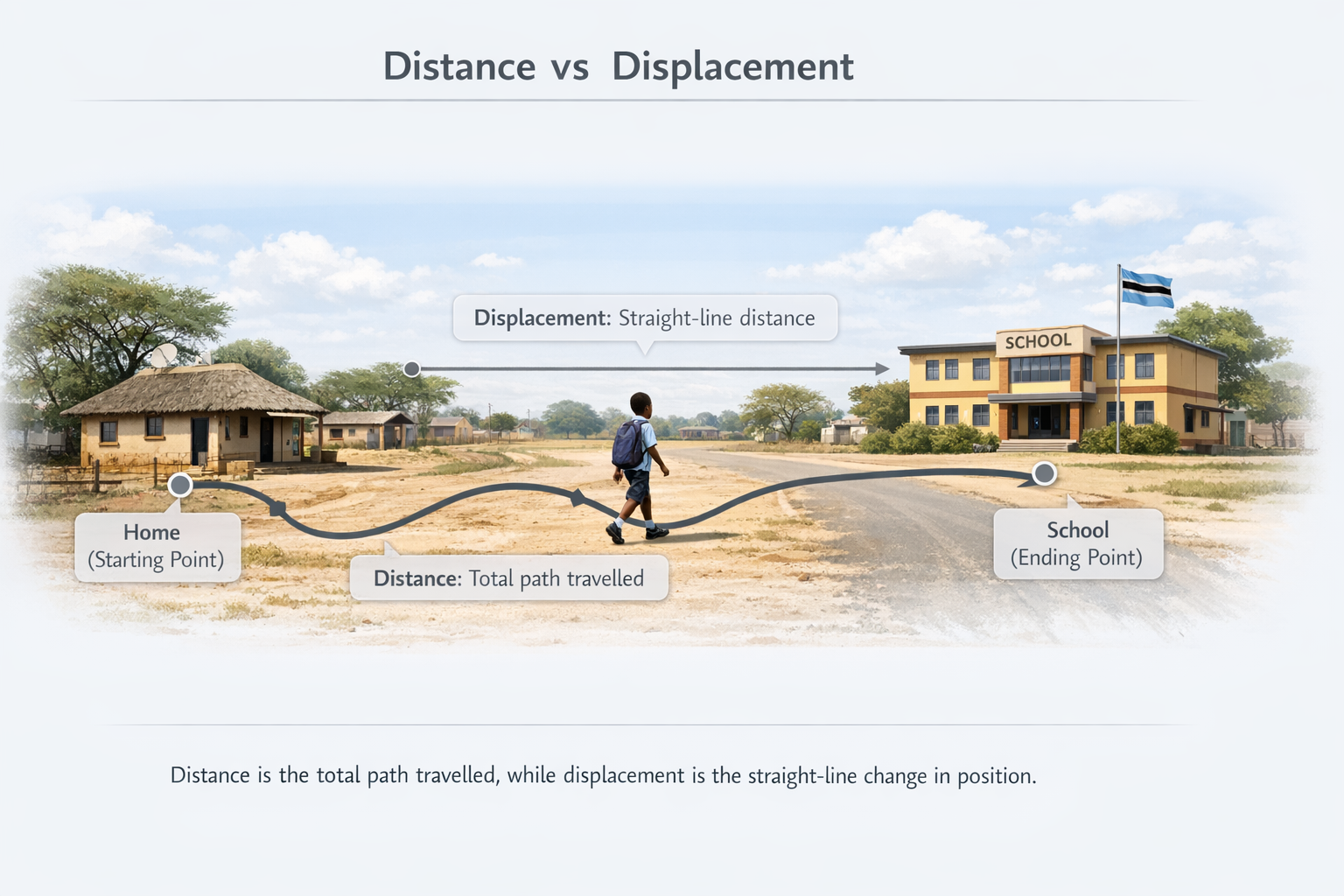
Displacement is the shortest straight-line distance from the starting point to the final position, including direction.
If a learner walks 200 m to school and returns to the starting point, the displacement is:
Displacement = 0 m
Because the final position is the same as the starting position.
Speed describes how fast an object moves.
Speed = Distance ÷ Time
A car travels 100 m in 10 s
Speed = 100 ÷ 10
Speed = 10 m/s
SI Unit: metres per second (m/s)
Velocity is speed in a given direction.
A car moving 20 m/s north has velocity because direction is included.
If direction changes, velocity also changes.
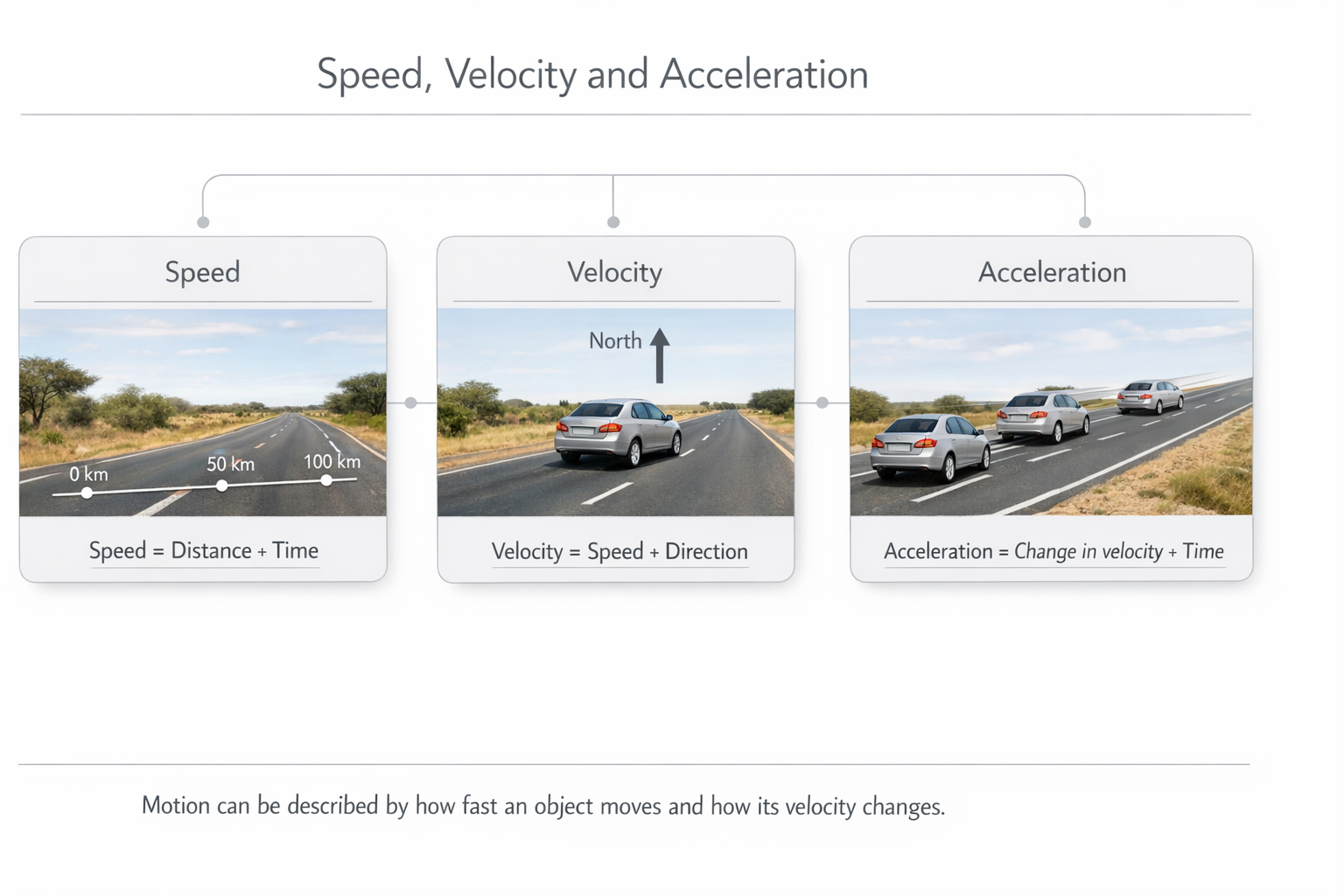
Acceleration is the rate of change of velocity.
Formula:
Acceleration = Change in velocity ÷ Time
A car increases its velocity from 10 m/s to 20 m/s in 5 s
Change in velocity = 20 − 10 = 10
Acceleration = 10 ÷ 5
Acceleration = 2 m/s²
Uniform motion occurs when an object moves with constant velocity.
A car travelling 60 km/h steadily along the Gaborone–Lobatse road.
• equal distances in equal time intervals
• constant speed
• straight line graph on distance–time graph
Non-uniform motion occurs when velocity changes.
A bus stopping at different bus stops along a route.
• unequal distances in equal time intervals
• changing speed
• curved line on distance–time graph
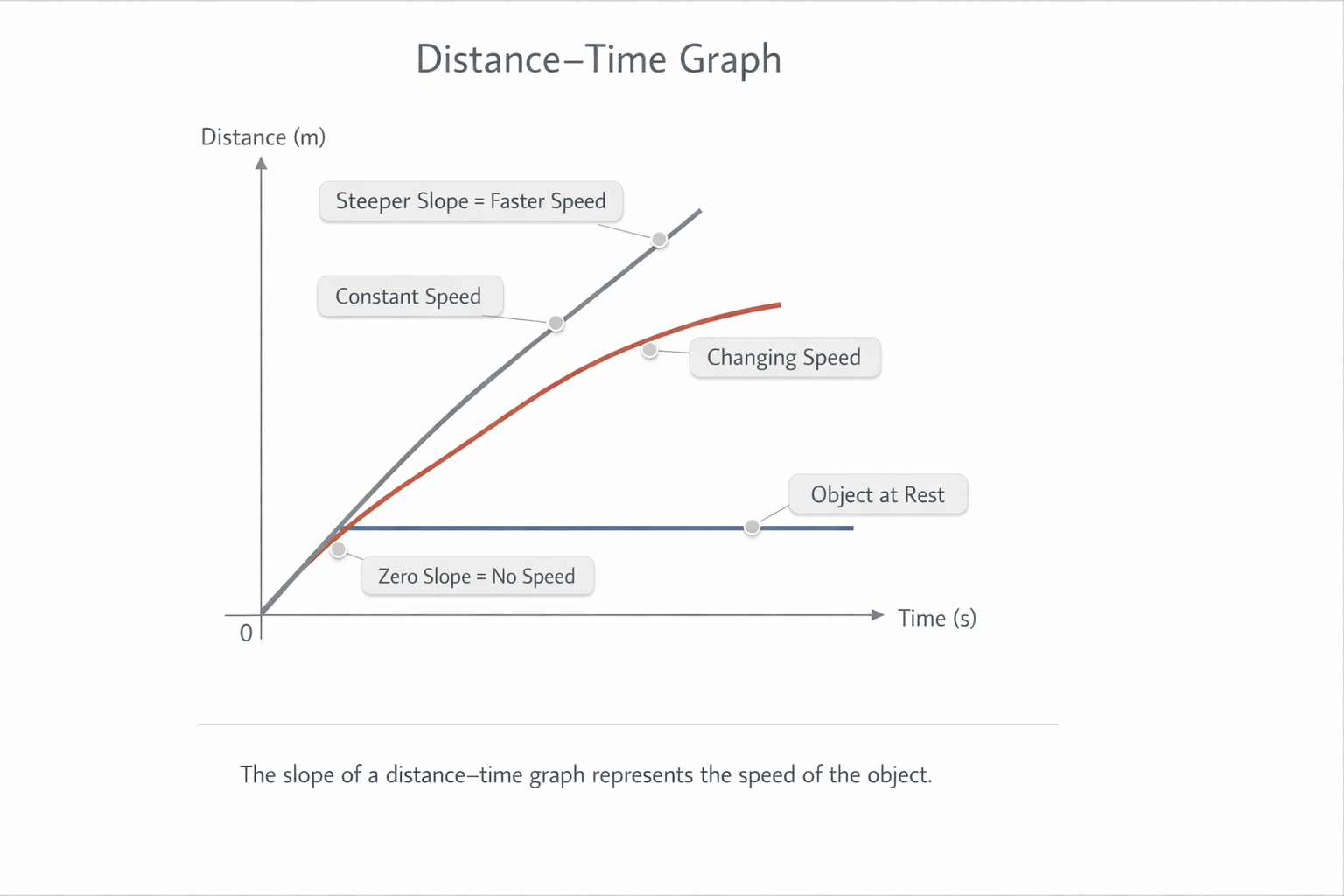
A distance–time graph shows how distance changes with time.
Straight line → constant speed
Curved line → changing speed
Horizontal line → object at rest
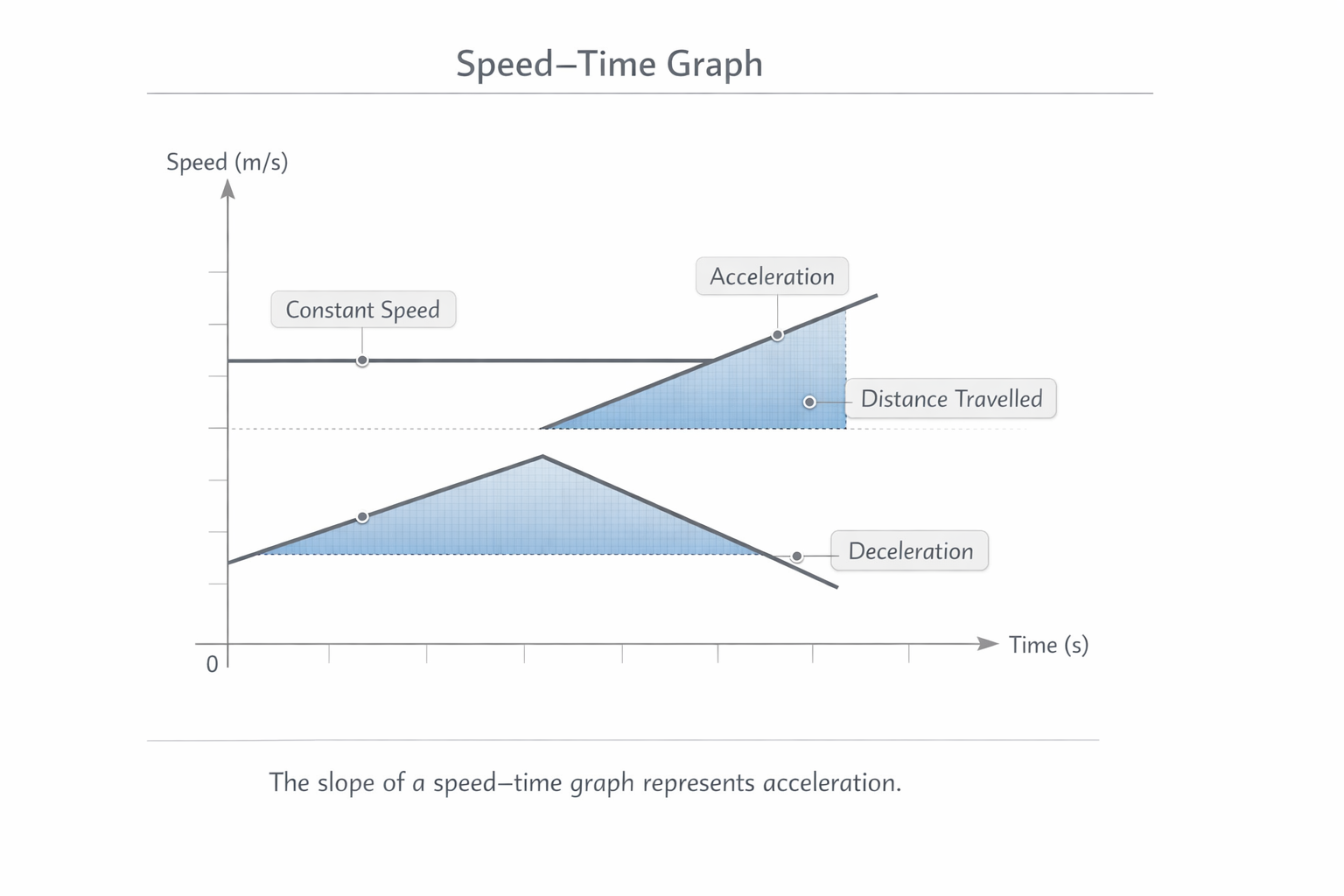
A speed–time graph shows how speed changes with time.
Horizontal line → constant speed
Sloping upward line → acceleration
Sloping downward line → deceleration
Simple motion calculations use equations such as:
Speed = Distance ÷ Time
Acceleration = Change in velocity ÷ Time
These equations help predict motion in real situations.
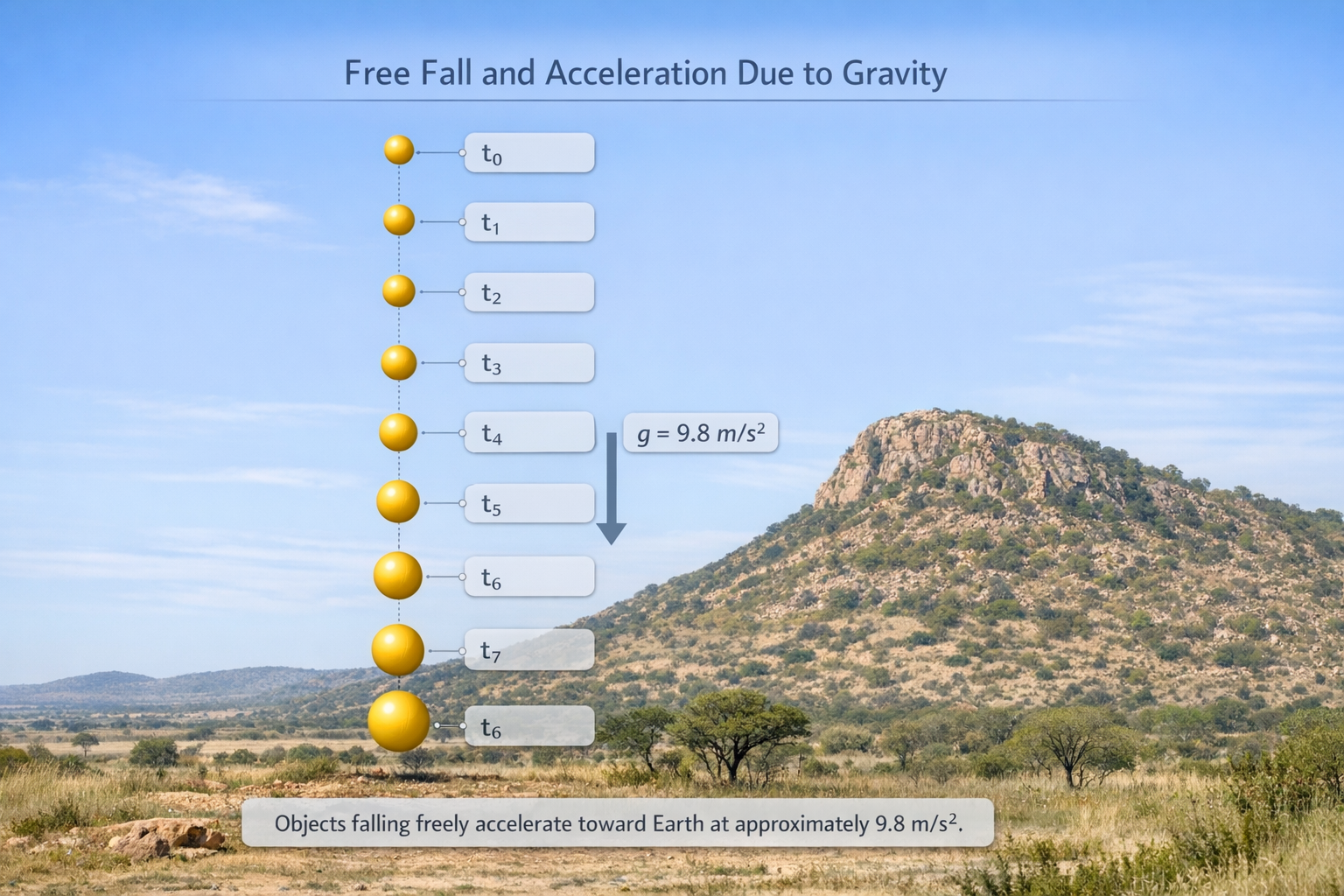
Acceleration due to gravity is the acceleration experienced by objects falling toward the Earth.
Symbol: g
Value near Earth’s surface:
g = 9.8 m/s²
This means the velocity of a falling object increases by 9.8 m/s every second.
Free fall occurs when an object moves only under the influence of gravity.
Example:
A stone dropped from a height.
During free fall:
• acceleration remains constant
• velocity increases continuously
When objects fall in air, air resistance opposes the motion.
Initially:
• gravity pulls the object downward
• velocity increases
As speed increases:
• air resistance increases
Eventually the forces balance.
Objects falling in liquids experience greater resistance than in air.
• raindrops falling in water
• objects sinking in oil
The object gradually slows until a constant speed is reached.
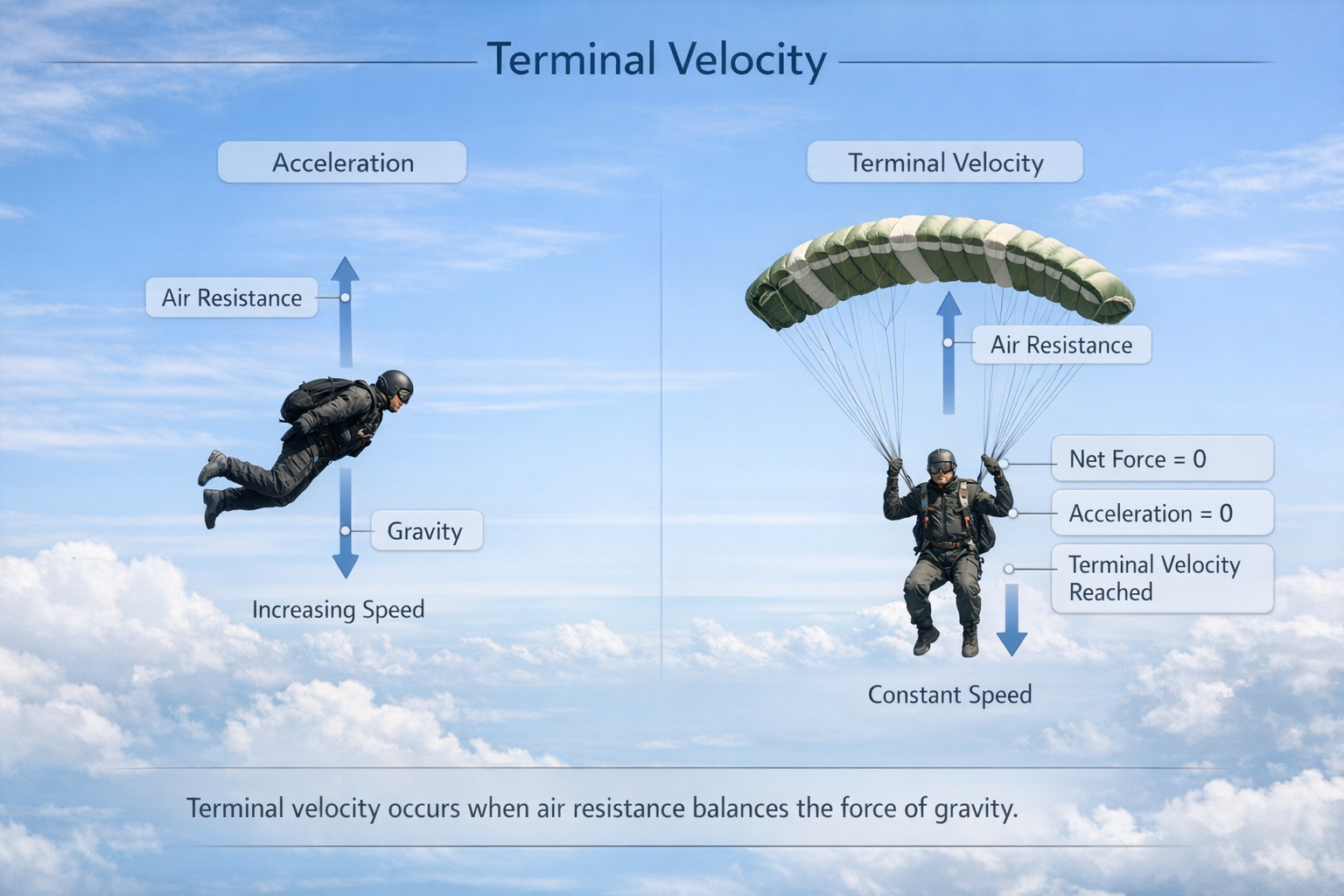
Terminal velocity is the constant maximum speed reached when the force of gravity equals the resistance force.
At terminal velocity:
Net force = 0
Acceleration = 0
A parachutist falling through air eventually reaches terminal velocity.
Examples of motion in Botswana include:
• vehicles travelling on the A1 highway
• athletes running during school athletics competitions
• a stone dropped from a cliff at Kgale Hill
• raindrops falling during the summer rainy season
These real-life situations demonstrate how motion occurs in everyday environments.


 Google