
Course:
Social Studies – 0585

This lesson introduces the meaning, characteristics and importance of Social Studies as a subject. It explains what Social Studies studies, how it is structured, and why it is significant in Botswana.
Understanding this topic is essential because it forms the foundation for all other topics such as governance, environment, development, population and research methods.
Social Studies prepares learners to understand society critically and to participate responsibly in national development.
Social Studies is the integrated study of human society and the relationships between people, institutions and the environment, aimed at developing responsible and informed citizens.
Key ideas in this definition:
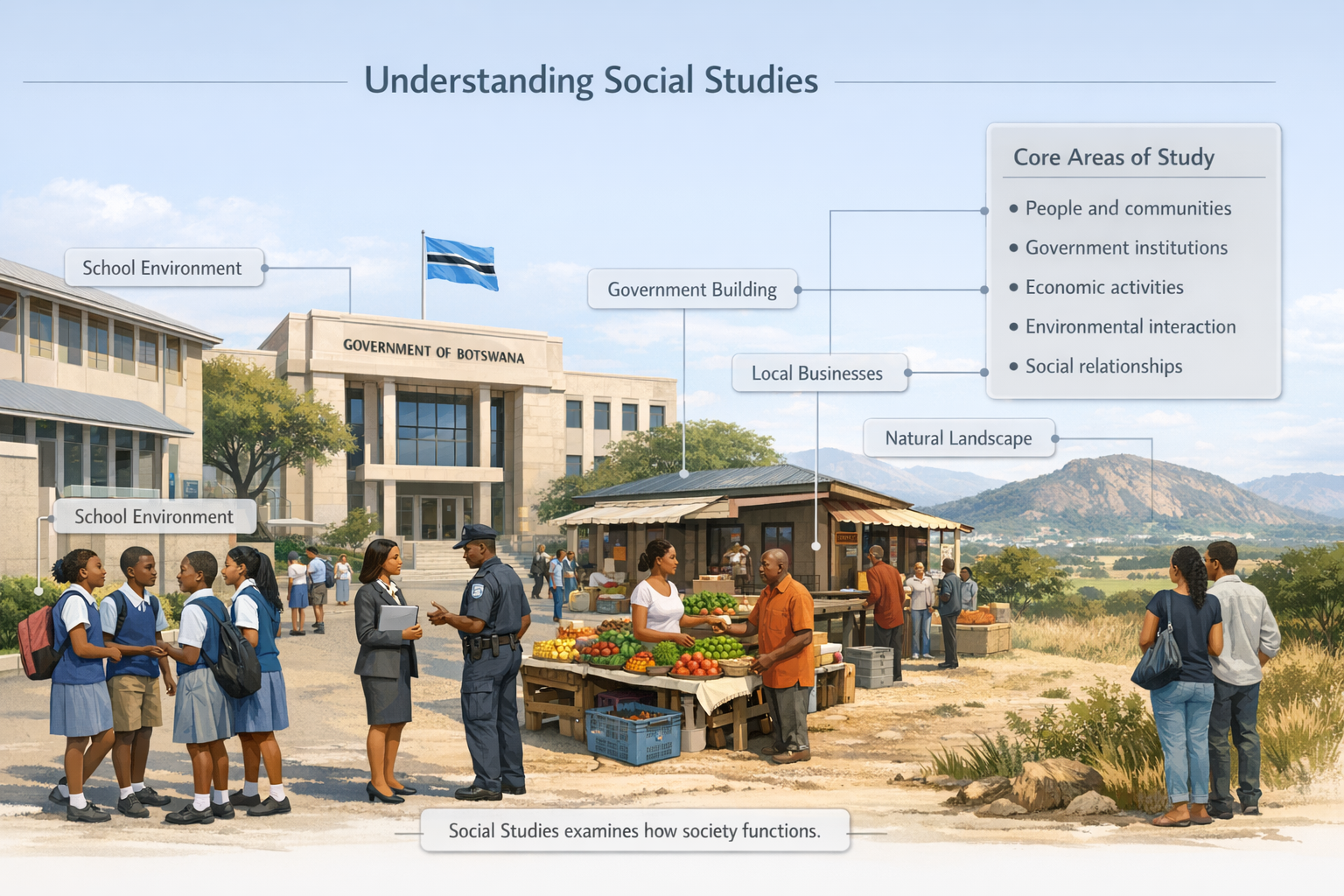
It is integrated (draws from several disciplines).
It focuses on society and human interaction.
It promotes responsible citizenship.
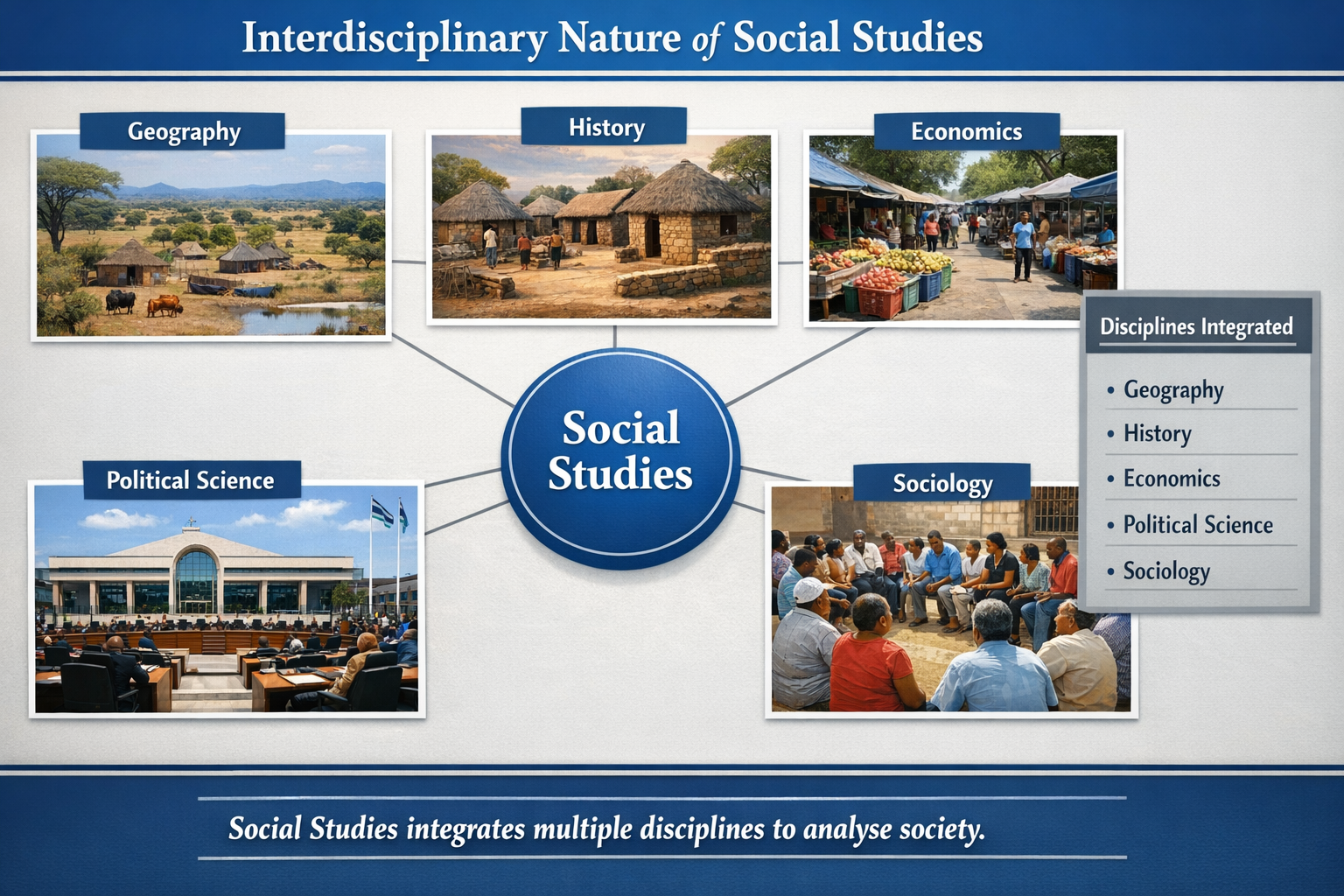
Social Studies combines knowledge from:
Geography
History
Economics
Political Science
Sociology
Environmental Studies
The nature of Social Studies refers to its characteristics and how it is structured.
Social Studies integrates different social science disciplines to understand complex issues.
For example, when studying unemployment:
Economics explains labour markets.
Geography explains rural–urban migration.
Government studies explain policy responses.
Sociology explains social impacts.
This integration allows learners to analyse issues holistically rather than in isolation.
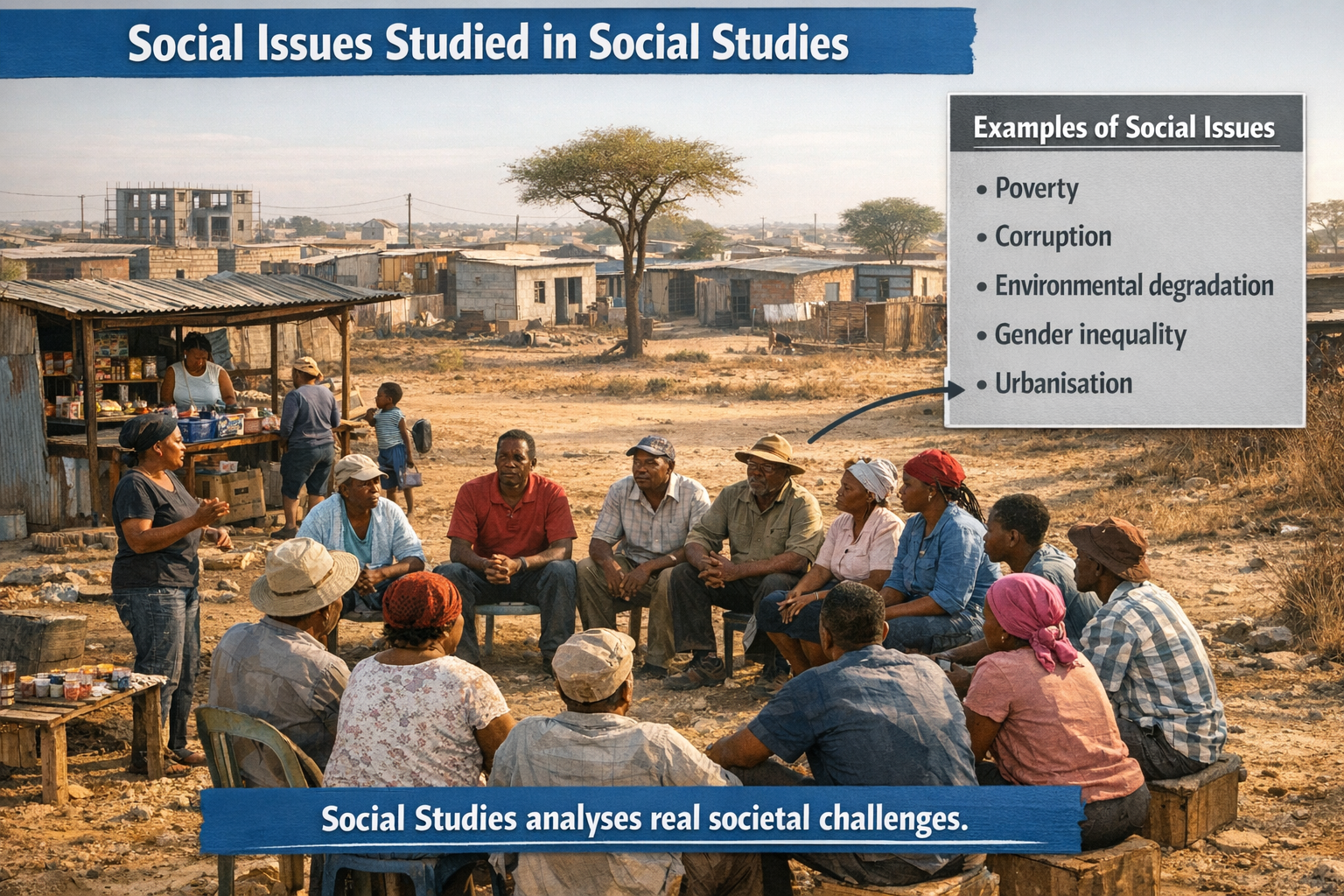
Social Studies focuses on real-life problems affecting society, such as:
Poverty
Corruption
Environmental degradation
HIV/AIDS
Gender inequality
Urbanisation
The subject does not only describe these issues but encourages learners to:
Identify causes
Analyse consequences
Propose solutions
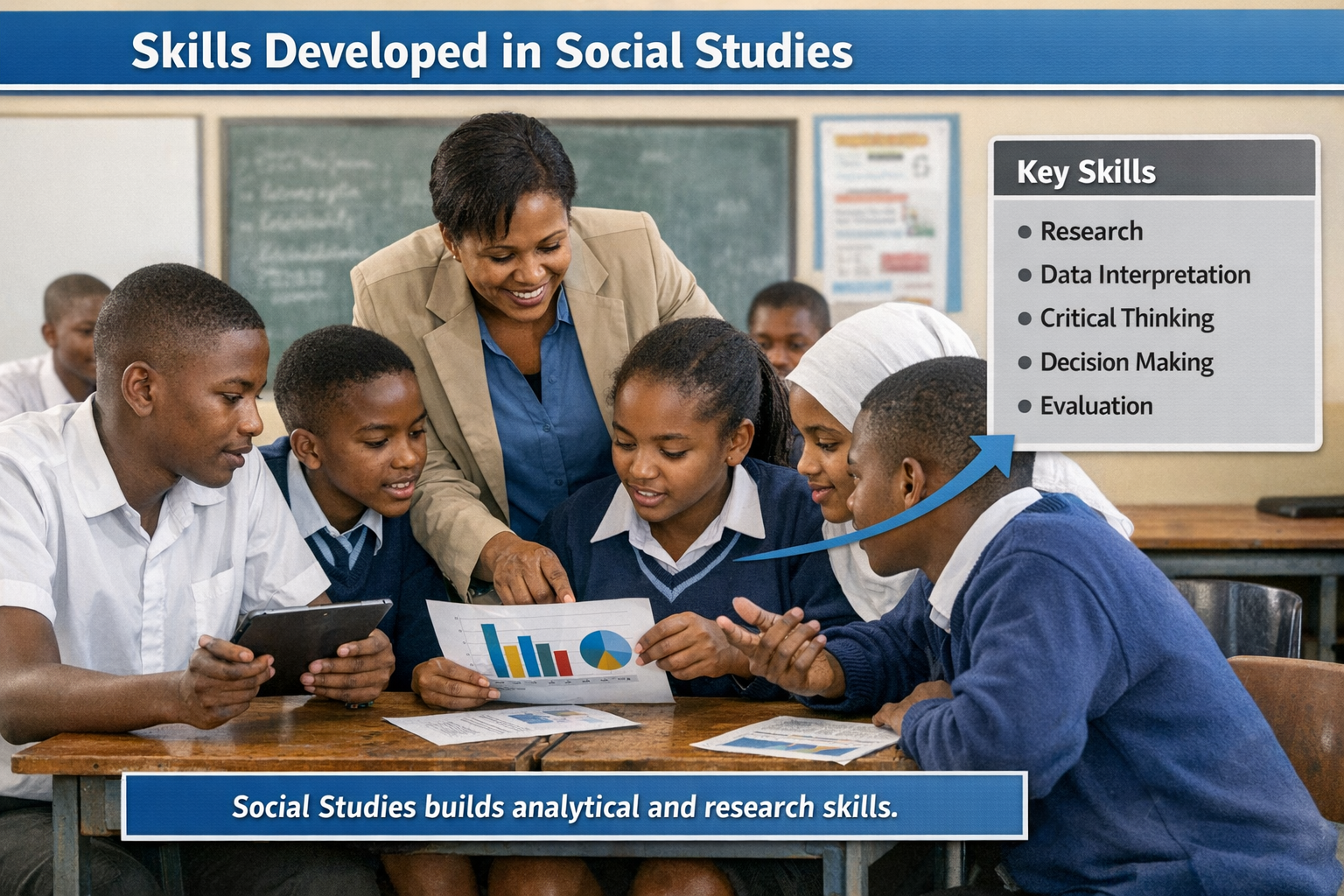
Social Studies develops important academic and practical skills, including:
Research skills
Data interpretation
Critical thinking
Decision-making
Evaluation
BGCSE examinations frequently test these skills through:
Graph interpretation
Survey analysis
“Assess” and “Evaluate” questions
Social Studies promotes important national and social values such as:
Justice
Equality
Tolerance
Unity
Democracy
Environmental responsibility
These values support Botswana’s national development goals and Vision 2036.
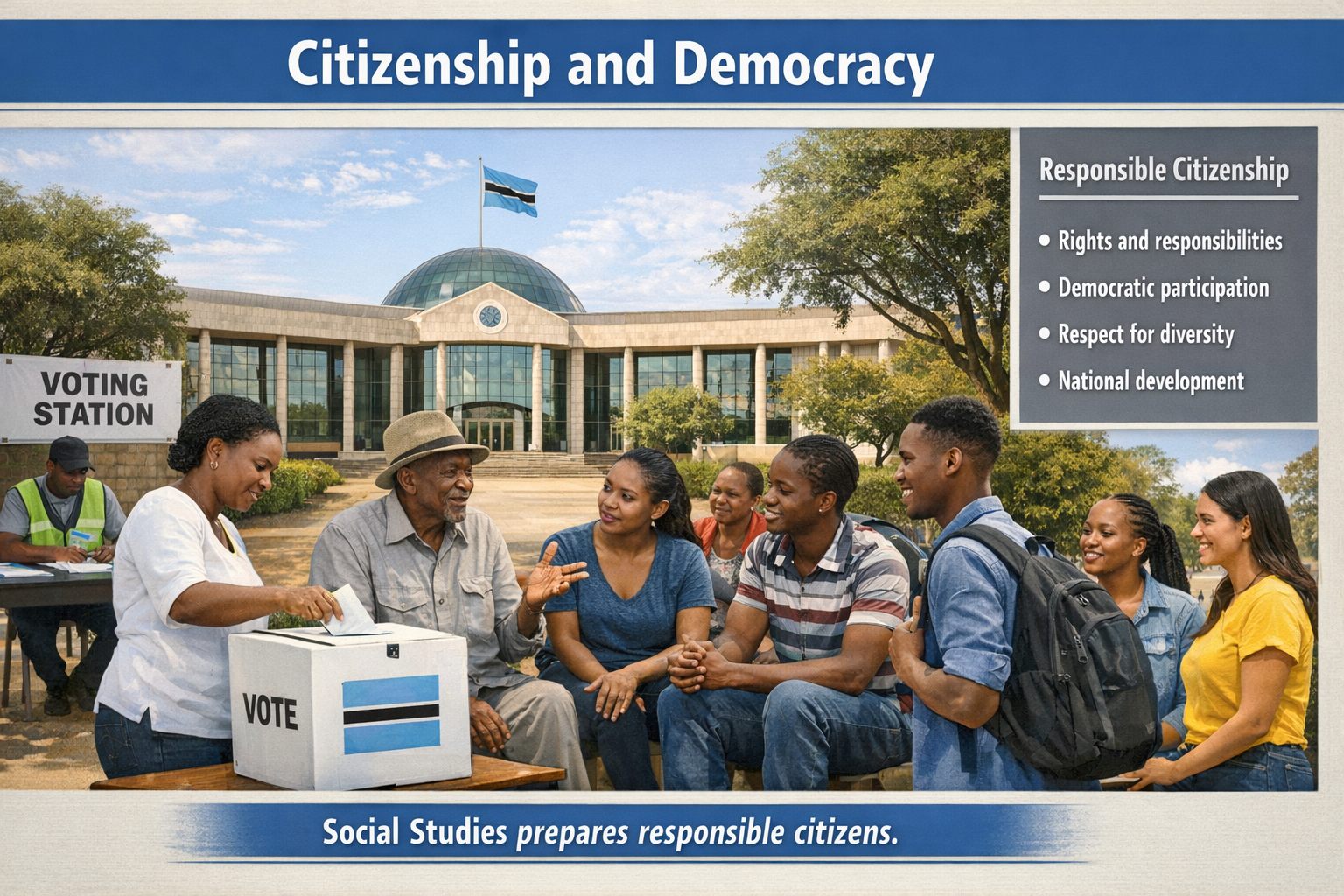
The main aim of Social Studies is to produce responsible citizens who:
Understand their rights and responsibilities
Participate in democratic processes
Respect diversity
Contribute to national development
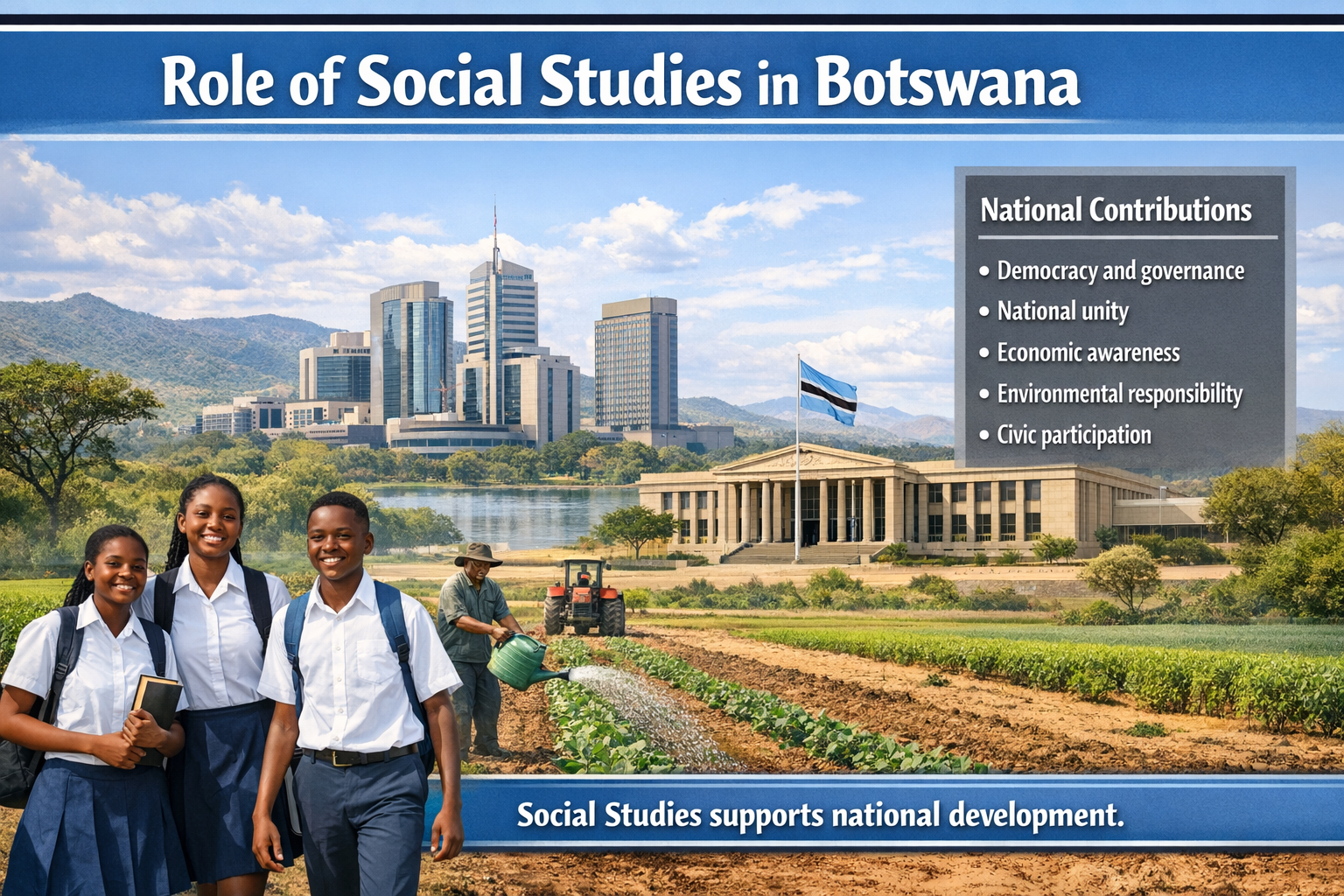
Social Studies plays a significant role in Botswana’s social, political and economic development.
Botswana is a constitutional democracy. Social Studies:
Teaches how government is formed
Explains citizens’ rights and responsibilities
Encourages informed voting
Promotes accountability
Botswana consists of diverse ethnic groups. Social Studies:
Encourages respect for cultural diversity
Promotes peaceful coexistence
Strengthens national identity
By studying:
Economic diversification
Entrepreneurship
Employment challenges
Global trade
Learners gain awareness of how economic systems function and how they can contribute to national growth.
Botswana faces environmental challenges such as:
Water scarcity
Desertification
Climate change
Social Studies builds awareness of sustainable resource management.
Learners acquire:
Questionnaire design skills
Data interpretation skills
Evidence-based reasoning
Structured academic writing skills
These skills are useful in tertiary education and employment.
To evaluate the significance of Social Studies, both strengths and limitations must be considered.
Strengthens democracy and civic responsibility
Encourages critical thinking
Promotes social cohesion
Supports sustainable development
Prepares learners for informed decision-making
May become theoretical if not applied practically
Limited resources in some schools
Overemphasis on memorisation instead of analysis
Limited fieldwork opportunities
Social Studies is highly significant in Botswana because it equips learners with civic awareness, analytical skills and developmental understanding necessary for national progress. However, its impact depends on effective teaching and practical application.
Interdisciplinary
Citizenship
Democracy
National development
Social issues
Critical thinking
Evaluation
Responsible citizenship
Learners must understand these terms and apply them in examination responses.

In Botswana, Social Studies:
Explains the First Past the Post electoral system.
Builds awareness about economic diversification beyond diamonds.
Promotes environmental sustainability in drought-prone areas.
Encourages unity in a multi-ethnic society.
Supports Vision 2036 development pillars.
When answering questions:
Give a clear and precise sentence.
State a point → explain how or why → link to Botswana context.
Present strengths → present limitations → conclude with balanced judgement.
Avoid:
One-sided answers
Vague general statements
Listing without explanation
Writing long introductions with little analysis
Social Studies:
Is an integrated and interdisciplinary subject
Focuses on solving real-life social problems
Develops analytical and research skills
Promotes citizenship and democratic participation
Plays a vital role in Botswana’s development

