
Course:
Social Studies – 0585

This topic introduces learners to research methods used in Social Studies. It explains the difference between quantitative and qualitative research, methods of collecting and presenting data, and how to design and conduct research.
This topic is critical for BGCSE because it forms the foundation of research-based assessment and Paper 3 skills. Learners must understand not only definitions, but also how to design instruments, analyse data and present structured findings.

Research is a systematic investigation carried out to gather information, analyse data and draw conclusions about a particular issue or problem.
Understand social problems
Make evidence-based conclusions
Suggest informed solutions
Planned
Objective
Ethical
Accurate
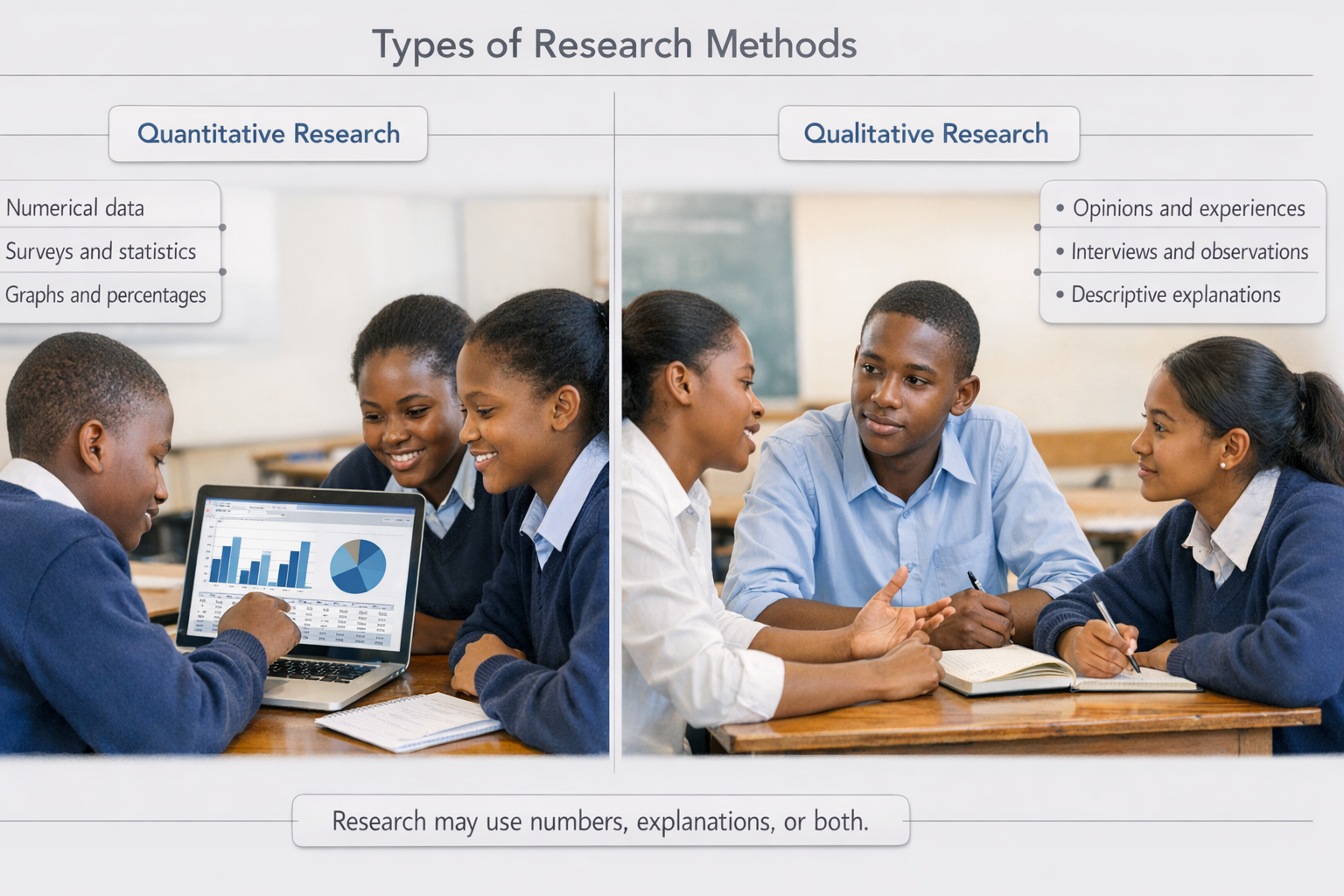
There are two main types of research methods:
Quantitative research involves collecting numerical data that can be measured and analysed statistically.
Surveys with closed questions
Census data
Statistical records
Structured questionnaires
Produces numbers and percentages
Can be presented using graphs and charts
Allows comparison between groups
Investigating unemployment rates in Gaborone using survey percentages.
Qualitative research involves collecting descriptive, non-numerical data that explains opinions, experiences and behaviours.
Interviews
Focus group discussions
Observations
Open-ended questionnaires
Produces detailed explanations
Provides deeper understanding
Explains “why” and “how”
Interviewing youth about reasons for unemployment.
Easy to analyse
Allows generalisation
Suitable for large samples
Objective and structured
Limited depth of explanation
May ignore personal experiences
Rigid response options
Provides detailed information
Explains attitudes and behaviour
Flexible and adaptable
Time-consuming
Difficult to analyse statistically
May be subjective
Balanced research often combines both methods.
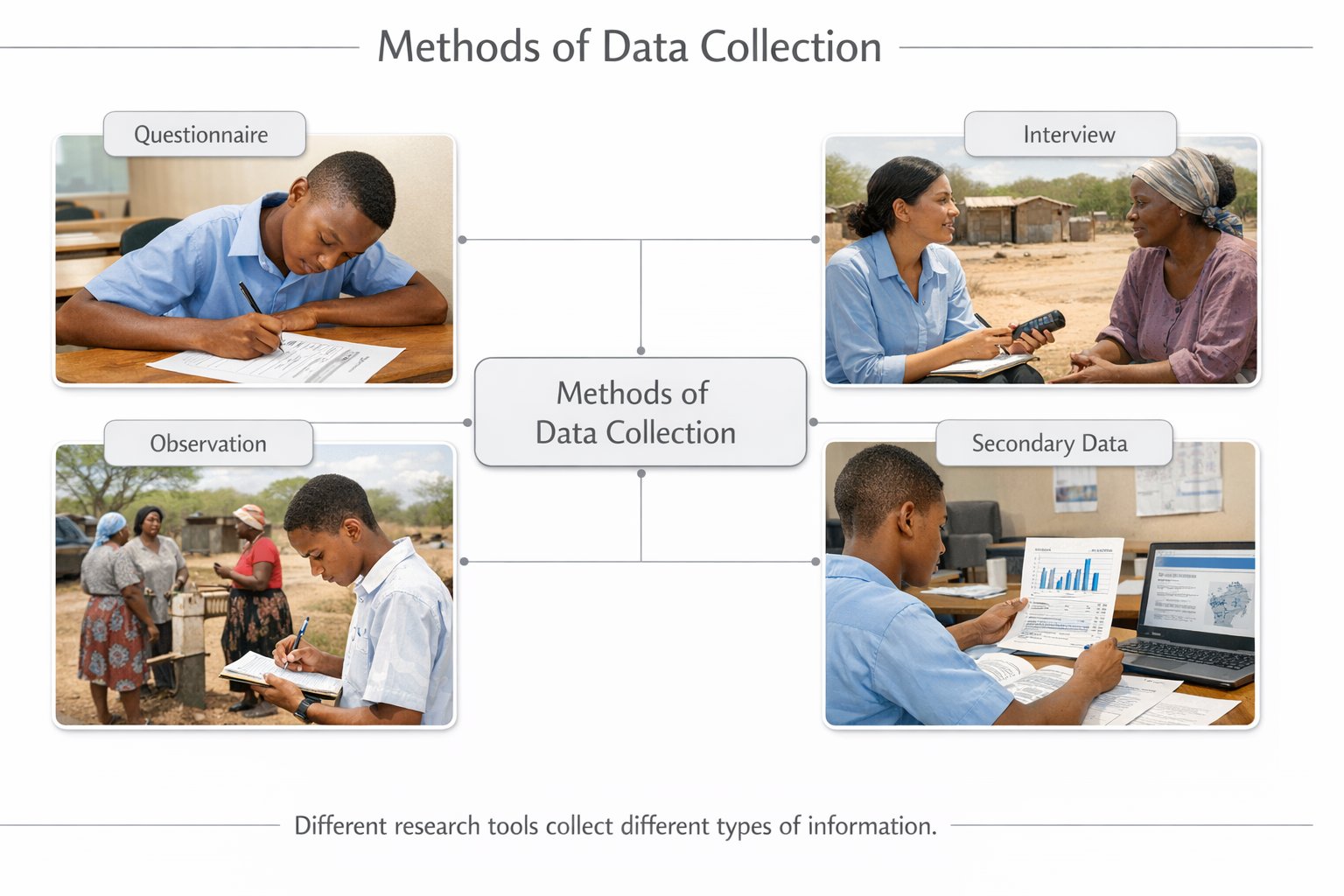
Data can be collected in several ways:
Written set of questions answered by respondents.
Closed-ended (Yes/No, multiple choice)
Open-ended (opinions, explanations)
Cost-effective
Suitable for large groups
Low response rate
Misinterpretation of questions
Direct verbal questioning of respondents.
Structured interviews
Semi-structured interviews
Unstructured interviews
Detailed responses
Clarification possible
Time-consuming
Interviewer bias
Watching and recording behaviour or events.
Real-life behaviour recorded
Useful where participants cannot explain themselves
Observer bias
Ethical concerns
Information already collected by others, such as:
Government reports
Census data
Newspapers
Academic publications
Saves time
Wide coverage
May be outdated
May not fit research purpose exactly

After collecting data, it must be presented clearly.
Tables
Bar graphs
Pie charts
Line graphs
Histograms
Written summaries
Type of data
Audience
Research objective
Quantitative data is best shown using graphs and charts.
Qualitative data is often summarised in paragraphs or thematic categories.
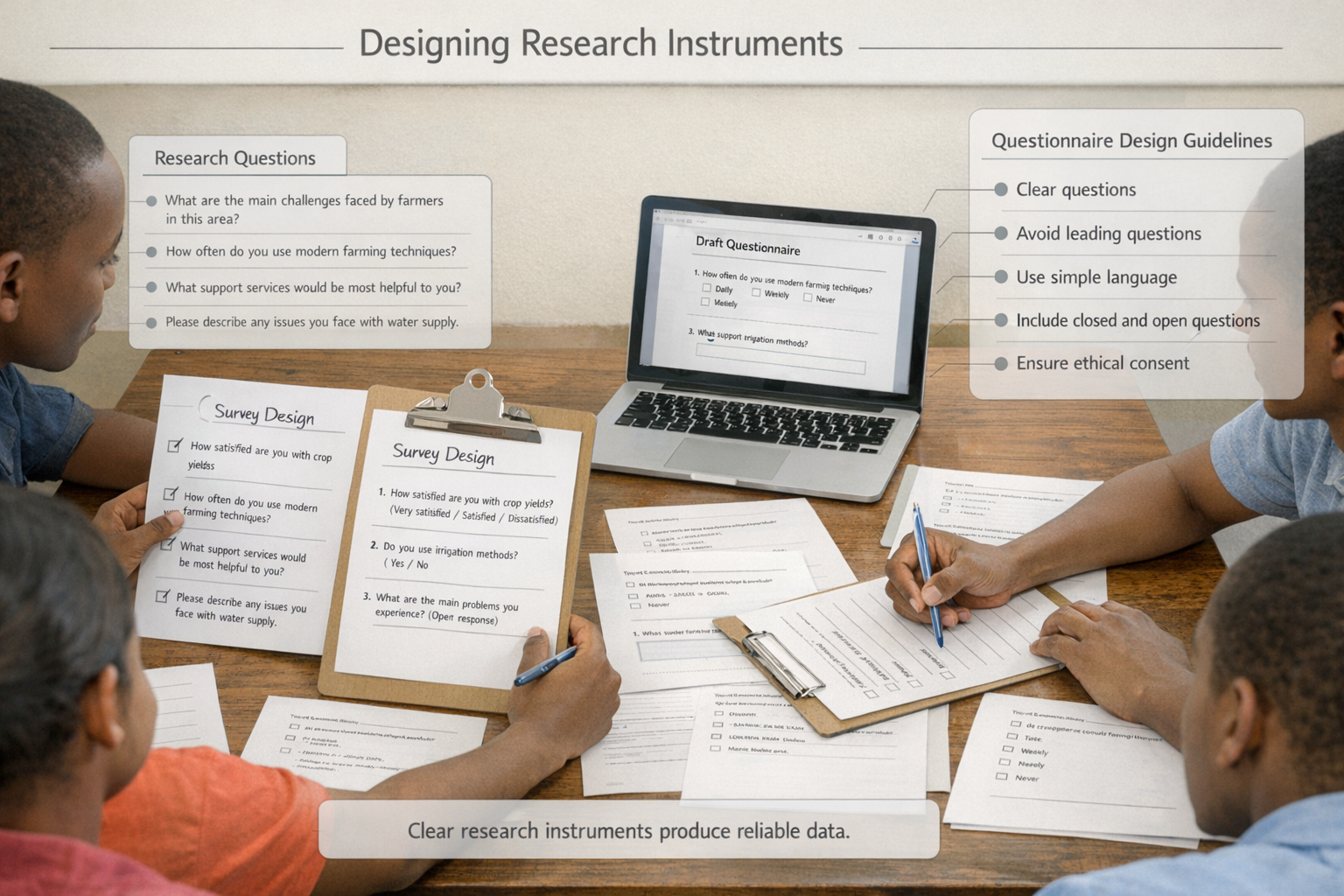
A research instrument is a tool used to collect data.
Questionnaire
Interview schedule
Observation checklist
Define the research topic clearly.
Ensure questions are clear and simple.
Avoid leading questions.
Include both closed and open questions where appropriate.
Ensure ethical considerations (consent and confidentiality).
Poorly designed instruments produce unreliable data.
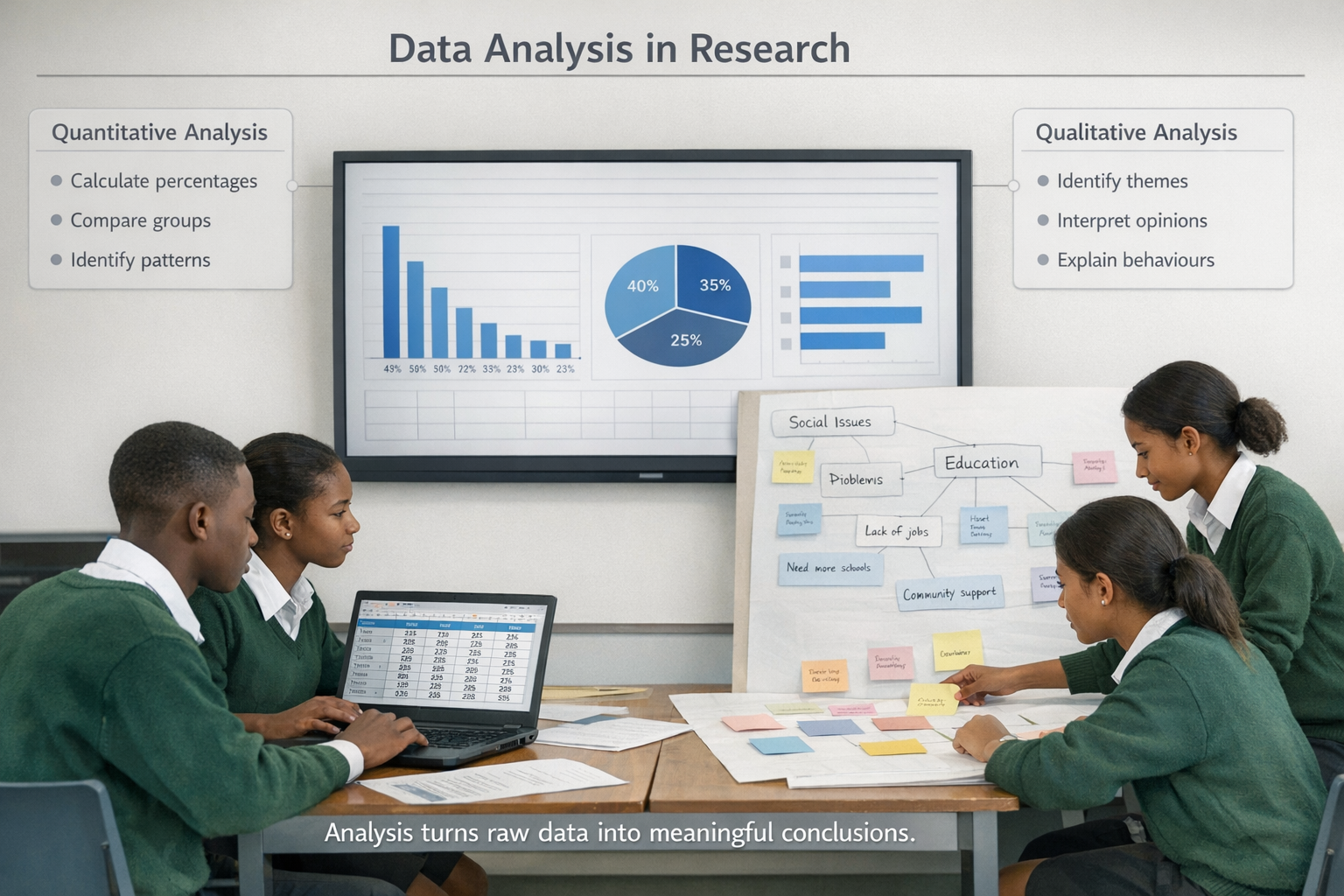
Identify target population.
Select sample.
Administer instrument.
Record responses accurately.
Calculate percentages
Identify patterns
Compare groups
Group responses into themes
Identify common opinions
Interpret meanings
Be objective
Be linked to research question
Use evidence from data

Research findings must be presented in a structured written report.
Title
Introduction (purpose of study)
Methodology (how data was collected)
Findings (results shown using tables/graphs)
Analysis (interpretation of results)
Conclusion (summary of findings)
Recommendations (suggested solutions)
Clarity and logical structure are essential.
Quantitative research
Qualitative research
Primary data
Secondary data
Questionnaire
Interview
Observation
Data analysis
Research instrument
Sample
Population
Learners must be able to define and apply these terms.
Study youth unemployment
Investigate school dropout rates
Analyse water shortages
Study rural-urban migration
Evaluate poverty eradication programmes
Government institutions such as Statistics Botswana rely heavily on quantitative and qualitative research for national planning.
For “Identify” questions:
List clearly without explanation.
For “Explain” questions:
State the method → explain how it works → give example.
For “Assess” questions:
Provide strengths → provide weaknesses → conclude with balanced judgement.
Confusing quantitative and qualitative methods
Listing without explanation
Not linking analysis to research question
Poorly structured research reports
Is systematic and planned
Uses quantitative and qualitative methods
Collects data through questionnaires, interviews, observation and secondary sources
Presents data using tables, graphs and written analysis
Requires structured reporting
Supports evidence-based decision-making

