
Course:
Business Studies – 0615


This topic examines the different ways in which countries organise their economies. It explains how resources are allocated in planned, free market and mixed economic systems. It also evaluates the advantages and disadvantages of each system. Understanding economic systems helps explain government involvement in business and decision-making in Botswana.
Economic system
Resource allocation
Free market economy
Planned economy
Mixed economy
Private sector
Public sector
Government intervention
Profit motive
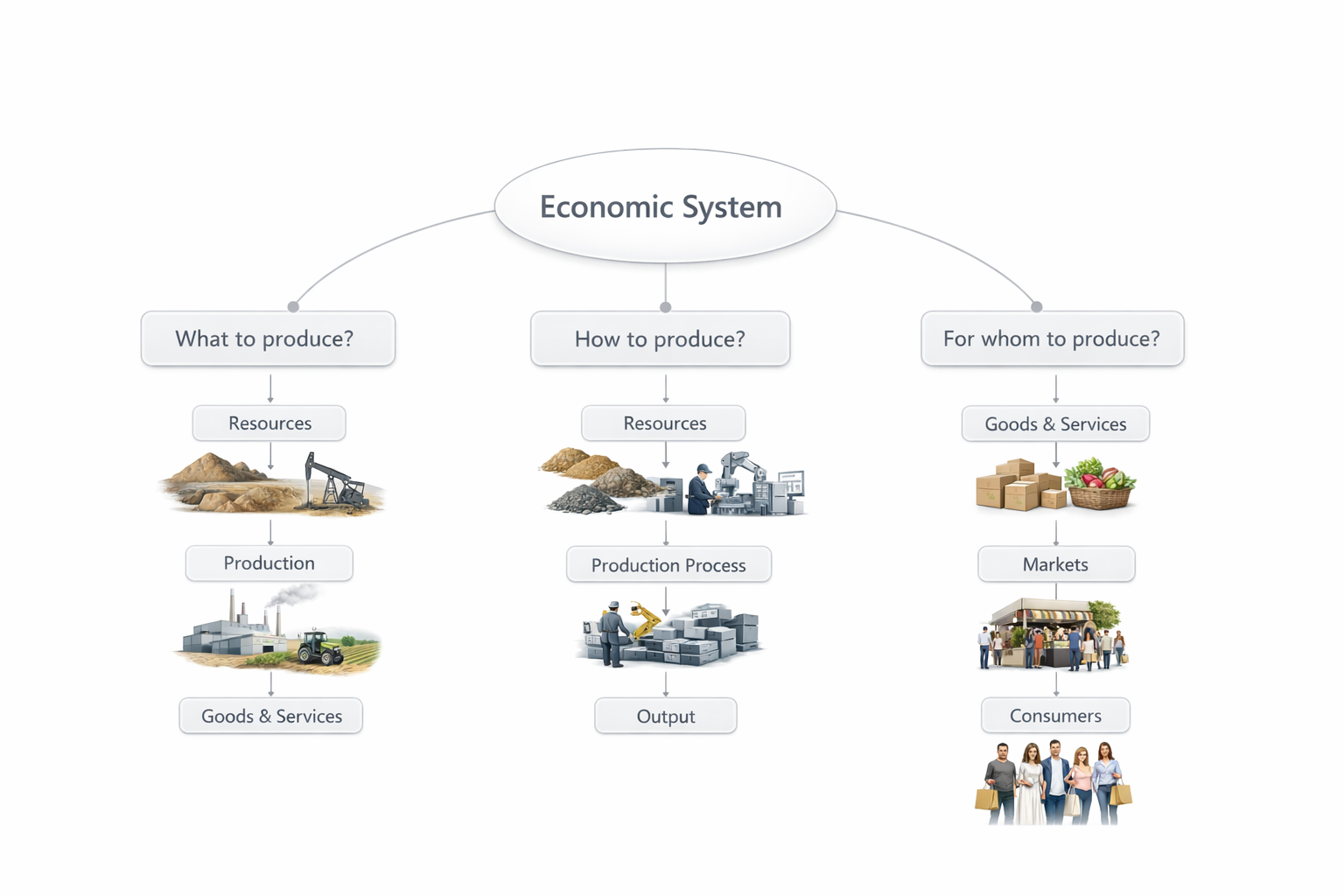
An economic system is the method used by a country to decide:
What to produce
How to produce
For whom to produce
These are known as the basic economic questions.
Different systems answer these questions differently.
A free market economy (also called a capitalist economy) is an economic system where:
Resources are privately owned.
Businesses operate to make profit.
Prices are determined by demand and supply.
Government intervention is minimal.
Production decisions are guided by consumer demand.
Consumers decide what is demanded.
Businesses produce what is profitable.
Competition regulates prices.
Encourages efficiency and competition.
Promotes innovation and entrepreneurship.
Wide variety of goods and services.
Consumers have freedom of choice.
Income inequality.
Essential services may be underprovided (e.g. healthcare).
Risk of monopolies.
Economic instability (inflation, unemployment).
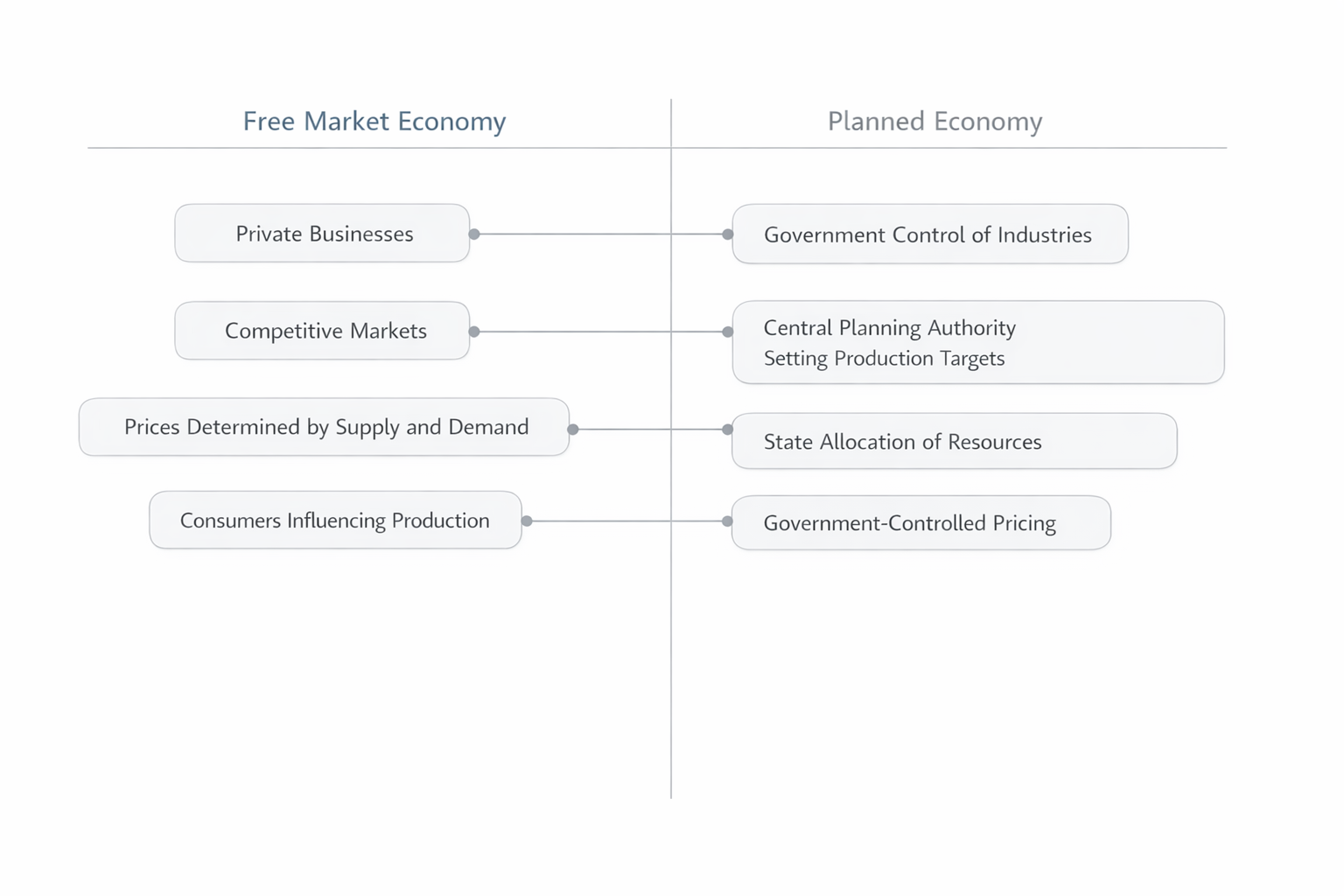
A planned economy (also called a command economy) is an economic system where:
The government owns most resources.
The state makes production decisions.
Prices are controlled by the government.
Profit is not the main motive.
The government decides what and how much to produce.
Central planning authority sets production targets.
Workers are allocated jobs by the state.
Goods are distributed according to government plans.
Reduced income inequality.
Basic needs may be guaranteed.
Better long-term planning.
Reduced unemployment (state employment).
Lack of competition reduces efficiency.
Limited consumer choice.
Shortages and surpluses may occur.
Low motivation due to lack of profit incentive.
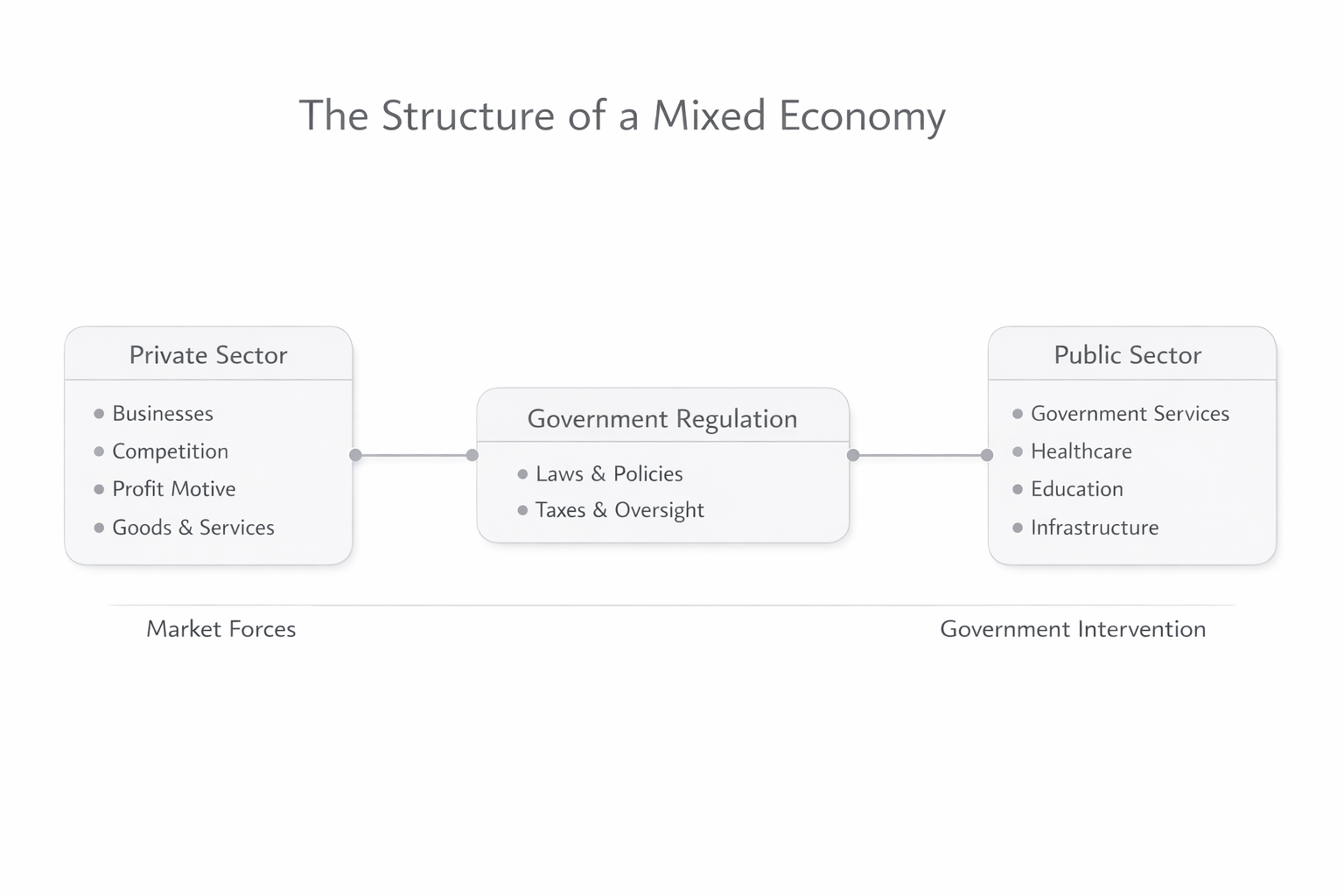
A mixed economy combines features of both free market and planned systems.
Private sector and public sector coexist.
Government regulates businesses.
Some industries are state-owned.
Market forces operate alongside government control.
Most modern economies, including Botswana, operate as mixed economies.
Private businesses operate for profit.
Government provides essential services (health, education, defence).
Regulations ensure consumer protection and fair competition.
Balances efficiency and social welfare.
Government can correct market failures.
Provides public goods and services.
Encourages economic stability.
Government intervention may reduce efficiency.
Risk of bureaucracy and corruption.
Higher taxes to fund public services.
Conflict between public and private interests.
Botswana operates a mixed economy:
Mining sector largely private but regulated.
Government owns key institutions (e.g. utilities).
Private businesses operate freely but within regulations.
Social services funded by government.
The system allows economic diversification while ensuring social stability.
No economic system is perfect.
Free market economies promote efficiency but may increase inequality.
Planned economies promote equality but reduce innovation.
Mixed economies attempt to combine the strengths of both systems, but require strong governance to function effectively.
The effectiveness of any system depends on leadership, transparency and economic management.
Define the system clearly.
Explain how it operates.
Provide at least two advantages and disadvantages.
If asked to compare, use structured contrasts.
Apply to Botswana if evaluation is required.
Confusing planned economy with mixed economy.
Stating advantages without explanation.
Ignoring disadvantages.
Forgetting to explain how prices are determined.
Failing to link to government involvement.