
Course:
Business Studies – 0615


This topic explains how production can be organised through specialisation and division of labour. It examines the meaning of both concepts, their advantages and disadvantages, and the different levels at which specialisation occurs. These concepts are important in understanding productivity, efficiency and economic development.
Specialisation
Division of labour
Productivity
Efficiency
Interdependence
Individual specialisation
Regional specialisation
National specialisation
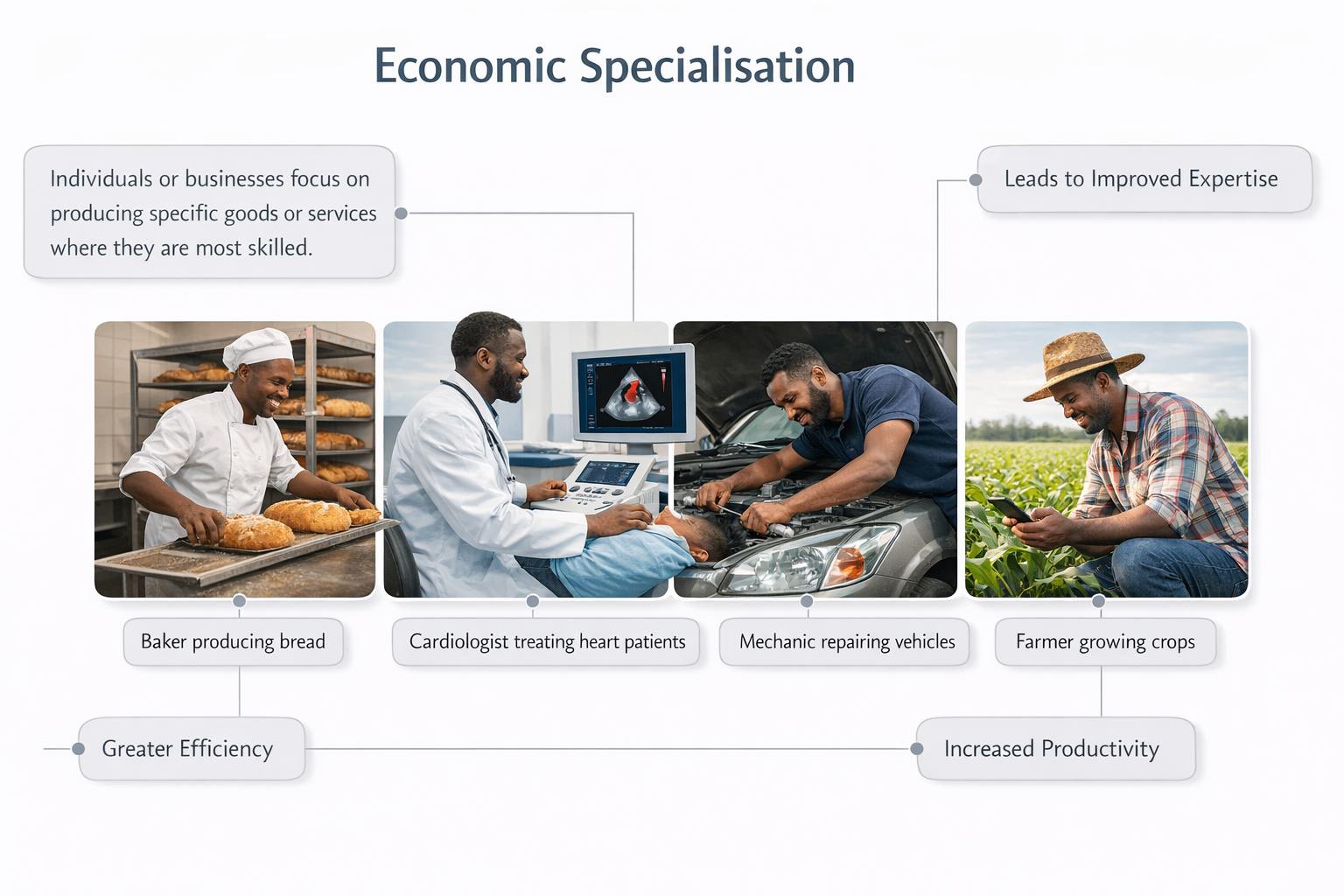
Specialisation occurs when individuals, businesses, regions or countries concentrate on producing a limited range of goods or services.
It involves focusing on what one does best.
Specialisation improves expertise and efficiency.
A bakery specialises in producing bread instead of producing bread, furniture and clothing.
A doctor specialises in cardiology instead of practising general medicine.
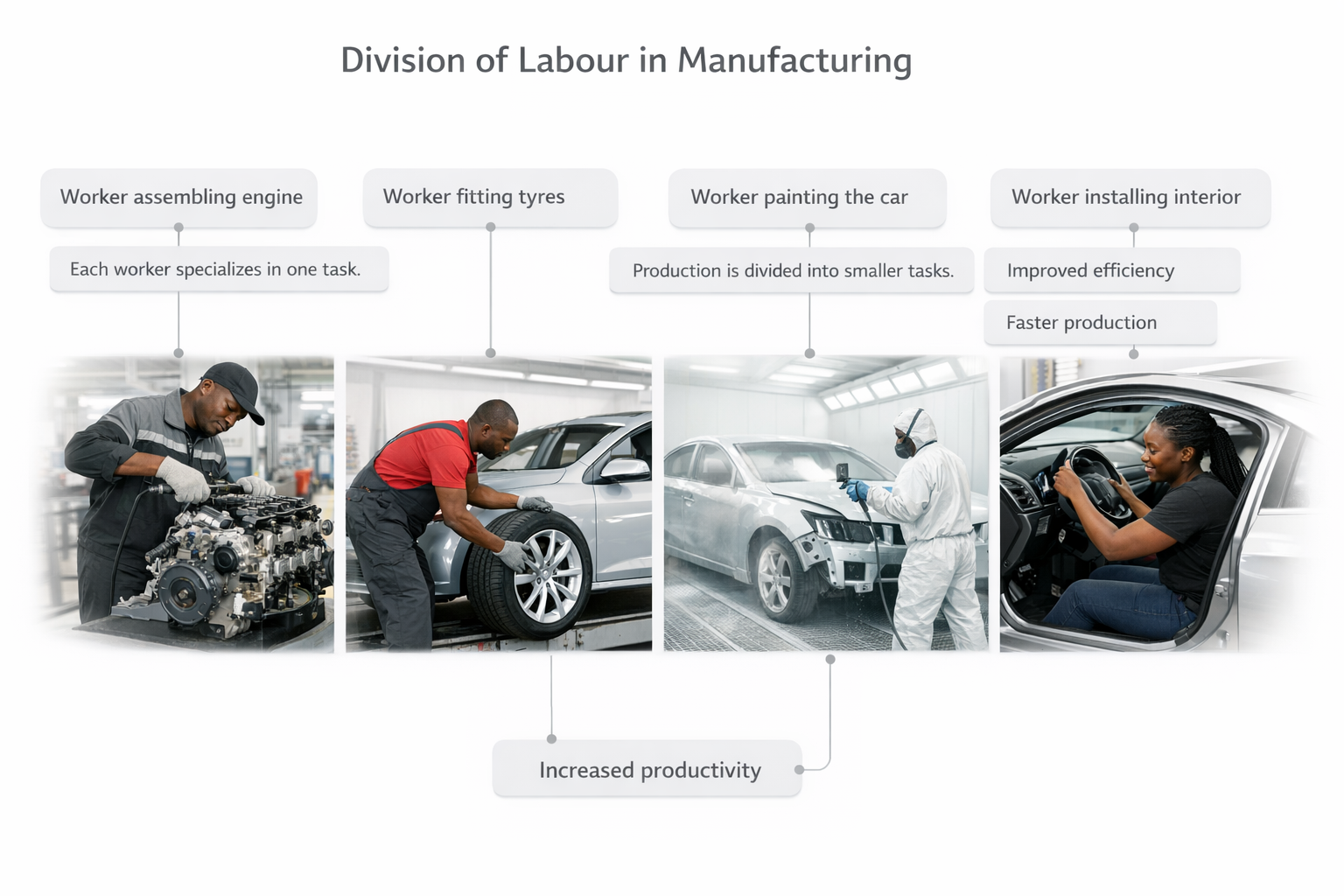
Division of labour refers to breaking down production into small tasks, with each worker performing a specific task repeatedly.
It is common in manufacturing industries.
In a car manufacturing plant:
One worker fits tyres.
Another installs engines.
Another paints the car.
Each worker focuses on one specific task.
Division of labour is a form of specialisation within a production process.
Workers become highly skilled at one task, increasing output.
Less time is wasted switching between tasks.
Workers gain expertise in their specific roles.
Higher productivity reduces cost per unit.
Specialists develop better techniques and methods.
Repetitive tasks reduce job satisfaction.
Workers may struggle to perform other tasks.
If one worker stops working, production may halt.
Highly specialised workers may struggle if demand changes.
Reduced motivation may affect productivity.
Specialisation can occur at three main levels:
Occurs when a person focuses on one occupation or skill.
Teachers specialise in education.
Mechanics specialise in vehicle repair.
Lawyers specialise in legal services.
This increases personal productivity and expertise.
Occurs when a particular region focuses on producing certain goods or services due to resource availability.
Orapa specialises in diamond mining.
The Okavango Delta specialises in tourism.
Southern districts specialise in cattle farming.
Climate
Natural resources
Skills
Infrastructure
Occurs when a country specialises in producing goods or services in which it has a comparative advantage.
Botswana specialises in diamond production.
Saudi Arabia specialises in oil production.
Japan specialises in automobile manufacturing.
National specialisation promotes international trade.
Specialisation leads to interdependence.
Countries, regions and individuals rely on others for goods they do not produce.
Trade
Economic growth
Globalisation
However, overdependence on one product (e.g. diamonds) can create economic vulnerability.
Botswana’s economy heavily specialises in diamond mining.
High export earnings.
Foreign exchange income.
Economic vulnerability to global diamond prices.
Limited diversification.
This highlights the need for economic diversification.
Specialisation increases efficiency and economic growth.
It may increase inequality.
It may create dependency.
It reduces flexibility in changing economic conditions.
Balanced diversification is necessary for long-term sustainability.
Define both terms clearly.
Explain the difference between specialisation and division of labour.
Provide at least two advantages and disadvantages.
If asked about levels, explain each level clearly with examples.
Use Botswana examples where possible.
Confusing division of labour with specialisation (division of labour is a type of specialisation).
Listing advantages without explanation.
Ignoring disadvantages.
Failing to mention different levels of specialisation.
Not linking specialisation to productivity.