
Course:
Religious Education – 0588

This lesson examines the dimensions of religion as identified by Ninian Smart. It compares Oriental and Judeo-Christian religions, analyses common features of African Traditional Religion (ATR) and Hinduism, evaluates how ethical teachings promote social harmony, and discusses distinctive features of Buddhism and the Baha’i Faith.
Dimensions of religion
Doctrinal
Mythological
Ethical
Ritual
Experiential
Social
Material
Monotheism
Polytheism
Reincarnation
Salvation
Enlightenment
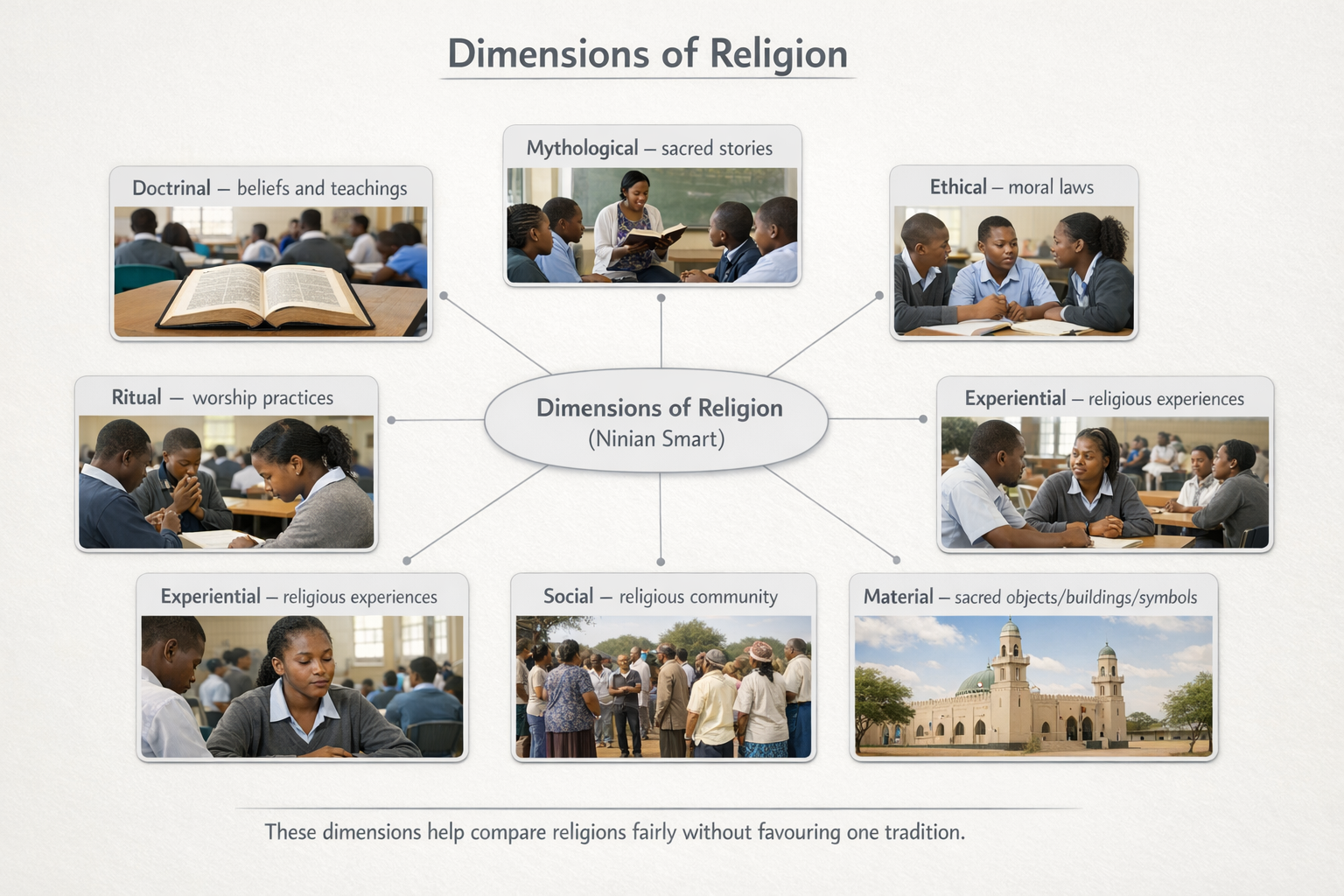
Doctrinal Dimension – Beliefs and teachings
Mythological Dimension – Sacred stories
Ethical Dimension – Moral laws
Ritual Dimension – Worship practices
Experiential Dimension – Religious experiences
Social Dimension – Religious community
Material Dimension – Sacred objects, buildings and symbols
These dimensions help compare religions without favouring one tradition.

Examples: Hinduism, Buddhism
Often believe in reincarnation
Cyclical view of time
Focus on enlightenment or liberation
May include multiple gods (polytheism)
Emphasis on meditation
Examples: Judaism, Christianity
Monotheistic (one God)
Linear view of history (creation → judgement)
Emphasis on salvation
Strong prophetic tradition
Sacred scriptures central (Bible, Torah)
Both have ethical systems, rituals, sacred texts and communities.
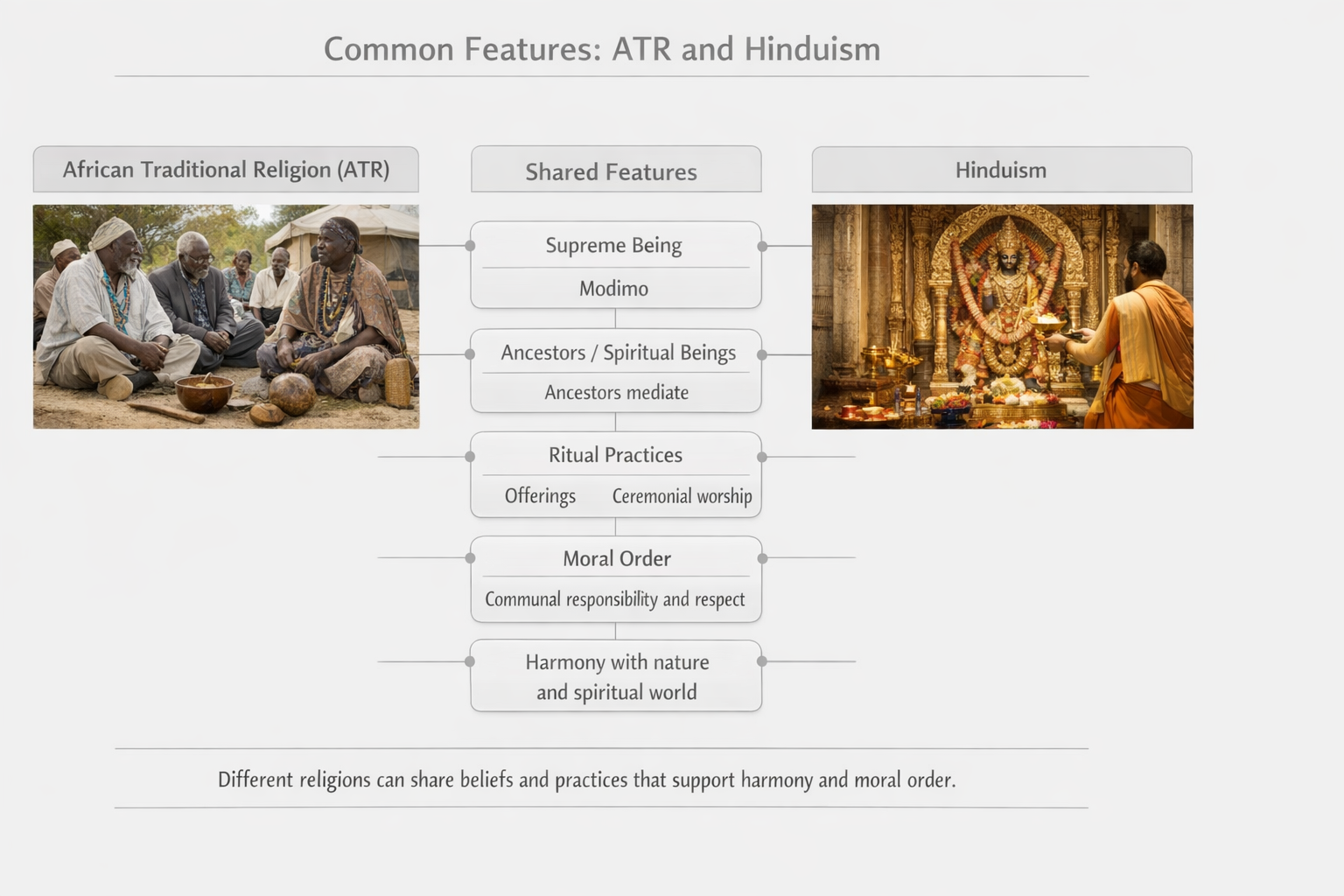
Although different geographically, ATR and Hinduism share some similarities.
ATR – Modimo
Hinduism – Brahman
ATR – Ancestors mediate between God and people
Hinduism – Reverence for ancestors and spiritual beings
Offerings
Sacrifices
Ceremonial worship
ATR – Oral tradition
Hinduism – Sacred texts but strong ritual tradition
ATR – Respect for community and elders
Hinduism – Dharma (moral duty)
Both emphasise harmony between human beings, nature and the spiritual world.

The ethical dimension refers to moral teachings within religion.
Christianity – Ten Commandments
Islam – Sharia principles
Hinduism – Dharma
ATR – Respect and communal responsibility
Promote honesty
Encourage forgiveness
Reduce crime
Strengthen families
Promote justice
Ethical behaviour promotes social stability and cooperation.
Encourage peaceful coexistence
Promote human dignity
Influence legal systems
Ethical interpretations may differ
Some moral codes may create social debate
Overall, ethical teachings enhance social harmony when applied inclusively.
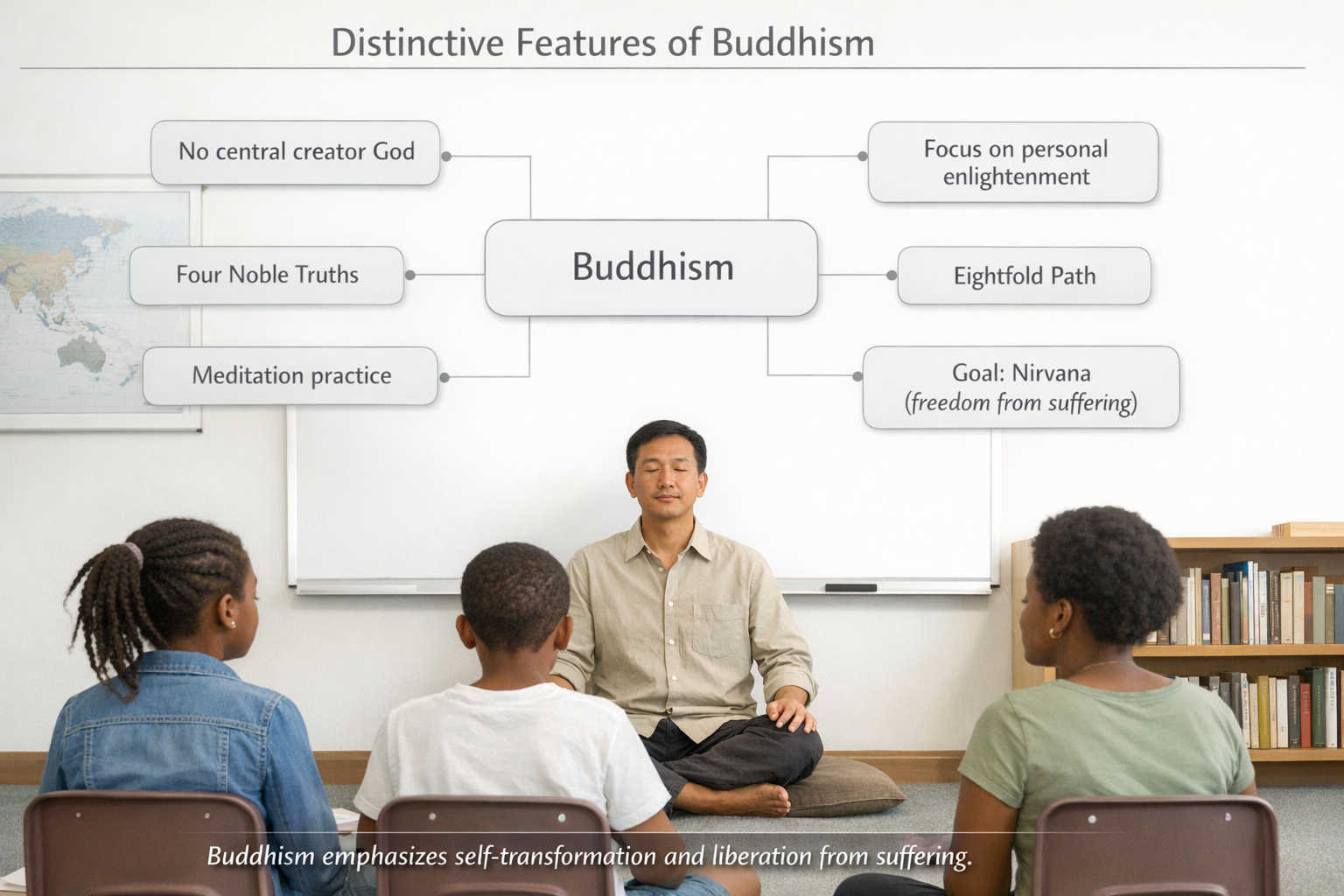
No central creator God
Focus on personal enlightenment
Four Noble Truths
Eightfold Path
Emphasis on meditation
Goal: Nirvana (freedom from suffering)
Buddhism focuses more on self-transformation than divine worship.

Unity of all religions
Unity of humanity
Equality of men and women
Global peace
Progressive revelation
Recognises founders of major religions as messengers of God
Strong emphasis on global unity
Administrative order without clergy
The Baha’i Faith promotes universalism.
Dimensions allow fair comparison between religions.
Concept of God
View of time
Understanding of salvation
Have moral teachings
Provide community structure
Influence social behaviour
Ethical dimensions are central to social harmony.
Non-theistic emphasis (Buddhism)
Universal unity (Baha’i Faith)
Religions vary in doctrine but share structural similarities.
Compare religions – use structured comparison (similarities and differences).
Examine common features – identify at least three shared characteristics and explain.
Discuss ethical dimension – link moral teachings to social harmony.
Explain distinctive features – clearly state what makes the religion unique.
Avoid listing without explanation.
Confusing Oriental with African religions
Ignoring Smart’s dimensions
Listing differences without comparison
Failing to link ethics to social harmony
Giving vague definitions
State two dimensions of religion identified by Ninian Smart.
Name one similarity between ATR and Hinduism.
Explain how ethical teachings promote social harmony.
Compare two differences between Oriental and Judeo-Christian religions.
“Despite doctrinal differences, religions share common structural dimensions.”
Discuss this statement.
Refer to Smart’s dimensions accurately
Use direct comparison language
Show understanding of doctrinal differences
Link ethical dimension to societal impact
Provide balanced evaluation
Higher-level responses demonstrate structured comparison and critical reasoning.

