
Course:
Religious Education – 0588

This lesson identifies religions found in Botswana and examines the socio-economic and political factors that led to the origins of Christianity, the Baha’i Faith, Sikhism and Islam. It also discusses reasons for the proliferation of religions in Botswana.
Origins of religion
Colonialism
Missionary activity
Migration
Trade
Globalisation
Religious freedom
Pluralism
Proliferation
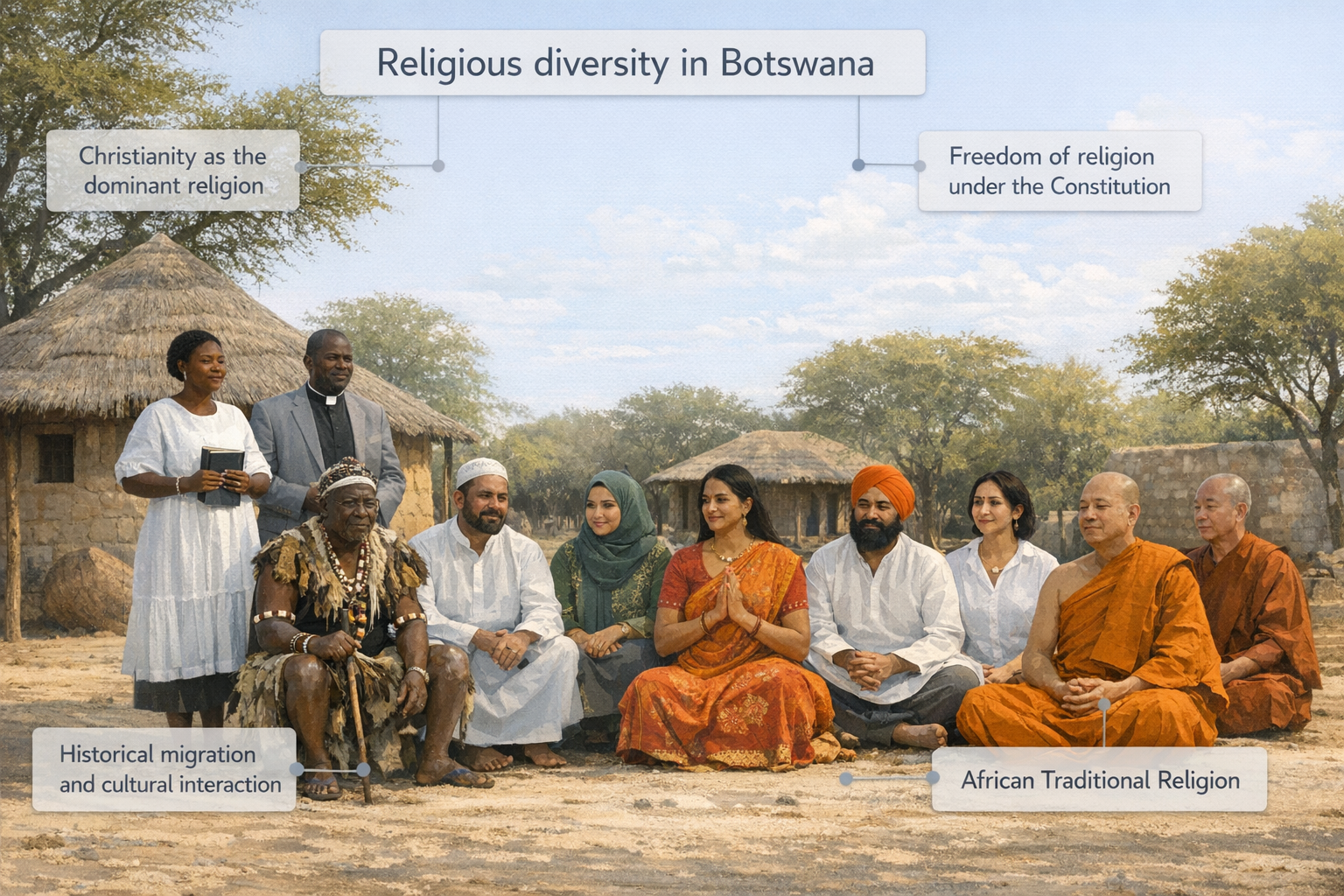
Christianity
African Traditional Religion (ATR)
Islam
Hinduism
Sikhism
Baha’i Faith
Buddhism
Christianity is the dominant religion, but Botswana recognises freedom of religion under its Constitution.
Religious diversity reflects historical migration, colonial influence and global interaction.
Christianity originated in the Middle East (1st century AD), based on the life and teachings of Jesus Christ.
European missionary activity
Colonial expansion
Trade routes
Establishment of mission schools
Western education
Literacy
Medical services
Christianity grew because it was linked with access to education and socio-economic advancement.
Colonial governments supported missionary activities. Christianity became closely associated with modernisation and formal governance systems.
Islam originated in the 7th century in Arabia through the Prophet Muhammad.
Trade networks
Migration from East Africa and Asia
Business communities
Muslim traders established commercial links that introduced Islamic practices.
Islam remains a minority religion in Botswana but is growing through migration and conversion.
Sikhism originated in 15th century India, founded by Guru Nanak.
Indian migration during colonial and post-colonial periods
Economic migration for business opportunities
Sikh communities established religious centres and maintained strong cultural identity.
The Baha’i Faith originated in 19th century Persia (Iran).
Founder: Baha’u’llah.
Missionary outreach
Global expansion efforts
Emphasis on unity and equality
Its teachings on global peace and unity appealed to multicultural societies.
Religious proliferation refers to the increase in number and diversity of religious groups.
Botswana guarantees freedom of worship.
Establishment of new churches
Registration of religious organisations
Public religious gatherings
Global media and migration expose people to new beliefs.
Internet
Television
International travel
Cultural interaction
Exposure to different beliefs
People may convert due to new influences.
Community support
Social services
Hope during hardship
Economic insecurity may encourage religious participation.
Influential leaders
Promise of prosperity
Healing ministries
Religious tolerance
Religious diversity
Interfaith cooperation
Some new religious movements raise concerns about regulation and accountability.
Religion remains dynamic in Botswana.
Migration
Trade
Political expansion
Socio-economic opportunity
Religious diversity reflects both historical colonial influence and modern globalisation.
Doctrinal conflicts
Competition among churches
Regulatory challenges
Religious pluralism requires tolerance and interfaith dialogue.
Identify religions – list clearly and accurately.
Explore origins – link religion to socio-economic and political factors.
Discuss proliferation – give multiple causes and explain each.
Evaluation answers must consider both benefits and challenges of religious diversity.
Avoid simple historical narration without analysis.
Confusing origin of religion with origin in Botswana
Ignoring socio-economic factors
Listing religions without explanation
Failing to link to Botswana context
Writing emotional personal views
Identify three religions found in Botswana.
State one socio-economic factor that influenced the spread of Christianity in Botswana.
Explain how migration contributed to the spread of Sikhism in Botswana.
Explain one reason for the proliferation of religions in Botswana.
“Religious diversity strengthens Botswana’s social development.”
Discuss this statement.
Distinguish between global origin and local spread
Mention specific socio-economic and political factors
Show understanding of constitutional religious freedom
Provide balanced discussion in evaluation questions
Higher-level answers demonstrate structured reasoning and Botswana-specific examples.


 Google