
Course:
Science Double Awards - 0569

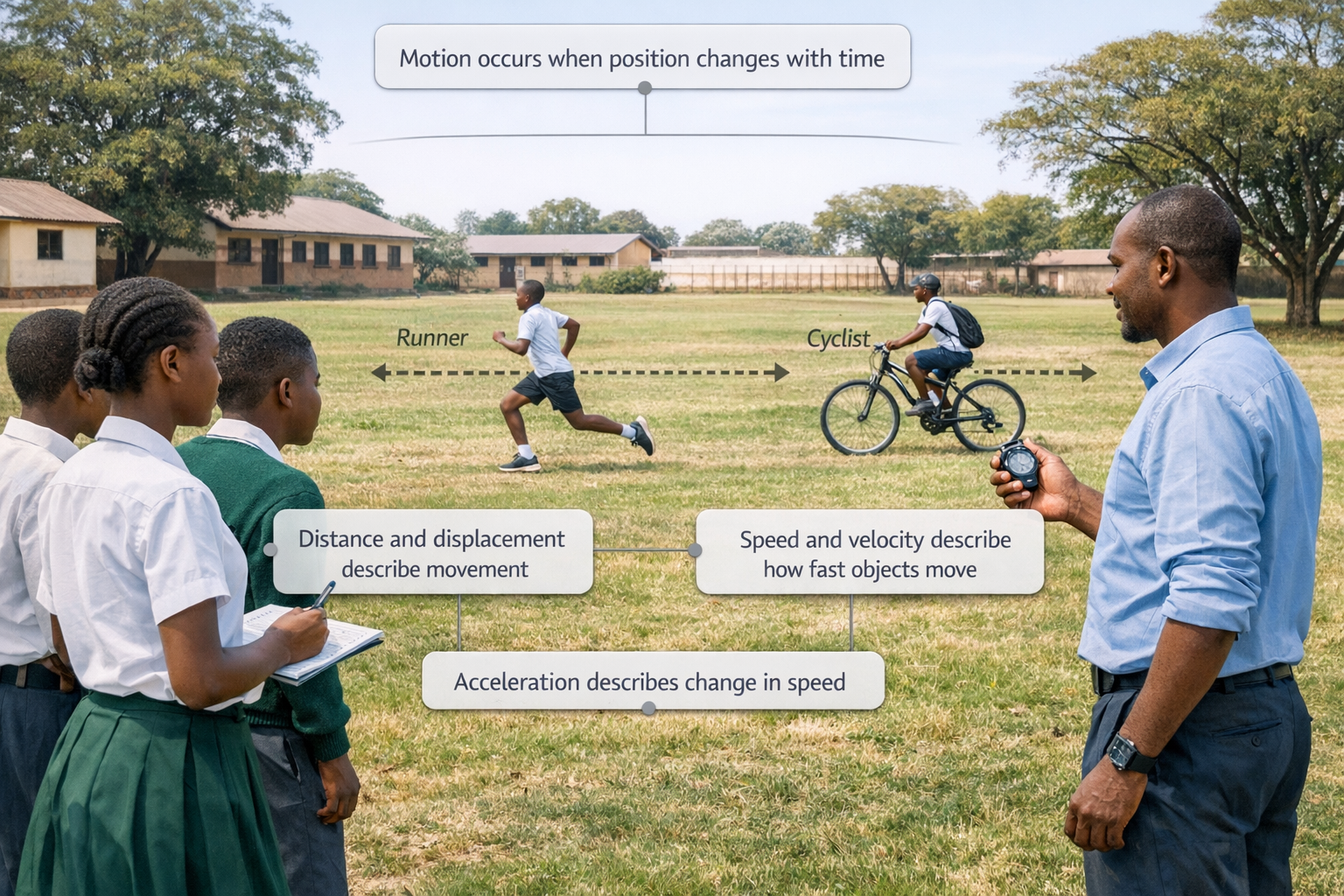
Motion occurs when an object changes its position with time. Scientists describe motion using quantities such as distance, displacement, speed, velocity and acceleration.
Objects may move with uniform motion, where speed remains constant, or non-uniform motion, where speed changes with time. Motion can be represented using speed-time graphs, which show how speed varies over time.
When objects fall towards Earth, they accelerate due to the force of gravity. This acceleration is known as acceleration due to gravity (g) and is approximately 9.8 m/s², often approximated as 10 m/s² in calculations.
When falling through air or liquids, objects eventually reach a constant speed called terminal velocity because the upward resistance force balances the downward gravitational force.
Distance
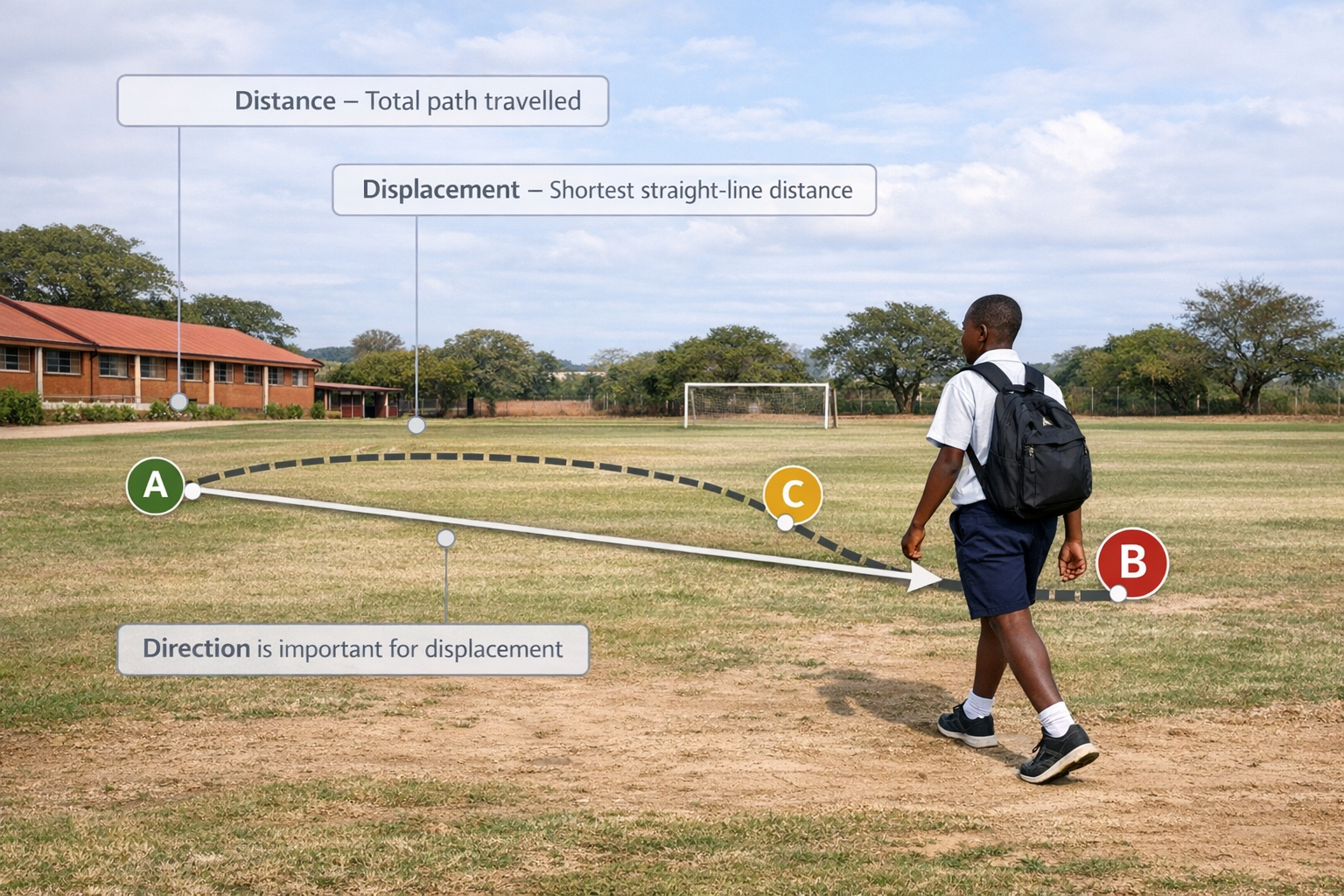
Distance is the total length of the path travelled by an object.
Example
A student walks 10 m forward and 5 m back.
Distance travelled = 15 m
Displacement
Displacement is the straight-line distance between the starting point and the final position, including direction.
Example
If a student walks 10 m forward and 5 m back:
Displacement = 5 m forward
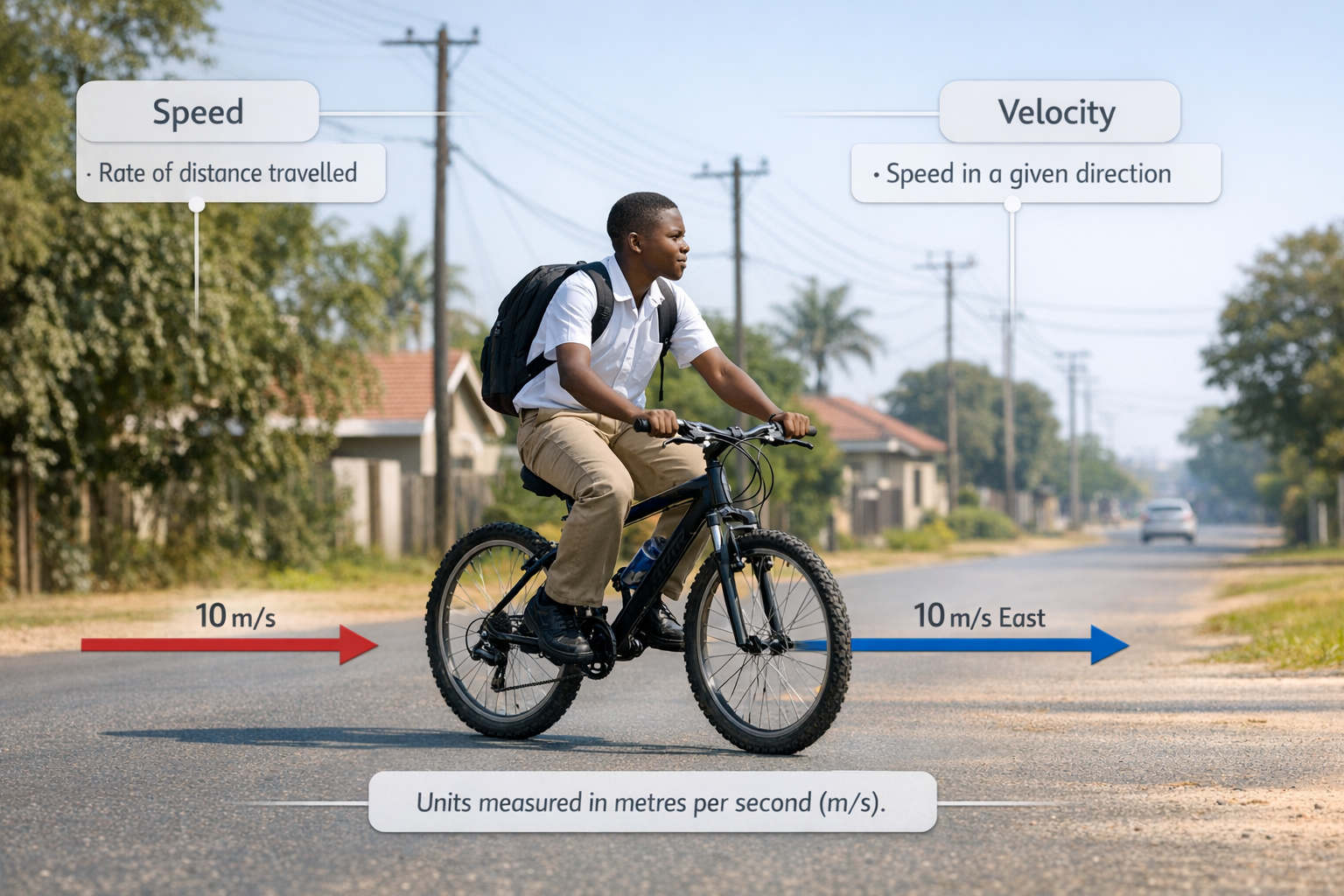
Speed is the rate at which distance is travelled.
Speed = Distance ÷ Time
Unit: m/s
Example
A car travels 100 m in 5 seconds.
Speed = 100 ÷ 5
Speed = 20 m/s
Velocity is speed in a given direction.
Example
A car moving 20 m/s north.
Acceleration is the rate of change of velocity.
Acceleration = Change in velocity ÷ Time
Unit: m/s²
Uniform motion occurs when an object moves at constant speed.
Example
A car travelling at 60 km/h on a straight road.
Non-uniform motion occurs when speed changes with time.
Example
A car accelerating or slowing down.
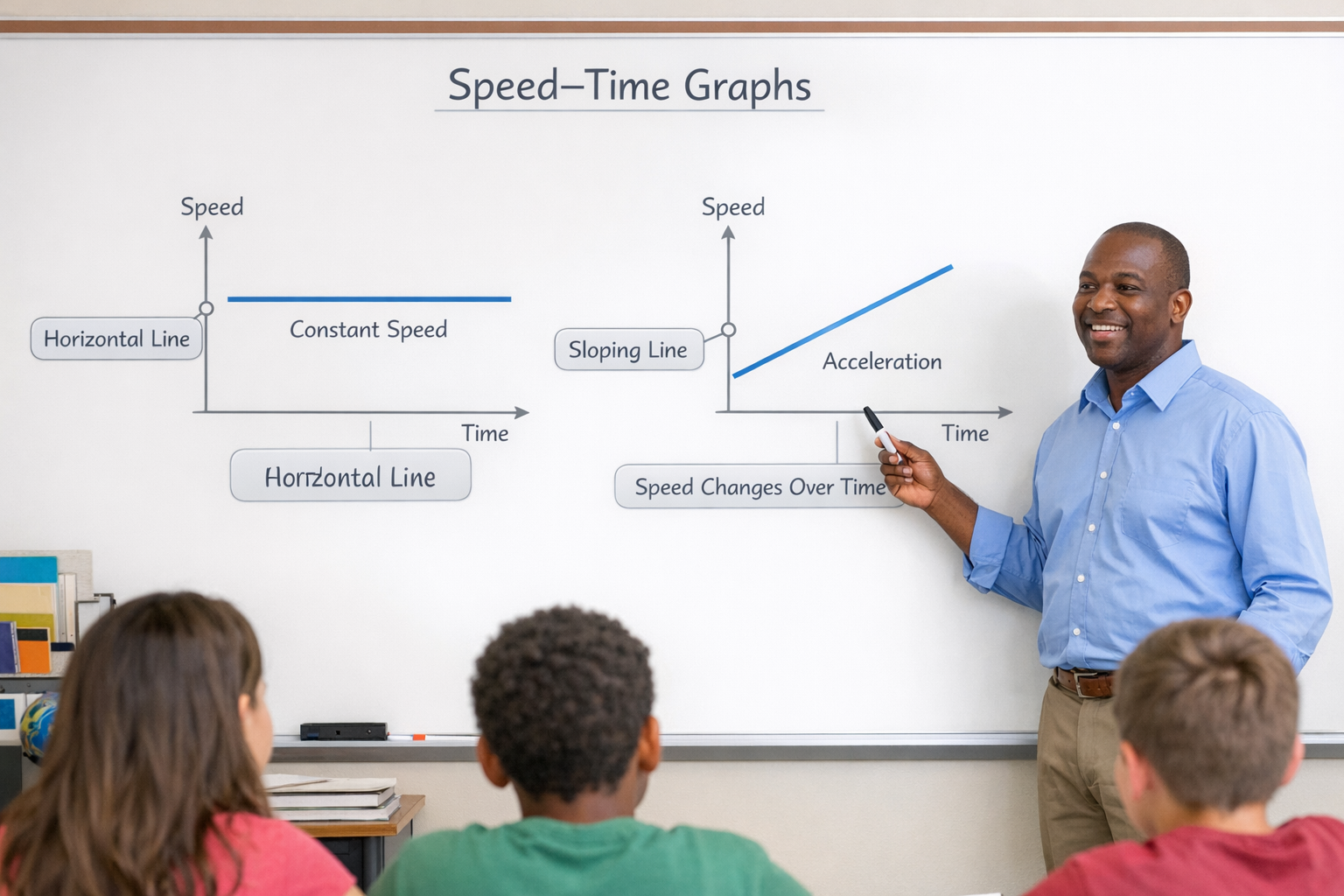
A horizontal straight line on a speed–time graph represents constant speed.
Characteristics:
• speed remains constant
• acceleration = 0
A sloping line on a speed–time graph indicates changing speed.
Characteristics:
• acceleration occurs
• speed increases or decreases
Three main equations are used in motion calculations.
v = u + at
s = ut + ½at²
v² = u² + 2as
Where:
v = final velocity
u = initial velocity
a = acceleration
t = time
s = displacement
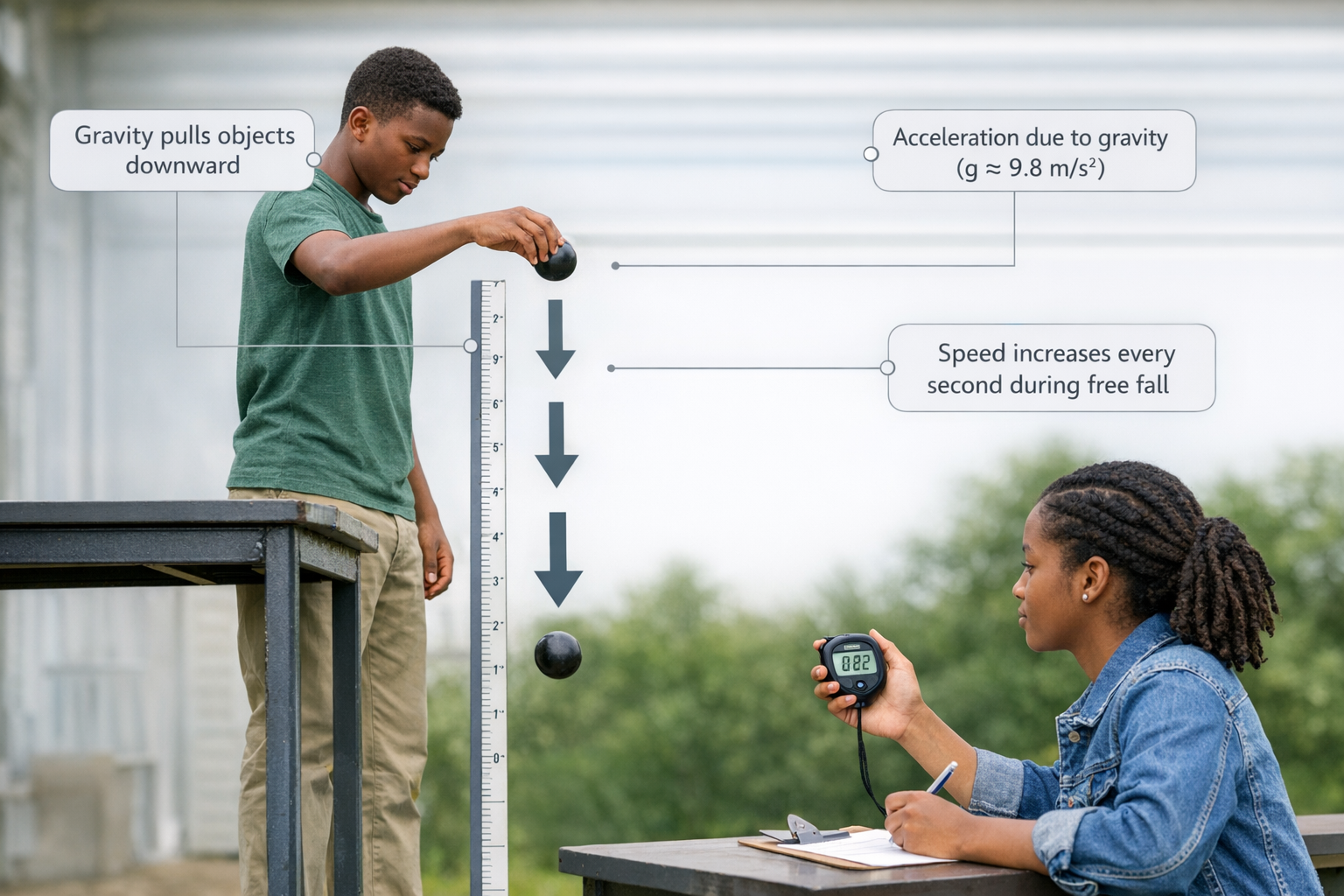
Acceleration due to gravity is represented by g.
g ≈ 9.8 m/s²
Often approximated to 10 m/s².
This means that when an object falls freely near Earth, its speed increases by about 9.8 m/s every second.
Free fall occurs when an object falls under the influence of gravity alone.
Characteristics:
• acceleration is constant
• speed increases continuously
• direction is downward
When objects fall through air or liquids, they experience resistance.
For example:
• air resistance
• liquid resistance
These forces act opposite to the direction of motion.
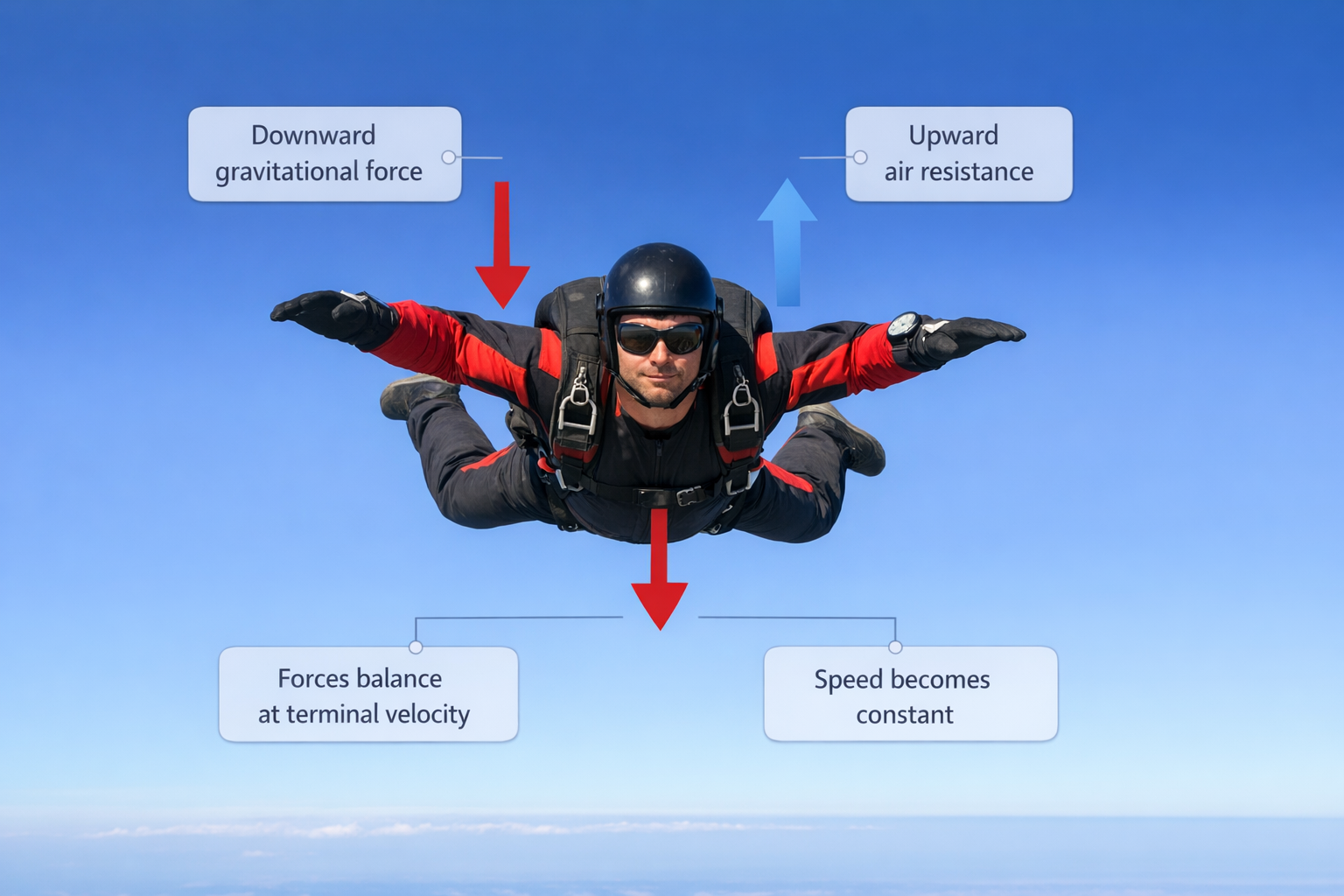
Terminal velocity occurs when:
downward gravitational force = upward resistance force
At this point:
• acceleration becomes zero
• speed remains constant
Example:
Skydivers reach terminal velocity before opening a parachute.

