
Course:
Science Double Awards - 0569

Mass and weight are important quantities used to describe objects in physics. Mass refers to the amount of matter contained in an object and remains constant regardless of location. Weight, on the other hand, is the force exerted on an object by gravity and may change depending on the strength of the gravitational field.
Mass is closely related to inertia, which is the tendency of an object to resist changes in its state of motion. Objects with greater mass have greater inertia.
The centre of mass of an object is the point where the object’s mass can be considered to be concentrated. For symmetrical objects this point lies at the centre, while for irregular shapes it can be determined using experimental methods.
The position of the centre of mass plays an important role in determining the stability of objects, such as buildings, vehicles and furniture.
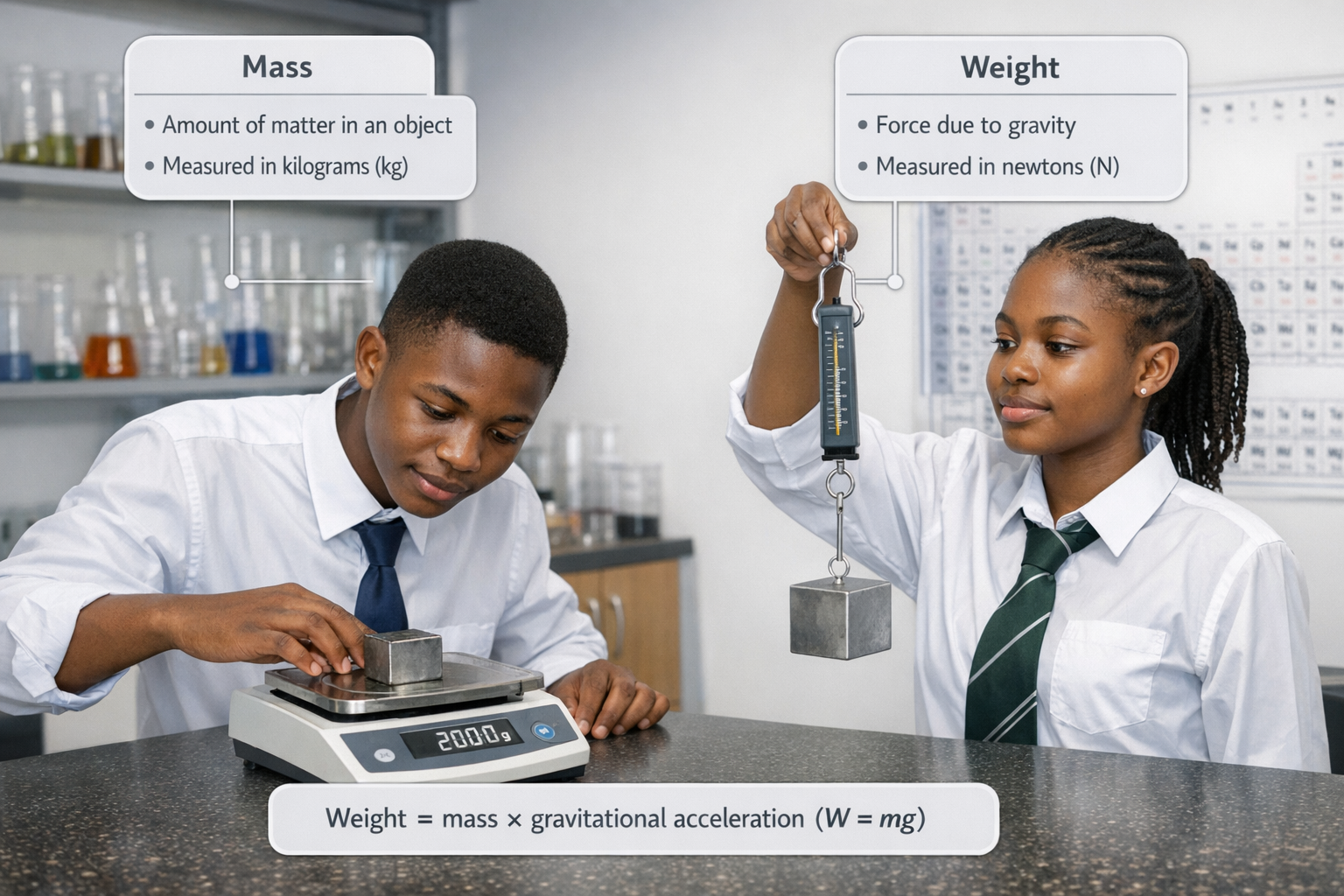
Mass is the amount of matter contained in a body.
Characteristics of mass:
• measured in kilograms (kg)
• remains constant everywhere
• does not depend on gravity
Example
A 2 kg object on Earth will still have a mass of 2 kg on the Moon.
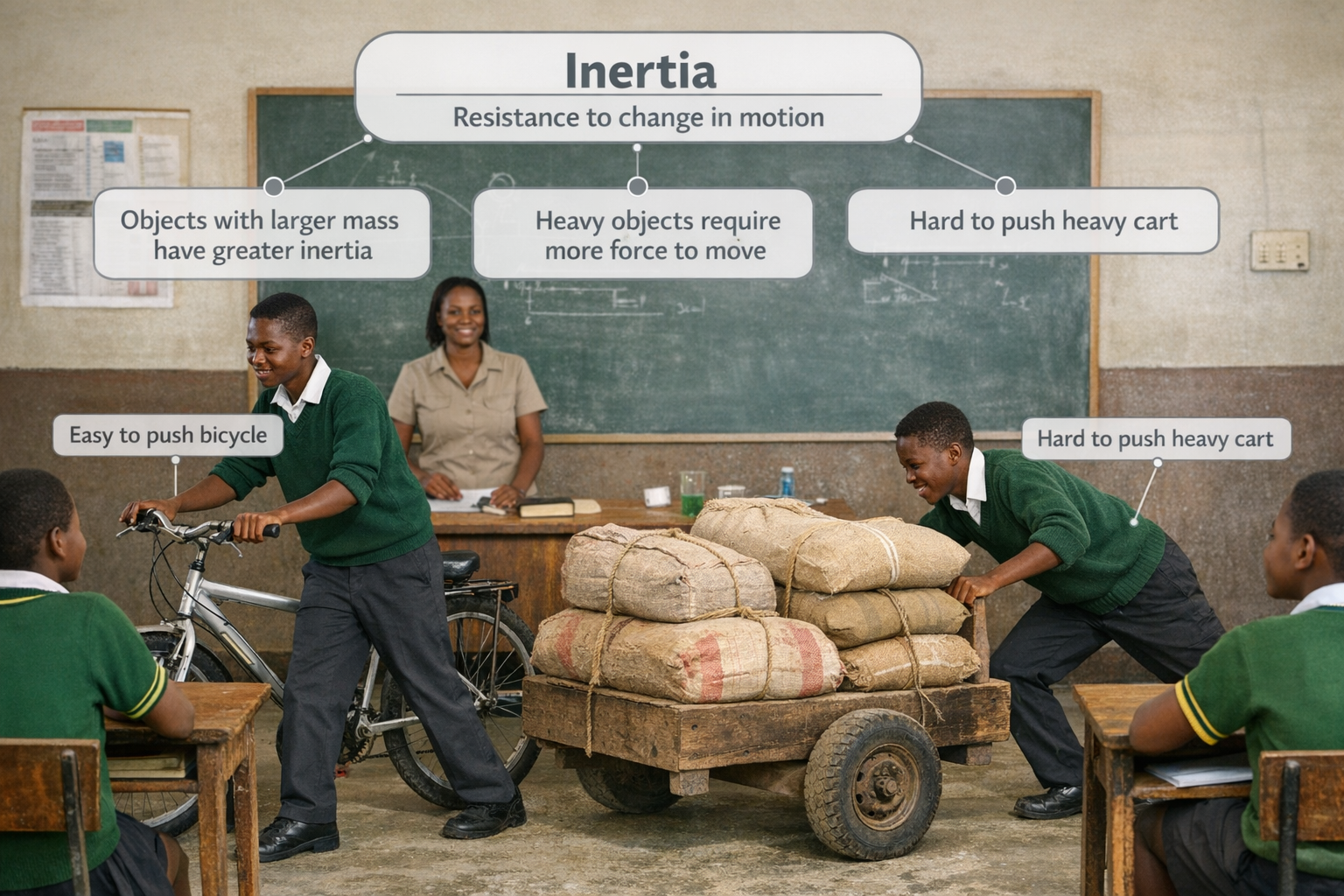
Inertia is the tendency of an object to resist changes in its motion.
Objects with greater mass have greater inertia.
Examples:
• a loaded truck is harder to stop than a bicycle
• a heavy object is harder to push than a light one
Weight is the force exerted on a body due to gravity.
Weight is given by the equation:
Weight = mass × gravitational acceleration
W = mg
Where:
W = weight (newtons, N)
m = mass (kg)
g = acceleration due to gravity (≈ 9.8 m/s²)
Example
If a mass is 2 kg
W = 2 × 9.8
W = 19.6 N

Mass is measured using:
• beam balance
• electronic balance
Weight is measured using:
• spring balance (Newton meter)
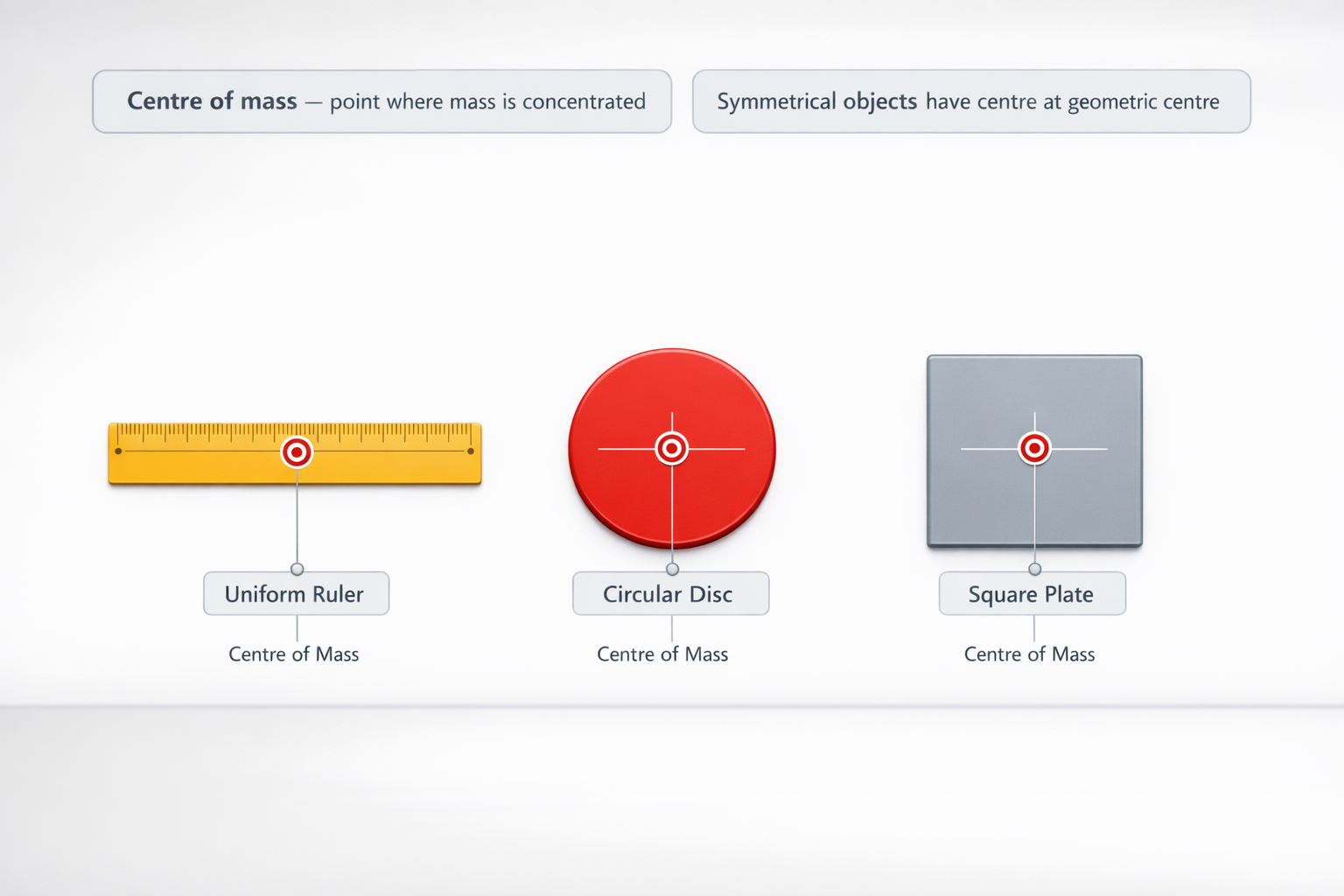
The centre of mass is the point at which the mass of an object is concentrated.
For symmetrical objects, the centre of mass lies at the geometric centre.
Examples:
• centre of a uniform ruler
• centre of a circular disc
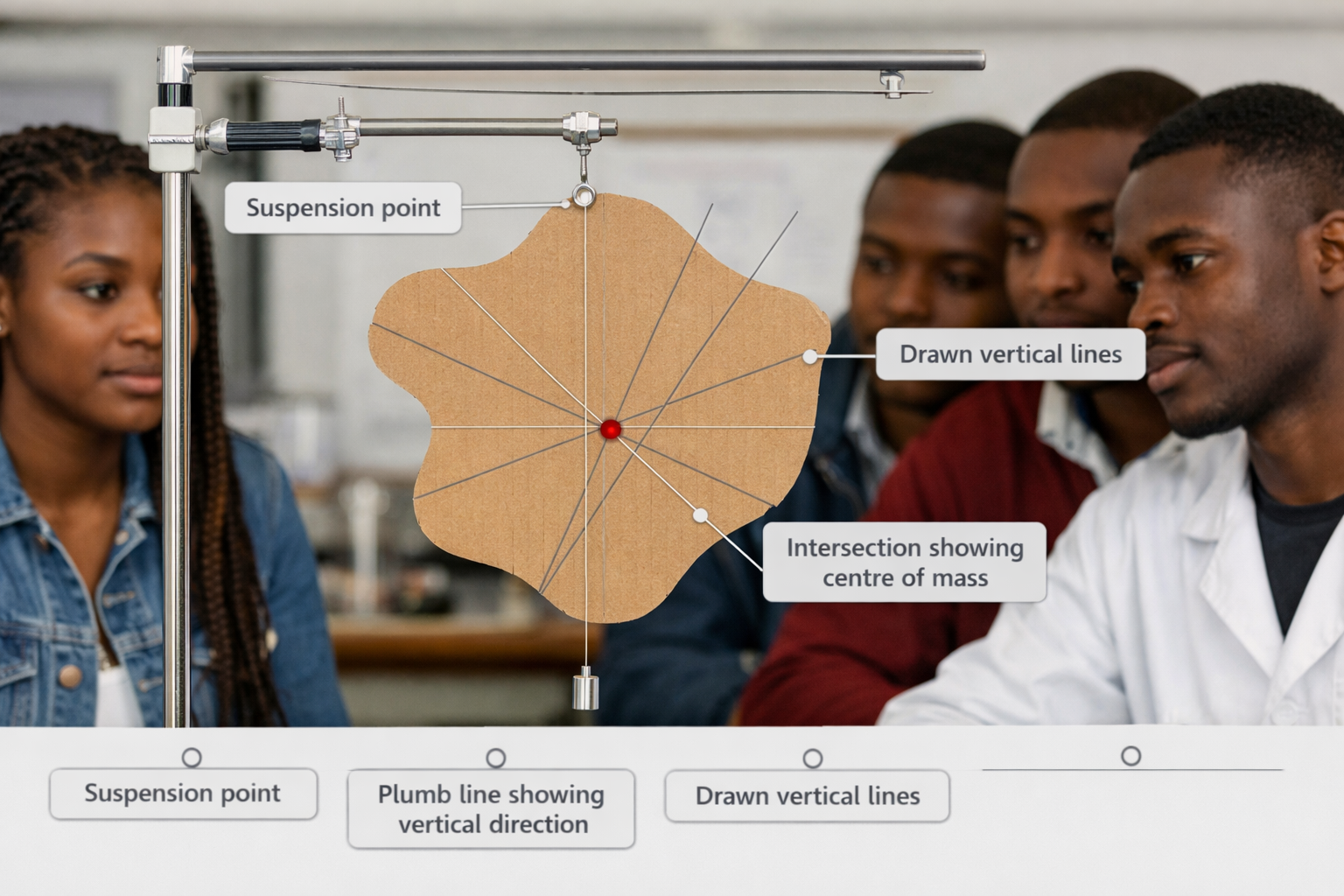
A lamina is a thin flat sheet of material.
For regular shapes, the centre of mass is found using symmetry.
Example:
• centre of a square
• centre of a triangle
Experimental method:
1 Suspend the lamina from one point.
2 Hang a plumb line from the suspension point.
3 Draw the vertical line along the plumb line.
4 Repeat using another suspension point.
5 The intersection of the lines is the centre of mass.

An object is stable when it returns to its original position after being slightly tilted.
1. Size of base
Objects with a wider base are more stable.
Example
A table with wide legs is more stable.
2. Position of centre of mass
Objects with a lower centre of mass are more stable.
Example
Sports cars are designed with a low centre of gravity to prevent overturning.

